Raj Gaurav Verma
Raj Gaurav Verma
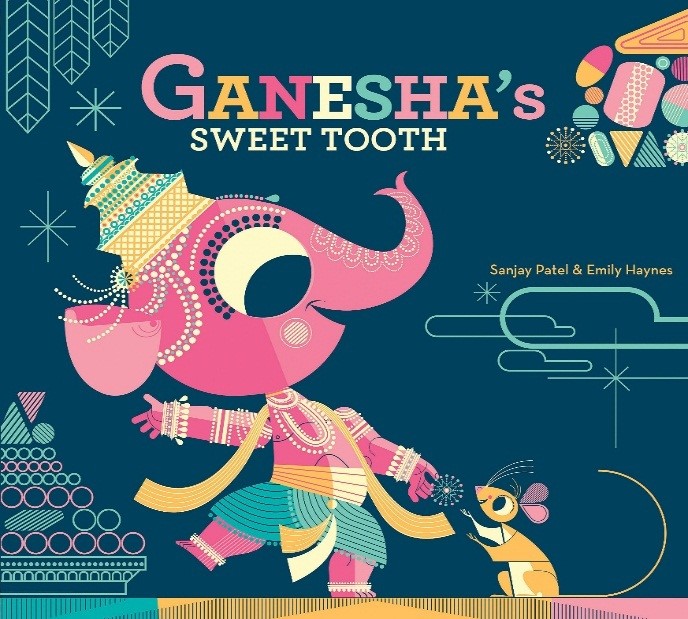
Fig. 1
(Credit for all pictures in the article to the author)
This paper attempts to explore some of the recent advancements made in the writings for children in India. Earlier researches on children’s fiction in India show the impact of western legacy on writings for children in India. From 1935 to 1990 children’s literature remained very scattered and skimpy. In fact, the future of children’s books in India was a primary concern for major writers, theorists and critics. Hence, as Meena Khorana puts it in her bibliography on children’s literature, “till the 1970s the publishing field for children was dominated by the textbook market” (1991: xii). There has been an influx of children’s literature since the last decade of the twentieth century. Most of the information and reviews are available on the websites of the publishers and authors for the sake of publicity and quick dissemination which form a major resource of information about children’s literature in India. Radhika Menon, the founder of Tulika Books, points out in an online article about the recent inclination that publishing houses have developed. She says “older and established publishing houses like Penguin, HarperCollins, Frank Brothers, RatnaSagar, Orient Longman, Macmillan, Navneet and recent entrants like Neve, an imprint of BPI publications, are [now also] concentrating more on their children's books department.” Shobha Vishwanath, the Co-founder and Publishing Director of Karadi Tales Company, also projects a similar picture stating, there are also indigenous publishers such as Karadi Tales, Tulika Publishers, Tara Books, Duckbill, Katha, Pratham Books etc. who are struggling hard to establish their names in this field and “have brought quality to children’s literature by creating content through contemporary stories that are well written and illustrated by talented artists.”
By the second decade of the twenty first century, there are significant developments in the genre of children’s literature in India. Even the lesser experimented genres like detective fiction and science-fiction have now gained impetus into this field. On the other hand, mythological fiction has also emerged as a new kind of genre peculiar to Indian children’s literature in comparison to the western counterpart. Ruskin Bond has also admitted, “Compared to 10 or 15 years ago, children's literature is now being taken seriously by publishers.” By the end of 2020, children’s literature ought to touch new landmarks.
The decade 2010-2020 also saw an upward swing in the picture book category. Picture books are usually regarded as iconic of children’s literature category and trivial for that matter. Peter Hunt, the leading theorist in children’s literature studies observes regarding picture books:
This is merely proof of the essential triviality of the form: what place is there in a respectable literary system for what is usually a thirty-two-page text, often with minimal words, and intended for scarcely literate audience? Further, what place does something essentially non-verbal have in a literary system at all?
The answers are straightforward. The first is that reading a picture book is an extremely sophisticated act. The second is that, with a minority of exceptions, the word-picture interaction is vital and fundamental. (Hunt 2001: 288)
This is because the process of reading picture books involves an interaction of “non linear ‘reading’ of the picture to linear processing of words” (Hunt 2001: 288).
Perry Nodelman, another important theorist of children’s literature, describes the impact of picture books on children and how they help them respond to their perception of the world around them. He says:
… Because we assume that pictures, as iconic signs, do in some significant way actually resemble what they depict, they invite us to see objects as the pictures depict them – to see the actual in terms of the fictional visualization of it….
Furthermore, the intended audience of picture books is by definition inexperienced – in need of learning how to think about their world, how to see and understand themselves and others. Consequently, picture books are a significant means by which we integrate young children into the ideology of our culture. (Nodelman 1999: 131)
There are many picture books that have surfaced based on Indian mythology and epics. This category of picture books usually has a twist in the narrative and at the same time writers in this category have used myths to cultivate curiosity and moral understanding in children.
Sanjay Patel and Emily Haynes have come up with a picture book, Ganesha’s Sweet Tooth (2012, Fig.1 above) with graphic illustrations. They write in the author’s note:
The story of how Ganesha broke his tusk is one of the most popular legends in Hindu mythology. In it, the poet Vyasa asks the great god Ganesha to transcribe the Mahabharata… Ganesha agrees to help as long as Vyas can recite the poem without stopping. Vyasa agrees with the condition that Ganesha understand everything he says before he writes it down. Soon after they begin, Ganesha’s pen breaks. In order to keep writing, clever Ganesha quickly breaks off his tusk and uses that to finish recording the tale. (Patel and Haynes)
Ganesha’s Sweet Tooth is based on this incident of Ganesha breaking his tusk. Patel and Haynes admit that this book “is not a retelling of this classic legend, though it is loosely based on the story. Some elements and scenes in this book are not found in Hindu mythology (the super jumbo jawbreaker laddoo!) and we changed certain plot points to develop an original… picture book.”
This book introduces Ganesha as a naughty child who is just like other children. As it goes in mythology, this Ganesha too loves to eat. He also has his friend Mr. Mouse who is his vehicle in traditional narratives. Then one day Ganesha and Mr. Mouse come across “the super jumbo jawbreaker laddoo.” Mr. Mouse warns Ganesha not to have it as it will break his tusk. But Ganesha remains convinced that being a god he is invincible. He has the laddoo and as he bites his tusk breaks. Ganesha is ashamed of his broken tusk. He thinks that everyone will make fun of him now. Out of anger he throws his broken tusk at the moon but it travels and strikes an old man. The old man turns out to be sage Vyasa who says to Ganesha that he needs someone to transcribe his poem but that would not be possible with a common pen as no pen can sustain that long. Therefore, Vyasa asks Ganesha to write it with his broken tusk. The story thus surprises the reader with its twist as Ganesha is gradually transformed from a naughty boy into a serious and sad child once he has broken his tusk. He is then made to understand the use of his broken tusk by Vyasa and thus his happiness is restored and at the same time he is engaged in the writing of the great epic.
 |
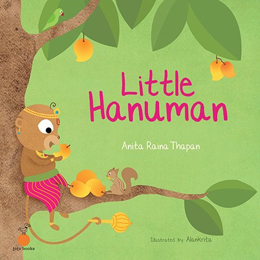 |
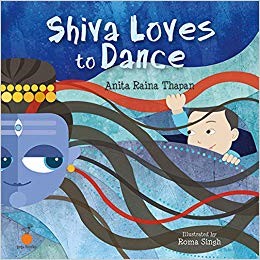
| Fig. 2 | Fig. 3 |
Anita Raina Thapan’s Shiva Loves to Dance (2015, Fig. 2) and Little Hanuman (2016, Fig. 3) beautifully describe Hanuman and Shiva in Hindu mythology through the conversations between the mother and the child. Shiva Loves to Dance introduces the readers to a child named Gittoo who becomes fascinated with Shiva seeing his sister Gauri offering him flowers before her dance performance. The same night Gittoo asks his mother about Lord Shiva. His mother explains that Shiva is the first dancer as his dance created the world. Raina Thapan also gives a twist to her story by resorting to the demon trampled under his foot. When Gittoo asks about him, she tells his name: “Apasmara.” Then his mother explains about this demon Apasmara:
It is Apasmara who makes brothers and sisters fight with each other. He also makes people greedy so that they always want more and more… makes us forget that we are born to do good things; to love and look after each other; to take care of plants, trees, animals, birds and fish. (Thapan 2015)
Anita Raina Thapan’s Shiva Loves to Dance has a special appeal because of its take on Apasmara as a demon responsible for the crisis in the modern world.
Little Hanuman continues with the conversation between Gittoo and his mother. Standing on his balcony Gittoo looks down at the swimming pool which looks very small from there. Out of this curiosity he asks his mother innocently if anyone could dive from the balcony into the swimming pool and come out unhurt. His mother replies that only Hanuman can do such a thing. She explains that it was not the magic but that Hanuman was blessed with special powers by his father Vayu, the God of Wind, Shiva and his mother Anjani.
Little Hanuman continues with naughty adventures of Hanuman as a child who becomes a cause of concern for everyone. When they are unable to bear the naughty acts of Hanuman they go to Brahma, the creator, and ask him to withdraw his powers. But Brahma denies stating that Hanuman is blessed by Shiva and therefore his powers cannot be withdrawn. Later, Brahma comes up with the solution that Hanuman would forget about his power only when he grows up and meets someone very special, it is only then that his special powers will be restored. However, this ends all the fun for Gittoo as he exclaims “So sad” as Hanuman will now not be able to act naughtily anymore. Then onwards Hanuman becomes as common as other children. He becomes serious and starts studying. This story shows the transition in the character of Hanuman as a child who was naughty and becomes serious and studious. Perry Nodelman suggests that sometimes picture books evince “a process of colonization” in which the “books persuade them of conceptions of themselves as children that suit adult needs and purposes” (Nodelman 1999: 135). Picture books based on myths project this tendency of inclining children towards reading, writing and studying and fulfilling their mission of civilizing them if not colonizing them.
On the other hand, picture books can equally act as a potent source of subversion. They can even react against the “childlikeness they teach” and how and what culture “views as natural in children” (Nodelman 1999: 135).
 |
 |
 |
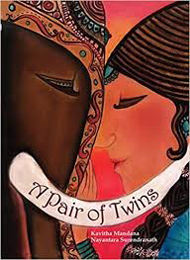
| Fig. 4 | Fig. 5 | Fig. 6 |
Kavitha Mandana and Nayantara Surendranath’s A Pair of Twins (2014, Fig.4) is based on the relationship between two twins: a girl child named Sundari and a baby elephant called Lakshmi. The text takes a feminist angle of girls being equal to boys. Sundari’s father is a mahout and next in line would be his son. So, when Sundari expresses her desire of being a chief mahout it goes against the family and social tradition. As the narrative develops it so happens that the elephant that was being trained for the traditional Dussehra procession falls sick and there is no elephant that can replace him except Lakshmi who has now grown as large as other elephants. When it is suggested to the Maharaja and Maharani that Lakshmi can be trained for the procession the major opposition comes from Sundari’s father. However, the Maharani agrees that Sundari will train Lakshmi and be the leading mahout. The politics of representation has also been projected in the story as the Maharani says that Sundari has to lead the procession in men’s clothing, but Sundari says that she would like to lead the procession as a woman. Thus, the twins manage to create a space for themselves amidst the patriarchal traditions of society.
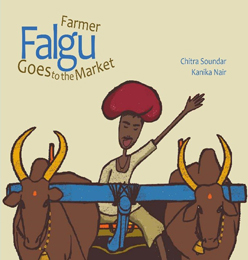
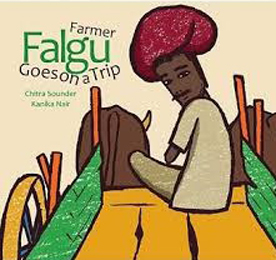
Chitra Sounder’s Farmer Falgu Goes to the Market (2014, Fig.5) and Farmer Falgu Goes on a Trip (2014, Fig.6) are special in their approach as they offer not only the pictures, and the words but also the sounds. These two books paint a picture of rural India. They are based on onomatopoeic words as Farmer Falgu sets on his trip. Both the texts make use of irony and hilarious twists in their narration. What can be noted in these books is the “information about the sequential activity” (Nodelman 1999: 137). It can be seen that “the sequential pictures of a picture book imply all the actions that would take the character from the fixed position depicted in one picture to the fixed position in the next” (Nodelman 1999: 137). Farmer Falgu Goes to the Market is story about Falgu going to sell off tomatoes, onions, chilies, coriander, white eggs, brown eggs, and duck eggs. But as he moves his eggs begin to crack with jerks, his tomatoes are crushed by the sack of onions and when he is in the market his coriander is eaten by goats. Everything that he has brought to sell is destroyed. But then an idea strikes his mind. He asks his friend to lend him some pans. He chops the vegetables, lights the stove and starts making omelettes. As the smell of omelettes spreads there is a long line of people waiting to eat his omelettes.
Farmer Falgu Goes on a Trip begins with all kinds of discordant and unpleasant sounds in Farmer Falgu’s farm, so much so that, irritated, he decides to leave his farm in search of silence. He prepares his cart, washes his bullocks, packs some lunch and starts his trip in search of silence. On his way Farmer Falgu comes across an old man with a sack who asks him for a ride. As they proceed ahead the old man takes out his drum and starts playing it. Farmer Falgu forgets about silence and joins the man in his funny song. As he moves ahead, he comes across a snake charmer and a dance troupe. They ask for a ride and Falgu asks them to climb on. All of them start a song with a refrain. The day passes and they reach the next town. All of them get down one by one: the dancers at the fair, the snake charmer at the town-square and the old man at the riverside. Once again Farmer Falgu is left by himself and he thinks this is silence but then his peace is disturbed by the sounds of crickets, frogs and the wind blowing. His search for silence ends hopelessly. Then he realizes that his “farm is not noisy. It is happy” (Sounder 2014: 27). He turns his cart around and sets off to his home. The book is filled with all sorts of colours and sounds of rural India.
 |
 |
 |
| Fig. 7 | Fig. 8 | Fig. 9 |
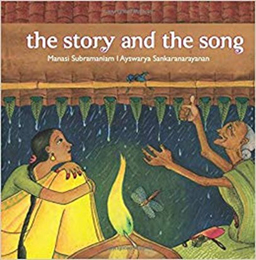
Manasi Subramaniam and Ayswarya Sankaranarayanan’s The Story and the Song (2012, Fig.7) is a beautifully narrated folk story with the theme of preserving the folk songs and stories. The book begins with Parvathi’s marriage preparation. She gets gifts from many people in her village. But then she is given a strange gift by Thayi, the oldest, wisest woman in the village. Thayi says since she is not rich, she can only tell a story and a song which will always stay with Parvathi as her company. She says: “Share them with everyone you know. After all, of what use is a story that is not told and a song that is not sung?” Thayi asks Parvathi to remember the song and tell it to others. After marriage with Kamban, Parvathi remains busy in her household chores. She knew the story and the song but she never finds the time and occasion to tell it to anyone. Just like Parvathi has received her gift, Kamban too has received his gifts: a wooden betel nut crusher and a small carved box. It is revealed that the story and the song remain in spirit form inside a person but told once they cannot remain untold for very long. They enter the betel nut crusher and the box and quietly leave the house because they cannot exist in spirit form in the outside world. When Kamban returns he finds his gifts missing. Kamban shouts at Parvathi for not keeping them properly and leaves the house in anger and goes into the nearby temple. There he realizes that it is the song and the story, which were also as precious a gift as his, have also escaped his house and have entered the betel crusher and the box which is why they are now missing. Kamban goes back to his house and asks Parvathi to tell him the story and to sing the song, but Parvathi has forgotten them. Mysteriously, the story and the song enter back into Parvathi while she is sleeping. So, when she gets up in the morning, she is happy as she is able to remember them. The story ends with a message that “if you know a story and a song, make sure you share them with everyone.” It can be seen that a picture book “depends very much on a particular reader’s memories, expectations and affinities” as well as on “an artist/ writer’s intentions and historical moment” (Moebius 2011: 170). This holds true especially for folk tales which are converted into picture books because the author also turns out to be a reader/listener who converts the tell-tale into a written and pictured story.
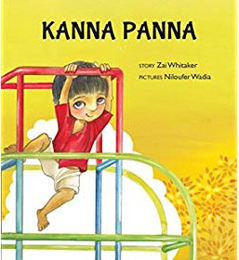
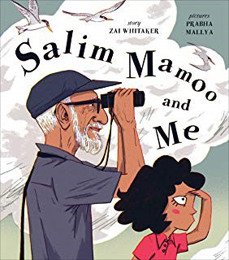
Zai Whitaker’s Kanna Panna (2015, Fig.8) and Salim Mammoo and Me (2017, Fig.9) problematizes the issues of young children such as their cognitive abilities, their inefficiencies and lack of interest. Kanna is a very young boy who is constantly nagged by his parents over minor things. This makes Kanna diffident and unsure about himself. However, he discovers a talent for making words rhyme. So when people say things to him he turns it into a game by completing their words and sentences with his rhyming words. Salim Mammo and Me presents a young girl Zia whose whole family is crazy about birds. All of them are ornithologists except her. This separates her from her family as she is confused and unsure and finds it very difficult to learn about birds. For this reason, she also develops a dislike for them. However, as she grows, she understands that it is not important to remember the details about the birds but to love them and so she begins to enjoy their colours and their sounds.
 |
 |
 |
| Fig. 10 | Fig. 11 | Fig. 12 |
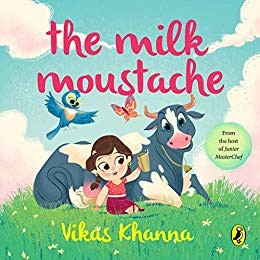
There are picture books based on human-animal bonding and interaction. Vikas Khanna’s The Milk Moustache (2015, Fig.10) is based on a girl, Jassi who can talk to animals. Her best friend is Kali the cow. One day it so happens that children stop drinking milk and soon the milk strike spreads among children. This makes Kali the cow very sad. Then Jassi comes up with a plan of a milk-drinking race with a “special prize for the child with the longest milk moustache” (Khanna 2015). She sends the invitation and children participate in the competition. When the competition is over children go to Kali with their milk moustache. Kali is delighted to see them and all of them become friends.
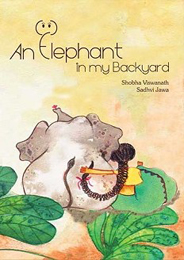
Shobha Viswanath’s An Elephant in My Backyard (2013, Fig.11) tells a sweet encounter of a young girl named Maya with a baby elephant whom she befriends when she is returning from the temple. The elephant sneezes and so Maya calls her Acchu. Every time Maya goes and says to her family that she has an elephant in the backyard her family makes fun of her and responds to her childishly. This book portrays the pictorial irony at its best. As Nodelman notes, “things are not merely as they appear in the picture… events are not exactly as the words describe them. Picture books are inherently ironic” (Nodelman 1999: 137). It is only by the end of the book that Maya’s family realizes that whatever Maya was saying was true, that there was really an elephant in the backyard.
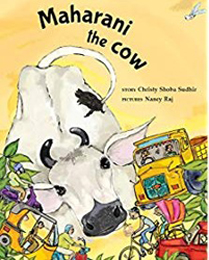
Christy Shoba Sudhir’s Maharani the Cow (2017, Fig.12) has been awarded The Hindu Young World Goodbooks Award 2018. This book is also filled with urban onomatopoeic sounds and brings to life the clamorous city life and what happens usually in cities when a cow sits on a busy road. So, Maharani the cow sits on the street and jams the entire road. People try to lure her with different things, they try to scare her, but she does not listen to anything. It is only when the sun is about to set and it is time for Maharani to go home that she gets up and goes to her home giving way to vehicles stuck in jam, emphasizing nature-time versus urban-time.
 |
 |
| Fig. 13 | Fig. 14 |
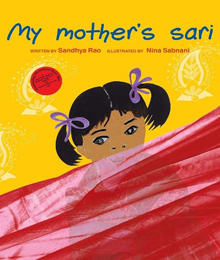
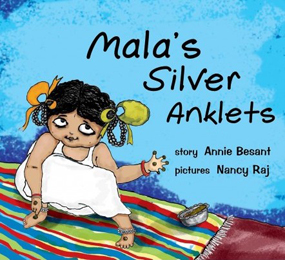
Sandhya Rao’s My Mother’s Sari (2006, Fig.13) and Annie Besant’s Mala’s Silver Anklets (2011, Fig.14) present the soft touch of female sensibilities. My Mother’s Sari shows how children use their mother’s sari for playing. The book beautifully presents the soothing mother’s touch that is ever present in her sari. Mala’s Silver Anklets is a story of a young girl Mala who is very naughty and loves to scare people around her. So, her mother presents her silver anklets and therefore, whenever Mala tries to scare people they understand through the sounds of her anklets that Maya is around. The book shows how Maya is chained by the sound of her anklets but then Maya realizes the effect of her anklets and she unlocks them from her ankles. This is an ingenious attempt at de-constructing gender as the story helps girls and boys realize that ornaments meant for girls serve to restrict their movement, curb their basic tendencies and hinder the growth of their personalities.
 |
 |
| Fig. 15 | Fig. 16 |
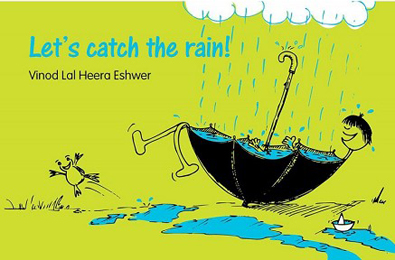
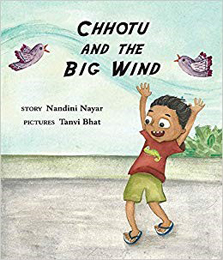
Vinod Lal Heera Eshwar’s Lets Catch the Rain! (2012, Fig.15)) appears poetic in its approach but it sends a very important message of saving water especially rainwater which is an important source of fresh water. Small and handy, the picture book gives an important ecological message to children. Nandini Nayar’s Chhotu and the Big Wind (2017, Fig.16) breaks the monotony in a child’s world when the wind pushes him, and he is carried by the wind. His journey on wind seems Alicean in nature as he floats in the cloud. When he is bored of floating, he descends gradually on his terrace and tells his mother about his recent adventure.
William Moebius points out that “the picture book may be best viewed as an experiment for the child and even for an adult student of literature” (2011: 173). On the other hand, Perry Nodelman writes that “picture books work to make their audiences aware of the limitations and distortions in their representations of the world,” thus turning their readers into semioticians (1999: 137). Kimberley Reynolds also adds the importance of picture books: “they shape aesthetic tastes and introduce the principle and conventions of narrative. In all these ways picture books are a vital part of artistic and literary culture, but they are also witty, entertaining and part of child’s world of play” (Reynolds 2005: 209). The contemporary picture books for children in India can be seen as “bleeds” or “bled” as the pictures are bled “to the very edge of the paper when it has no frame and leaves no margin. The effect is to pull the reader more actively into the picture” (Graham 213). Almost all the books are without frame. Instead of giving an appearance of “looking out of a window” (Graham 2005:212) they create a different world altogether enabling children “to accept things that are never normally encountered in life” (Graham 2005: 212) or sometimes that are normally encountered. They are filled with all sorts of themes and concern from a simple adventure in air to a trip in a temple or sanctuary; from cityscape to rural landscape; from gender equality to ecological concerns; from human-animal relationship to adult-child relationship. These books establish what Zohar Shavit, an eminent authority on child and youth culture, says about the evolution of children’s literature. She observes that there had always been “a certain idea of the child in the mind; when this idea changed, the texts for children changed as well” (2009: 7). The authors of recent picture books have raised their status from infantile reading to semiotic learning, blending cognitive skill-giving with pleasurable reading and enhanced critical thinking.
Works Cited and Consulted
Besant, Annie, and Nancy Raj. Mala’s Silver Anklets. Chennai: Tulika Publishers, 2011.
Bond, Ruskin. “Children’s literature is now being taken seriously.” Zee News. Aug 02, 2015.
Date of access- 29 November, 2018.
http://zeenews.india.com/entertainment/bookworm/bookworms-trail/children%E2%80%99s-literature-is-now-being-taken-seriously-ruskin-bond_1640461.htm
Eshwar, Vinod Lal Heera. Let’s Catch the Rain! Chennai: Tulika Publishers, 2012.
Graham, Judith. “Reading Contemporary Picturebooks.” Modern Children’s Literature. Ed. Kimberley Reynolds. New York: Palgrave Macmillan, 2005. pp 209-226.
Hunt, Peter. Children’s Literature. Oxford and Massachusetts: Blackwell Publishing, 2001.
Khanna, Vikas. The Milk Moustache. Gurgaon et al: Puffin Books, 2015.
Khorana, Meena. The Indian Subcontinent in Literature for Children and Young Adults: An Annotated Bibliography of English Language Books, Westport, Greenwood Press, 1991.
Mandana, Kavitha, and Nayantara Surendranath. A Pair of Twins. Chennai: Karadi Tales, 2014.
Menon, Radhika. “An Overview of Indian Children's Literature in English.” Web. Visited December 12, 2014.
(http://tulikabooks.com/editors/an-overview-of-indian-childrens-literature-in-english)
Moebius, William. Picture Book. Keywords for Children’s Literature. Eds. Philip Nel and Lissa Paul. London and New York: New York University Press, 2011. pp 169-173.
Nayar, Nandini, and Tanvi Bhat. Chhotu and the Big Wind. Chennai: Tulika Publishers, 2017.
Nodelman, Perry. “Decoding the Images. How Picture Books Work.” Understanding Children’s Literature. Ed. Peter Hunt. 2nd. ed. New York: Routledge, 1999.
Rao, Sandhya, and Nina Sabnani. My Mother’s Sari. Chennai: Tulika Publishers, 2006.
Reynolds, Kimberley. Modern Children’s Literature. New York: Palgrave Macmillan, 2005.
Shavit, Zohar. Poetics of Children’s Literature. Athens: University of Georgia Press, 2009.
Soundar, Chitra, and Kanika Nair. Farmer Falgu Goes to the Market. Chennai: Karadi Tales Company Pvt Ltd, 2014.
---. Farmer Falgu Goes on a Trip. Chennai: Karadi Tales Company Pvt Ltd, 2014.
Subramaniam, Manasi and Ayswarya Sankaranarayanan’s. The Story and the Song. Chennai: Karadi Tales Company Pvt. Ltd., 2012.
Sudhir, Christy Shobha, and Nancy Raj. Maharani the Cow. Chennai: Tulika Publishers, 2017.
Thapan, Anita Raina, and Roma Singh. Shiva Loves to Dance. New Delhi: Tota Books, 2014.
Thapan, Anita Raina, and Alankrita. Little Hanuman. New Delhi: Tota Books, 2015.
Viswanath, Shobha, and Sadhvi Jawa. An Elephant in my Backyard (2013). Chennai: Karadi Tales Company Pvt. Ltd., 2017.
Viswanath, Shobha. “Children’s Literature in India: A Fairy-Tale?” The Hindu 13 November 2014. Web. Visited December 15, 2014.
(http://www.thehindu.com/features/metroplus/childrens-literature-in-india-a-fairytale/article6594822.ece)

Issue 89 (Jan-Feb 2020)
-
Editorial
- Deepa Agarwal: Editorial Comment
-
Articles
- Anurima Chanda: One Size Does Not Fit All
- Bedotroyee Bhattacharjee: The Tales of Beedle the Bard
- Gaurav Pati: What Makes Children’s Book Illustration So Challenging?
- Ira Saxena: Reading is Feeling, Reading is Healing
- R R Gandikota: Aesop’s Fables and Panchatantra
- R R Gandikota: Children’s Education vis-a-vis Sataka Sahitya
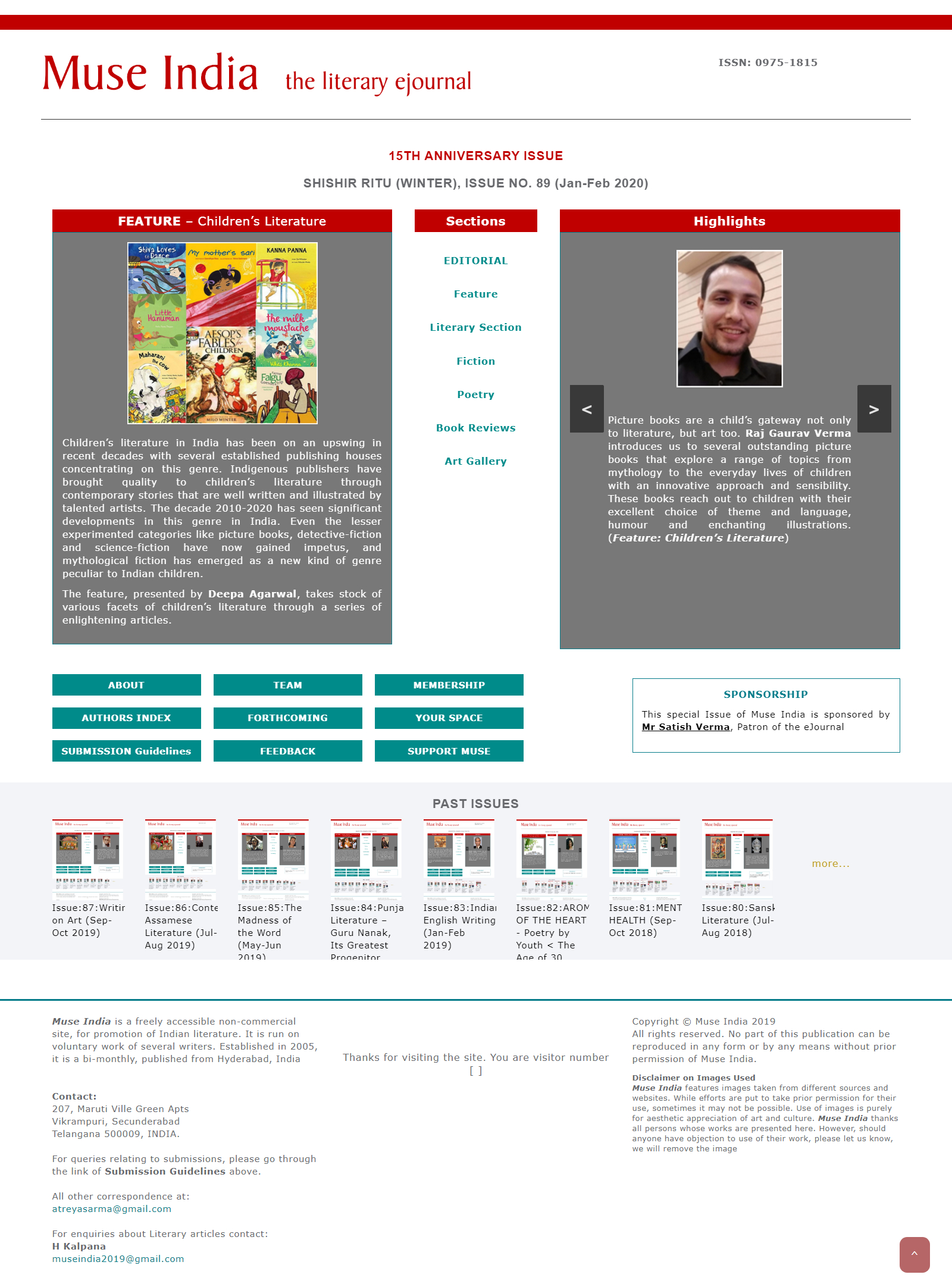
- Raj Gaurav Verma: Picture Books for Children in India - An Overview
- S M Kompella: Irrelevance of English Nursery Rhymes in Indian Schools
- Swapna Dutta: Bani Roy - The Forgotten Pioneer of School Stories in Bengali
-
Book Review
- Vinita Agrawal: “Poems Grow With You”
-
Children’s Compositions
-
Letter
- Deeksha Vissapragada: “To my Dad”
-
Poems
- Aaditya Singh
- Ayan Kumar Paul
- Lakshya Vissapragada
- Mohit Sharma
- Ruhaan Ahmed
-
Letter