Chandrakant K Mhatre
Chandrakant K Mhatre
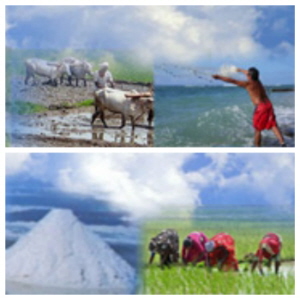
Agri community at work. Image courtesy- Agri Samaj images
'Dhavalaas' of the Agri Community of Coastal Maharashtra
Folk music originates in religious acts of diverse nature form nativity rituals to funeral rites; accordingly performance of folk music is invariably linked to these rites and rituals. The folk songs/music of Agri community which populates the northern parts of Maharashtra's coastline is no exception to this generalisation. 'Dhavalaa', as the community terms these songs and their performances, accompany the community members right from their birth throughout the journey of their life. A new-born's first exposure to music is that of the dhavalaa sung on the third day (teejoraa) of their birth and the grandest performance dedicated to them takes place on three-day long celebration of their weddings. The Agri children grow up listening to these dhavalaa on great many occasions to such an extent that these rustic songs become part of their consciousness and many of them become accomplished original contributors to this form without any rigorous training or even formal initiation into this art form. The most commendable aspect of these dhavalaa is that they are performed exclusively by women who are called as dhavalaaree and enjoy the status of a priest in the community. In the rites and rituals of Agri community, who happen to be Hindus by religion, Sanskrit mantras are replaced by the dhavalaas and the Brahmin priest by the dhavalaaree, presenting a fine example of resistance to the all-pervasive process of sanskritisation.
The Agri community is one of the aborigines of coastal Maharashtra, and as such they have contributed handsomely to every aspect of folk tradition of the region: be it folk literature, folk theatre, or folk music. Of these the most significant contribution is their dhavalaas which hardly have an equivalent in Indian folk traditions. Being entirely in oral form, these songs have been passed down by generations of women composers to their successors in the most informal environs possible, which is what makes proper documentation of dhavalaas an arduous task. However, it is this same feature that has made the repertoire of these songs superabundantly rich as generations after generations of composers have added their own compositions and are still enriching it. Consequently, one witnesses a great deal of variety in the performances of these dhavalaas across the Agri region that encompasses length and breadth of Thane and Raigad districts of Maharashtra. Not only the lyrics of these dhavalaa change every five miles, but with it also changes the range of tunes as well as the accompanying instruments used during these performances. Despite all these local variations, what remains unchanged all over is the gender of the performer. The dhavalaaree can only be a woman: a sacred norm determined by the once matriarchal social set up of the Agri community.
A dhavalaaree is an institution in herself with a community elder, a priest and a performer rolled into one body. As such, she is a living archive of so much of heritage of the community: socially, culturally and spiritually. Though adherents of Hindu religion these dhavalaarees are worshippers of the primitive supreme deity Narayan, the Agri nomenclature for the Sun god who is the addressee of much of the dhavalaas. These dahvalaas evoke Narayan, before every ritual, praising him for his blessings and benevolence towards the community which is primarily an agrarian society, reflected in songs such as:
Kailashicha Narayan Devu Kokane utarala
(The Supreme Lord of heavens has descended upon the Konkan region)
It is the masterful rendering of these simple words of Agri dialect of Marathi language that enchants the entire surroundings of the wedding mandap where these dhavalaas are performed, making the entire assembly feel the very presence of the Lord right in the midst of the nuptial celebrations. The sonorous voice of the dhavalaree makes such a powerful impact that it keeps resonating in the ears of the entire marriage party days after the celebrations are over.
Once Narayan's blessings are sought and secured at the beginning of the performance, there begins a string of odes to the various deities of the community. Of these deities the most revered are, unsurprisingly, the seven divine mother-goddesses, or 'Saati Aasaraa' as the Agris call them. These are the songs that are performed most zestfully as almost the entire audience joins in the chorus, praising their beloved deity whom they fondly address as Mothyaa Baayaa:
Madhyaan raat jhaali Baayaanchan
Dhol kaya wajatee Baayaanchan
The celebrations of the Mother Goddess have reached their pinnacle at the
midnight; so where are Her celebratory drums playing?)
These simple words get loaded with primordial memories when the dholeeya (the drum-player) infuses them with such rhythms that there does not remain single hand that does not clap or a single head that does not swing to the beats of the song. What adds to this musical magic is the baritone engendered by the instrument called kaandaa, a stem of flax plant standing in the middle of a metal plate filled with water. The skilled hands of the dhavalaaree slide down form the top of the stem and into the water in the plate repetitively to generate a monotonous but enchanting sound that keeps vibrating through the entire atmosphere taking the performer as well as her listeners onto a different plane of existence altogether.
Like any other ancient culture, the Agris lay a great emphasis on the worship of the ancestors. They are remembered and honoured with equal reverence, if not more, as other deities. Something as grand as a wedding, of course, cannot take place without the sacred presence and blessings of the ancestors are what the Agris believe. Consequently, an invocation of the ancestral deities is an important part of the performance of a dhavalaaree who renders these songs with gusto especially reserved for them. Dhavalaas invoking and praising ancestors are peculiarly different from ones sung for other deities as they happen to be conversational: a dialogue between the ancestors invoked and the dhavalaaree as evident in this song:
Swargeeshee dyawaraya nisanee
Ho tumhee Peetar devaa
Aamhi ba kashanee yawa go
Swargichya nisanee kuraakalyaa
(Descend from heavens, O divine forefathers. The ladders have become too weak,
how should we get down? )
This conversational aspect is brought out masterfully in the performance by the dhavalaree who seamlessly alters her voice to signify the shift between the speakers of the dialogue. She becomes the forefathers incarnate when she renders the lines ascribed to them as if possessed by the spirits with her voice exhibiting other-worldly quality. However, the very next moment she manages to shift to the supplications of the devotee who is all immersed in earnestness and eagerness to seek the blessings. No wonders, that owing to such a sublime performance the ancestors relent, refraining from their initial hesitation, and bless their progeny with their presence and blessings during the ceremony.
Occasions of birth celebrations call for seeking special blessings from the mother-goddess Satwai worshipped on the fifth day from the child's birth known as paachawi. Dhavalaas performed on these occasions are entirely devoted to the mother-goddess who receives the ceremonial gifts just like the mother of the baby. The dhavalaree pictures these offerings vividly through her songs as in this:
Ye banee ubhyaa Baayaa maajhyaa te banee ubhyaa
Naaralaabanaakhaalee ubhyaa ga Baayaa maajhayaa
Khurkhuaraa naaralaa bharaa Bayaancya vatya
Naaralaa khaatee maajhayaa Baayaa
Kavatyaa kaa jhugarunee detee Baayaa
(The Mother-goddess is standing among the orchards. She is standing among the coconut trees; offer her the ceremonial gift of coconuts. The mother-goddess eats the flesh of the fruits throwing away the shells.)
The art of the dhavalaaree reaches its pinnacle while performing these songs as the audience also comprises a new-born who normally would be wailing its heart out. However, surprisingly, throughout the rendering of the dhavalaas, the child hardly breaks into cries even once despite being moved in and out of his mother's lap during the ceremony as if the dhavalaaree's voice keeps it spellbound through and through. No wonder everyone else present during the performance feels themselves being blessed, along with the baby and its mother, by the Mother-goddess herself though dhavalaaree's songs which narrate fabulous stories of the benevolence of the deity:
Saeechyaa anganee aalaa lalvilaa karelyacha
Aalaa lalvilaa karelyacha rop ugavalaa phanasachaa
Phanasaa phanasaa tujhyaa sarve angee kaataa
Phodunee paheela aat amrutaachaa saathaa
(A bittergourd creeper was planted in Saee's courtyard. However, it grew into a jackfruit tree. O jackfruit, though you've got thorns all over your body; on cutting open, you have got nothing but ambrosia inside.)
Dhavalaas have been an integral part of life of the Agri community from times immemorial, enriching every experience worth celebrating through the soulful performances of the davalaarees. In the course of time, they have also enriched the cultural diversity of Maharashtra's coastal region as the vastness of the region inhibited by the Agri community has rendered interesting characteristics to these performances like the ingenuous instrumentation accompanying the vocals of the davalaarees. The straightforward simplicity of the Agri dialect and the raw 'unprocessed' voices of the performers attribute a charm of its own to the dhavalaas. There is no doubt about the significance of this art form and its contribution in the cultural heritage of our country, what is needed is critical academic interest in the study of the dhavalaas that would bestow upon this humble art form the rightful place, that it deserves, among performing arts of India.

Issue 58 (Nov-Dec 2014)
-
Editorial
- Somdatta Mandal: Editorial Comments
-
I: Performance and Theatre
- Anita Singh: The Actress in Bharata’s Natyasastra
- Minakshi Kaushik: Indian Women’s Performance Art
- Partha Sarathi Gupta: Desacralization of Context in Modern Indian Theatre
- Shukla Chatterjee (Mandal): Vijay Tendulkar’s His Fifth Woman
- Sukla Basu-Sen: ‘Bera’ as stage-play and classroom text
-
II: Performance and Adaptations
- Debarati Ghosh: Saoli Mitra and the New Kathakata on the Bengali Stage
- Debopriya Dey: Performances of Rabindranath’s Phalguni in Santiniketan
- Saoli Mitra: In discussion with Anita Singh
- Sumanta Gangopadhyay and Somjit Halder: Cross Cultural Encounters
- Tapati Gupta: In Step with Macbeth
- Vikram Singh Thakur: Shakespeare and the Hindi Theatre
-
III: Performance Arts in Bengal
- Hiya Chatterjee & Shayeari Dutta: ‘Patachitra’ Art Form of Bengal
- Md. Shofiqul Islam: Gombhira Gaan of North Bengal and Bangladesh
- Sanchita Chowdhury & Anjali Gera Roy: Bâuls, Mystic Minstrels of Bengal
- Somdatta Mandal: Role of Women in Contemporary Jatra
-
IV: Performance Arts in South and Western India
- Chandrakant K Mhatre: Dhavalaas of Coastal Maharashtra
- Sudha Rani D: Madigas of Andhra Pradesh
- Teresa Hubel: Remembering the Devadasis
-
V: Folk Dances & Others
- Ashes Gupta: Hara-Gourir Naach of Tripura
- Bhaskar Roy Burman: Puppetry in India
- Debashree Dattaray: Folk Dance Traditions of North East India
- Margaret L. Pachuau: Folk Dance and the Mizo
- Sarat Kumar Jena: Animal Mask Dance of Southern Odisha