1. Priyadarshi Patnaik and Pinaki Gayen
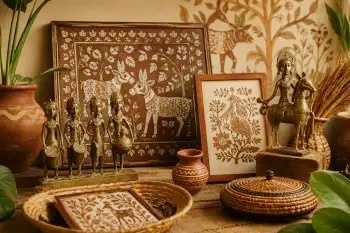
Image credit - Kalavan.in
Craft as Art, Knowledge and Livelihood: A Collection of Essays, Interviews and Photo-Features
When we decided to bring out a special issue on ‘Crafts,’ two things guided our decision. First, ‘craft’ needs as much attention as ‘art,’; second, we were in a unique position, since IIT Kharagpur had recently opened a Centre of Excellence on Indian Handicrafts with which we are associated.
We live among things that are hand-crafted. They can be utility objects like baskets or mats or decorative objects like carved wooden deities or clay dolls. We admire and use them, but hardly ever ask: who made it, where was it made, how, and how much effort went into creating it? And we always strongly differentiate between art, unique and without a second one, and craft, which can be produced in multitudes, though not exactly the same (as with machine-made goods). This distinction is one of the key reasons we decided to focus on crafts so that our readers realise the wide spectrum of processes, efforts and tools that go into creating them. Further, they are no less than any artwork.
In this special focus, Muse India brings together essays, reflections and conversations that look into these aspects of crafts, issues and challenges. Together, they treat craft not as a living practice, but as a body of knowledge and a sustainable livelihood source, since there are more than 30 lakhs registered and more than 1 crore unregistered artisans across India.
Several of these articles emerged out of craft workshops held at IIT Kharagpur, along with the Office of the Development Commissioner (Handicrafts), Ministry of Textiles. Various challenges and themes surfaced when our team interacted and worked closely with master artisans from across India. Other articles come from scholars of art history, literature and the humanities, from administrators and designers, both from India and abroad. This collection hopes to address the diverse tastes of readers.
Knowledge, Tools and Technology
Ankit Kumar and Saurav Kumar open with “Empowering Artisans”, discussing how artificial intelligence and digital technologies should be used in the context of crafts. They argue that craft is a system of knowledge, and that innovation should strengthen what artisans already know. They write that its purpose “should not be to make inherited human knowledge obsolete.” This also aligns with one of the CoE at IIT Kharagpur's basic mandates: using AI to assist artisans without challenging their creativity. Two field-based essays illustrate this approach. In “Relevance and Importance of the Prototype,” Debajyoti Swain Acharya and Suvadeep Swain Acharya describe a master woodcarver from Kallakurichi, Tamil Nadu, striking bare-metal chisels without handles. They illustrate how a simple attachable handle, tested in the workshop with the artisans themselves, can become a small but very meaningful prototype that addresses ergonomic and health challenges. G Manojit Rao and Ankur Kumar Das focus on Ringal bamboo craft from Uttarakhand. In the case of Ringal, cutting, splitting and sizing strips by hand need significant time, strain the body and can lead to injuries. Based on interviews at the Second Shristi O Anusandhan workshop at IIT Kharagpur, they recommend an artisan-led thigh support, Ringal-specific splitters and strip-sizing tools. They present a case for low-cost mechanisation and say that the aim is not to mechanise a craft but to make “those hands work better, safer and with more time for the work that only the artisan can do.” Subham Mondal’s photographic essay, “The Hands That Remember,” brings us closer to the actual processes of doing craft with hands. Through a series of photographs of woodcarvers at work, he follows the movement from drawing and cutting to the finished object. The focus of the article is on knowledge carried by the artisan’s hands, through years of observation, repetition and practice. The photographs illustrate that behind every crafted object, there are many small decisions and acts that one hardly notices in the finished craft product. The four essays and the Centre’s approach are to treat the artisan as an expert and to also respect her judgement.
Livelihood, Community and Women’s Work
Craft is always a living tradition. But there is a certain complexity to it – it is sustained through culture, community and market demands. Nandini Talukder’s critical essay asks how much creative freedom artisans can exercise when their livelihoods depend on market demand. Drawing on conversations with bamboo, cane, wood, clay and textile artisans she interacted with, she reframes a familiar question: It is not “Why do these artisans not experiment?” but “What social and economic conditions make experimentation possible?” This connects art and craft. On the other hand, Madhur Singh Pradhan and Sayoni Mondal look into women's empowerment in the Udayagiri wooden cutlery tradition of Andhra Pradesh, with its Persian-inspired lattice work, through the lives of three women master artisans and the leadership of Ghousiya Begum. Their essay highlights the fact that leadership is often collective. It illustrates how women have claimed and rearticulated their place within the craft. Pritha Banerjee’s “Kantha: A Living Tradition and Legacy” shows how layers of worn sarees stitched together in Bengali households became both missives and metaphors for memory and storytelling. She also traces how Santiniketan and Sriniketan link this largely domestic women’s practice to art education, rural development and modern design, and ends by asking what changes as Kantha enters the market. The final essay in this section is Mahashweta Mondal’s “‘Maybe’: Craft, Art and Embodied Knowledge in the Bamboo Craft of Bottala, Khejuri.” The essay is based on a short exploratory field visit to a village in Purba Medinipur. Through conversations with bamboo artisans, she examines how inherited skills are shaped by caste, gender, local ecology and livelihood-related issues. The artisans’ hesitant response of “maybe” to whether their work constitutes art is important. It raises questions about who determines artistic value. The essay also draws attention to women’s often unrecognised labour. It reiterates the uncertain future of craft knowledge as younger generations seek alternative employment opportunities.
Voices from the ground
The interview section focuses on three very different but closely linked professions – the administrator, the designer and the artisan. They all ultimately focus on craft and craftspeople. What they need, what can be done for them, what challenges they face and how they navigate them. In a conversation with Priyadarshi Patnaik, Sandeep Patel, Assistant Director (Handicrafts), recalls growing up in a carpet-weaving community in Bhadohi before entering government service. He finds the sector’s greatest strength in the sheer number and diversity of its artisans, their creative imagination and manual dexterity. Giving examples of clusters such as Bhadohi, Moradabad and Srinagar, he raises the issue of why a few artisans become exporters while most are left behind. He sees artificial intelligence as a tool that, like the Industrial Revolution before it, will only aid those who learn to use it, and insists that craft must first be a decent, viable livelihood through the support of technology. In another conversation with Meenakshi Samanta is designer Vandana Rathore, who grew up in “Baans ki Bareilly” and won the State Handicraft Award for a painting on a mat woven from water hyacinth, an invasive weed she turns into material for craft and ecological repair. Rathore talks about how she both learnt from and taught artisans. She uses a simple rule for design intervention – experiment with the product range, but never lose the essence of the craft. Arundhati Patnaik’s interview with Ramjan Milan, a block printer from Balotra in Rajasthan, is perhaps the most poignant. Milan dates his family’s lineage back six hundred years. His father’s workshop once employed twenty to twenty-five artisans and their families. Today only five brothers, their mother and an uncle sustain it. “Ours is the final generation remaining,” he says, “even though the demand for this legacy has recently surged.” That paradox of rising demand and vanishing craftsmanship carries much of the essence of the interview.
Making, Meaning and the Self
In the final section, the focus is different. It addresses connections, personal and literary, among practitioners of craft who are not necessarily artisans. Ishita Mondal follows the bangle from Mehrgarh and Mohenjo-Daro to the furnaces of Firozabad, India’s “Glass City,” and then into Sarojini Naidu’s “The Bangle Sellers,” where shifting colours trace a woman’s life from maidenhood to middle age. She also focuses on the collective labour behind each bangle and the customs that can turn an ornament of self-expression into a rule. Sugandhaa Pandey brings together her own experience of cross-stitching as a student far from home, her mother’s unacknowledged handiwork, Chikankari embroidery and Tennyson’s Lady of Shalott. She asks if women’s craft is a burden imposed on them or a silent form of freedom, and urges us to “recognise the woman behind the work she performs”. Writing from the Netherlands, Rinke de Haan recalls a childhood in which arts and crafts were part of every stage of schooling, and a long estrangement from making. She also talks of her uneasy but fruitful return to it as an adult. Making a string of bunting from market fabric taught her that she was more of a perfectionist than she had believed, and that the calm she sought lay in the process rather than the finished object. Rahul Pandit, also writing from Utrecht, reflects on a home where memories of India meet his partner’s love of design and art. On a slow autumn weekend, the brass pot, the bamboo blinds, the maroon rug and the block-printed bedsheets each become “a protagonist in its own right”. For him, aesthetics is more than just beauty. It also includes the thoughts and feelings that go into creating a block print.
Pinaki Gayen’s “Sonajhuri Haat: A Distinctive Local Craft Market of Shantiniketan” (presented in the Art Gallery section) takes us to the open-air craft market at Khoai, where local artisans, many of them women, display their handmade products amid the region’s distinctive cultural landscape of Baul music and Santhal dance. Gayen showcases 12 colourful images of the haat and draws attention to its changing character, as growing commercial demand and the introduction of machine-made products gradually challenge the distinctiveness of this local craft economy.
Read together, these pieces keep returning to the artisan’s handiwork and to the hands that hold the chisel, split bamboo, stitch kantha, press blocks on cloth to make an impression, or paint a coffee table in what feel like “childish” shapes and colours. They highlight, for the readers, that behind the finished object lies knowledge, labour, process, memory, and choices.
We hope this selection will be a fruitful exploration for our readers, and especially the craft lovers.

Issue 130 (Nov-Dec 2026)
-
INTRODUCTION
- 1. Priyadarshi Patnaik and Pinaki Gayen: Editorial Remarks
-
KNOWLEDGE, TOOLS & TECHNOLOGY
- 2. Ankit Kumar and Saurav Kumar: Empowering Artisans Through Technology - Knowledge, Cultural Continuity, and the Future of Indian Craft
- 3. Debajyoti Swain Acharya & Suvadeep Swain Acharya: Relevance and Importance of the Prototype
- 4. Manojit Rao G & Ankur Kumar Das: Empowering the Fingers that Create Ringal Craft of India
- 5. Subham Mondal: The Hands that Remember
-
LIVELIHOOD, COMMUNITY & WOMEN'S WORK
- 6. Nandini Talukder: Impact of Market Demands on Craft Occupation: A Critical Observation on Different Craft Traditions in India
- 7. Madhur Singh Pradhan and Sayoni Mondal: Beyond Craft - Women’s Leadership and Community Transformation in the Udayagiri Wooden Cutlery Tradition
- 8. Pritha Banerjee: Kantha - A Living Tradition and Legacy
- 9. Mahashweta Mondal: “Maybe” - Craft, Art and Embodied Knowledge in the Bamboo Craft of Bottala, Khejuri
-
VOICES FROM THE GROUND(INTERVIEWS)
- 10. Priyadarshi Patnaik: In Conversation with Sandeep Kumar Patel, Assistant Director, Handicrafts
- 11. Meenakshi Samanta: In Conversation with Vandana Rathore
- 12. Arundhati Patnaik: In Conversation with Ramjan Milan, Textile Artisan
-
MAKING, MEANING & THE SELF
- 13. Ishita Mondal: The Symbolic Significance of Bangles - From Traditional Craftsmanship to Literary Representation in Sarojini Naidu’s poem The Bangle Sellers
- 14. Sugandhaa Pandey: Lady of Shalott and Ambiguity of Craft
- 15. Rahul Pandit: Some Thoughts on Aesthetics and Craft
- 16. Rinke de Haan: A Personal Observation on Arts and Crafts