Vidya Tewani
Vidya Tewani
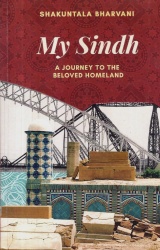
My Sindh: A Journey to the Beloved Homeland
Non-Fiction | Author: Shakuntala Bharvani |
Publisher: Black-and-White Fountain, India | First Edition, April 2021 |
ISBN No: 978-93-83465-26-2 | E-Book ISBN No: 978-93-83465-24-8 |
Pages: 231 | Price: Rs. 400
Book Review
Evoking collective memories of a scattered community, with a personal narrative endowing historical awareness to a past that is both elusive and palpable, this book brings the homeland home, says the reviewer, VIDYA TEWANI.
Shakuntala Bharvani was a young child when her family had to leave their home and the homeland, Sindh. Sindh, undivided at the time of Partition, was placed on the map of Pakistan, in its entirety. Nearly 1.4 million Sindhi Hindus had to seek refuge elsewhere. Bharvani’s book, My Sindh: A Journey to the Beloved Homeland, offers a journey to her lost homeland; the roadmaps here are drawn through the memories of those who gain and give access to a homeland that remains elusive and is yet palpable.
The thematically interconnected chapters are centred on the idea of exploring a migrant community’s past to reflect on its present. Bharvani’s long-standing experience as a professor of English lends this book a poetic grace, combined with her remarkable scholarship. With the skill of a raconteur, Bharvani narrates stories of those who lived through Partition, faced displacement, and rebuilt their lives with faith and fortitude. The book, like a long journey full of scenic beauty and many memorable milestones, presents a rich discussion on the socio-cultural history of Sindhis—of Sindh, of the Sindhi language, their religious practices, the Sindhi food, festivals and festivities.
The author offers fascinating insights and anecdotes on this home-bound journey: the discussion on the Sindhi language is made winsome through the infusion of peppy pahakas; the chinwag with the chachis and the nanis is made charming through the chiming of the Sindhi words, left untranslated; and, fun facts are told through intriguing stories such as that of the Sindhi mutton in New York! The author endows a sense of historical awareness by providing points of reference to our everyday experiences: the section on the archetypal Sufi song Damadam Mast Qalandar adds context and meaning as the author translates the lyrics, in a note written for her young niece.
One cannot miss Bharvani’s uninhibited sense of humour that makes the book so pleasurable: Writing about the Indus and its course, she piquantly throws in a pause-worthy comment: “...the Indus has been more whimsical and changeable—just like its Sindhi people! And, like us, unmindful of our history, it has wiped out so much of our past.” The book is strewn with these interjections, nudging us to think a little more. Dotted with musing monochromes—photos from family albums, images from personal collections, and sketches from history and travel books—the book compels the reader to imagine Sindh and Sindhis through the expanses of the landscapes and the contours of the portraits.
What sets the book apart are the chronicles that unravel to a young reader the simultaneity of Sindh in the lives of Sindhis: When the author writes about the Sadh Belo (Rohri, Pakistan), she also shares how, in Bombay, her in-laws visit a temple that the Sindhis call the Sadh Belo. Such post-Partition phenomena are seen as an attempt at imbuing the immediate physical space with a sense of home-like semblance. The book introduces a myriad such places and notions that one sees on both sides of the border—like parallel universes that the Sindhis live in to bring the homeland home.
In this book, Bharvani both legitimises and contends the notion of place of origin. Weaving a personal narrative into a mosaic of collective memories, adding strokes of history, folklore, and mythology, Bharvani makes the reader see their (my) Sindh—a homeland that is as metaphorical as it is real. For those who wish to take the journey to the beloved homeland of Sindhis, this book has much to take home.

Issue 126 (Mar-Apr 2026)
-
MESSAGE FROM THE MANAGING EDITOR
- GSP Rao: Message from the Managing Editor
-
EDITORIAL
- Menka Shivdasani: Introduction
-
CONVERSATIONS
- Menka Shivdasani: In a Conversation with Mohan Gehani
- Menka Shivdasani: In Discussion with Nand Javeri
-
ARTICLES
- Barkha Khushalani: Lights, Language, Legacy - The Story of Sindhi Drama
- Maia Bhojwani: Old Times in Sind - Memoirs of Seth Naomul Hotchand, C.S.I., of Karachi, 1804-1878
- Manthan Bachani: The Resilient Ink - The Rise of Young Sindhi Voices in Indian Literature
- Menka Shivdasani: Bengal and Sindh - Lasting Connections
- Prerna Gulrajani: Sindhi Women Writers - Striving to Be Heard
- Saaz Aggarwal: Waiting on the Threshold
- Sravana J Doddapaneni: Beyond Partition Memory through Post-2000 Negotiations of Language, Diaspora and Gender in Sindhi Literature
- Susheel Gajwani: A Literature Without a Territory
- Vandana Govindani and Nirmala Menon: Partitioned Language, Audible Futures - Reconfiguring Access to Sindhi Literature through Digital Audio Archives
- Veena Shringi: The Life and Times of Dr Harumal Sadarangani Khadim
- Vidya Tewani: Bonding and Belonging - The River Sindhu in Sindhi Hindu Diaspora Poetry
- Vinod Asudani: Evolution of Sindhi Poetry in the Post-Independence Era
-
SELECTED SINDHI BOOKS
- Menka Shivdasani: From my Bookshelf – Books on Sindhi Literature in English
-
BOOK REVIEW
- Vidya Tewani: ‘My Sindh – A Journey to the Beloved Homeland’
-
POETRY
- Arun Babani
- Manthan Bachani: Poems in English Translation
- Menka Shivdasani: ‘The Flute and The Tree - A Tale of Marui-Umar’
- Nimano Faqir, Sufi Saint
- Rishika Williams
- Sandhya Chander Kundnani
- Vidya Tewani
-
SHORT STORIES
- A J Uttam: ‘Blind Faith…Self Faith’ - Translated by Abhilasha Sawlani
- Murli Melwani: ‘Those Who Have Been Behind the Rainbow’