Vidya Tewani
Vidya Tewani
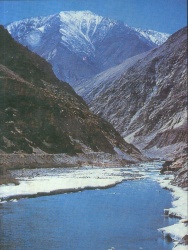
The mighty Sindhu (Indus) River symbolises the power and permanence of ancient Indian Civilisation, which evolved over thousands of years. Image credit – Back cover of ‘Glimpses of Sindhi Language’ by Dr Parso Jessaram Gidwani (2001).
VIDYA TEWANI explores allusions to the Sindhu River in select poems by the Sindhi Hindu diaspora. The River Sindhu, she believes, is envisioned as a source of connection to the past, fostering cultural continuity, ancestry, and a sense of belonging to a legacy recalling it as one of abundance and resilience.
Abstract:
The study aims to explore allusions to the Sindhu River in select poems by the Sindhi Hindu diaspora. Through these literary allusions, the paper argues that in Sindhi Hindu diaspora narratives, the River Sindhu is envisioned as a source of connection to the past, fostering cultural continuity, ancestry, and a sense of belonging to a past that is recalled as one of abundance and resilience.
Key Words: Sindhi Hindu Diaspora, Sindhu, Partition, Post-Partition, Homeland, Diasporic literature
**
Sindhi Hindu diaspora poetry often alludes to Sindh and the Sindhu River as their ancestral homeland. Nearly 14 Lakh Sindhi Hindus left Sindh—their homeland— due to the repercussions of the Partition of India in 1947, when India gained its freedom from British colonial rule. India was divided into two countries—India and Pakistan; this division was made on religious lines. Sindh, where Hindus lived as a minority, was not divided. Sindh became a part of Pakistan. Due to communal tensions, Sindhi Hindus left their homeland for safety; most of them arrived in India, leaving behind their homes and their homeland. The space lost was not compensated for geographically in India. Sociological studies of the Sindhi Hindu Partition experience argue that it involved the pain of leaving the motherland, the plight of arriving in India as refugees, and the struggles for survival (Bhavnani 2017; Kothari 2007).
Kothari, in her translation of post-Partition Sindhi short stories, deliberates on the experiences of Sindhi Hindu Partition as rendered in literary narratives: “The psychosis of fear, the separation from the language of home, the shedding of tangible and non-tangible possessions constituted trauma for the Sindhis, but perhaps not in the way trauma becomes akin to violence in Partition studies” (Unbordered Mememories xvi). In their English translation of Sindhi poems, Freedom and Fissures, Shivdasani and Makhija’s observations highlight the uniqueness of Sindhi Partition literary narratives. In their Translator’s Note, they remark that while they began collecting Partition poems, anticipating nostalgia, pain, and rupture, they found numerous poems, in addition to nostalgic recollections, that bore "gentle anguish”, remembered “a lost heritage”, and a “sentimentality” in the writings of younger poets born in the post-Partition era (xvii).
Poems written by the Sindhu Hindu diaspora recall the memories of their elders, who carried their homeland with them. Amongst these are memories of the Sindhu River, widely known as the Indus River, one of the longest rivers in Asia. The Sindhu flows year-round, making it a perennial river. This homeland river is alluded to and remembered in Sindhi literary works. Kirat Babani, a renowned Sindhi writer, narrates the struggles Sindhi Hindus faced as the Partition and migration rendered them homeless.
Someone asked me:
Who gave Sindhis the strength to rebuild?
…….
That strength came
from the Holy Sindhu.
(Babani 27)
For Babani, the community’s source of strength for survival is the holy Sindhu. The poet, in the state of homelessness and the struggle for resettlement, finds strength in the Sindhu River. The strength and resilience may have come from the geography of the river; it is a perennial river, changing its course when needed, for sustenance. Babani (1922-2015) was a Sindhi Hindu Partition refugee who lived in Sindh. He was separated from his homeland due to the Partition and arrived in Bombay, India, via ship in 1949. Babani, and numerous Sindhi Partition refugee writers, such as Popati Hiranandani, Sundri Uttamchandani, Hari Dilgir, Prabhu Wafa, Narayan Shyam, and many a renowned poet, bear to the readers the memories of their homeland. Most of the poets have written about the native memories of Sindh.
Arjan Shad, in his Foreword, in the same English translation of Sindhi Partition poetry, Freedom and Fissures mentioned above, remarks that “The poets who had been brought up in Sindh naturally remembered their distinct ethos. It is heartening to note that the younger generation of poets, brought up in India, also have started feeling the cultural vacuum, and wish to know about the lost heritage” (Makhija et al. xv). This observation brings us to the discussion in the paper: Post-partition Sindhi Hindus, who are born outside their ancestral homeland and may never have visited Sindh, imagine Sindh through the poetic memories of their elders and poetic predecessors, as their lost heritage. Early poets, such as Vimmi Sadarangani, Anju Makhija, Dholan Rahi, and Mahesh Nenvani, and later poets such as Smriti Notani, imagine Sindh as their ancestral heritage—one that they share a bond with—of cultural values, spirituality, and sacred geography.
Sindhi Hindu diaspora poems, as defined for this paper, are works in which the memories of Sindh are remembered through the elders, and/or Sindh is imagined in these works. The works of these Sindhi Hindu diaspora imagine Sindh through the inherited memories of the homeland, and they connect with the homeland in their imagination. Given the mythical, cultural and historical significance of rivers, they play a crucial role in literature, leading to one’s identity through one’s environment and one’s relationship with nature. They represent a community’s cultural values. Rivers represent historical narratives and cultural myths that a community collectively reckons with (Escobedo De Tapia and Gonzales 2016). Alvaro R. García, in his study, suggests that “rivers have often been depicted as powerful and symbolic elements that reflect the human condition or provide commentary on society and culture” (41). The Sindhu River is a symbol of the Sindhi Hindu diaspora’s inheritance, connection to the past, and expression of culture in the present. The poems allude to the river for values imbued generationally—they reflect life literacy and lineage.
Bonding and Belonging: The Sindhu River in Select Sindhi Hindu Diaspora Poetry
At the beginning of our discussion, it would be useful to present a brief note on the theoretical frameworks that provide scholarly conceptualisation for the present study. The study by Sidhwa on space as a unique point of analysis in Sindhi Hindu literature paves the way for discussions on post-Partition Sindhi literature. Sidhwa explains that Sindhis who migrated to India after Partition came to India as a stateless community and as a linguistic minority. Sindh became a full state in Pakistan, and thus, there is a “lack of an Indian version of that space” (112). Sidhwa’s study proposes that a study of Sindhi identity on the lines of spatial identity would lead to an examination of several spatial metaphors, such as “diaspora, roots, and routes” (112). The present study considers the Sindhu River as a spatial metaphor for diasporic literary imagination.
Additionally, Kumar’s study on space as a unique frame of reference in Sindhi diasporic imagination is also useful for the present study. Kumar suggests that for Sindhi Hindus, “homeland is manifest in the diaspora itself” (2). She contends that “‘Sindh’ for the diasporic Sindhi is more accurately conceived as an expression of their identity in their everyday lives” (2). Citing the cultural practices of Sindhi Hindu diaspora, which includes the worship of Jhulelal, the water God, symbolising the Sindhu River as sacred space, Kumar proposes that “In the act of displacement that created the Hindu Sindhi diaspora, the homeland is also displaced and gradually re-created in the homes of its multiply placed diaspora” (5). The Sindhi Hindu diaspora poems discussed in the study illustrate the diasporic manifestation of the homeland. This manifestation of the homeland in the diaspora lends the study the postulation of belonging.
The postulation of bonding is borrowed from Sawlani’s literary conceptualisation of the Sindhi word—sikka. In her study on the idyllic inter-communal relationships in post-Partition Sindhi literature, Sawlani introduces ‘sikka’. She adopts the Sindhi word—Sikka— to interpret the nostalgia, and the inter-faith friendships in pre-Partition Sindh: “Longing and affection cohere in that Sindhi word 'sikk’, testifying to the continuity of cross-religious affective bonds” (7). For Sawlani, this emotion interprets the “nostalgic utopianism”— a literary act of remembering and presenting in fiction the memory of a peaceful and prosperous past. Sikk here may be said to refer to friendly bonds between communities not overshadowed by the historical ruptures, such as partition. This sentiment of love and fond remembering stemming from the Sindhi word Sikka may be utilised for the present study to give meaning to the Sindhi Hindu diaspora’s loving memory of the Sindhu river, which naturally sustains a bond—a sikka—for the lost homeland, while showing the continuity of its cultural belonging by associating with the past. Sikka mein—in affectionate memory—is a traditional valediction in Sindhi letter writing. For the Sindhi Hindu diaspora, their address to the Sindhu signifies a spiritual longing for that which is divine and sacred—such as the river—that divine river that we worship; that which is within and yet desirable.i
Lastly, the present discussion is based on a selection of poems on the Sindhi Hindu diaspora collectively. Here, once again, the definition of minor literature by Sidhwa offers necessary justification. Sidhwa argues that Sindhi literature may be read as “minor” literature (115). Minor, Sidhwa defines, is not a matter of numbers here, “but of the quality that every unit/number brings with itself to the whole group.” (116). In terms of space as a literary trope in Partition literature, Sidhwa highlights the uniqueness of this trope as different from other Partition literary narratives. In Sindhi literature, Sidhwa suggests that Sindh seems to be like a space that has an identity outside of Pakistan: “as if Sindh is a land that belongs to the Sindhi, even after Partition, outside the context of Pakistan (119). This, attached to Kumar’s definition of Sindh as manifest in the diaspora, builds a ground for discussion on the allusions to the Sindhu River in Sindhi Hindu diaspora poems discussed in this paper, henceforth.
Dholan Rahi, one of the earlier Sindhi Hindu diaspora poets, addresses his elders, reminding them of the Sindhu they lived by, while imagining for himself as one who is deprived of this heritage: “Sindhri’s emerald gardens, where the Sindhu flowed / Its heaven-like lap, where your life was spent” (51). For Rahi, the Sindhu is the river that flows in his Sindh, whom he endearingly addresses as Sindhri—in Sindhi, this adjectivisation of a place or person, by adding the inflexional sound—i (long ee), signifies love and affection. This affectionate imagination of the Sindhi Hindu diaspora of the homeland where their ancestral ‘life was spent’ bears to the reader an imagined bond with the addressee. For Rahi, Sindhri is where the Sindhu flowed—the river of his ancestors now imagined by him as one belonging to him—it is a metaphor for his ‘roots’ as posited in Sidhwa’s study on the spatial study of the Sindhi Partition experience.
Similarly, Nenvani’s imagination of the Sindhu is through the memories shared by his uncle, who recalls the Sindhu: “At dinner, he talks of Sindhu / the fertile soil, the farmers” (32). The Sindhu is a metaphor for Rahi and Nenvani of the ‘fertile’ and ‘heaven-like’ geography that Sindhi Hindus lived in ancestrally. Bhavnani defines the richness of Sindh through the prism of the Sindhu: “Sindh lies in the north-western corner of the Indian subcontinent, a desert land greened by the mighty eponymous Indus. Bordered by the thirsty Thar desert and Rann of Kutch in the east, and the dark Khirthar mountains in the west, the Indus, revered by both Hindus and Muslims, is the main source of water in this rainless land” (Bhavnani xxii). The ‘eponymous’ Indus lends to the Sindhi diaspora writers like Rahi and Nenvani a place of origin—of belonging.
Rahi and Nenvani’s relationship with the Sindhu is of memories of the space-past—a place geographically distant in proximity, closer in imagination and memories. Makhija’s (Partition Wounds - Umbilical Connections) Sindhu is a trope for intergenerational storytelling; it is an intergenerational trope of cultural values that rivers surround through folklore. Makhija’s address is to the younger diasporic generation:
Oh, my little one,
Ride the waves, breast currents
As Sohini did on her matka
Sindhu’s banks you may chance upon
Discover the Indus, our forgotten past
(Partition Wounds—Umbilical Connections 329)
Rahi addresses his elders; Makhija, a post-Partition Sindhi Hindu diaspora poet, addresses the younger ones—both do so through the metaphor of the Sindhu River. Makhija expresses the desire for her daughter to chance upon the Indus. Makhija’s ‘forgotten past’ beckons Babani’s memories of the Sindhu, instilling in the younger generation the values of strength and resilience to ride the waves and breast currents as Sohini did—as Sindhi Hindu Partition refugees did.
The diaspora listens to the story of Sassui Panhu—of her strength, indicating the inheritance of bravery and braving the currents of the river for love. When Suhini, in the sikka of Panhu, crosses the river, the river, which could have been a hindrance, becomes the bridge, bringing the lovers together. This sikka—love and affection, is symbolised by the Sindhu that tells stories of bonds, strengthened by the Sindhu’s course; Sindhu is a symbol of the geography of belonging in the past. A young girl is told of the bravery that the river symbolises in folklore heroines. The strength also comes from the geography of the river: “It is a capricious god, though: bringing floods one year, abandoning its path the next, changing the course of history” (Bhavnani xxii). Thus, the Sindhu itself becomes a source of strength for Sindhi Hindus who lived by the Sindhu.
Makhija’s address as an early poet is to the younger generation, hoping that they might find themselves by the River Sindhu; Notani, a young post-Partition Sindhi diaspora poet, believes she is born of Sindhu: “The mighty Indus doesn't know me / Though I am born of her heart” (328). As Halbwachs argues, collective memory is sustained through group practices, and such rituals transform the river from a geographical absence into a cultural presence (54). River-based identity is maintained not through maps, but through communal acts of remembrance.
Notani’s inheritance is within her, symbolising, like a river’s flow, values that organically flow in its people, from generation to generation; the essence of the Sindhu is within the people, the Sindhis, who once lived by it: Sindhu flows in Sindhis. Kumar’s expression of the diasporic Sindh here is found in the everyday lives of the diaspora; Notani’s diaspora Sindhu is found within the diaspora as inheritance, and thus, it is present in the present. Sidhwa explains that, for Sindhi Hindus, the homeland of the past offers a chance to imagine it. Sidhwa suggests that the word Sindh should be interpreted not only as a physical space, but also, in the case of Sindhi Hindus, as “recognised as an expression” (115) of cultural connotations. The poet’s relationship with the Indus is so deep and yet distant. The poet is a part of the Indus, a descendant, and yet, as the poet says, the ancestor doesn’t know the progeny. Still, the connection exists. The bond persists. Kumar’s surmisation pertains here: “‘Sindh’ as river, a civilisation, a culture and heritage, a people and their history, is testimony to ‘Sindh’ being much more than ‘homeland’ in the sense of ‘land’ per se. Its polysemy is evident in the variety of interpretations provided, and all meanings hold true.” (2).
Conclusion
Prabhu Wafa writes, “Wherever you find Sindhis, call it Sindh” (4). This wherever-ness is an intergenerational diasporic expression. Sindhi Hindu diaspora finds the Sindhu River wherever they are - in their imagination and in their inheritance. The river becomes not only a memory of a lost homeland but also a portable homeland itself, invoked whenever stories of Sindhu’s abundance and sacredness are retold. The Sindhu embodies a diasporic ethic of continuity, offering a geography of belonging that transcends the loss of Partition. The poetry of the Sindhi Hindu diaspora seeks to imagine the Sindhu that flows within the community.
Endnote
iThe word 'Sikka' is also spelt 'Sikk' here to align with the spelling in the title of Abhilasha Sawlani's study.
Works Cited
Álvaro R. García. "The Universal Symbolism of River Narratives in Modern Literature," International Journal of Social Science and Humanity, vol. 14, no. 1, pp. 41-44, 2024. https://doi.org/10.18178/ijssh.2024.14.1.1191.
Bhavnani, Nandita. The Making of Exile: Sindhi Hindus and the Partition of India. Tranquebar Press, 2017.
Escobedo de Tapia, Carmen, and Angela Mena Gonzales. “The Poetics of the River in Indian Literature in English.” Journal of English Studies, vol. 14, 2016, pp. 35–52. https://doi.org/10.18172/jes.3281
Halbwachs , Maurice. On Collective Memory. Edited and translated by Lewis A. Coser, University of Chicago Press, 1992.
Kothari, Rita. Unbordered Memories: Sindhi Stories of Partition. Penguin Books, 2009.
Kothari, Rita. The Burden of Refuge: Partition Experiences of the Sindhis of Gujarat. OrientBlackswan, 2007.
Kumar, Mamta Sachan. “Alternative Engagements with Homeland”: Sindh as an Expression of Diasporic Sindhi Identity.” (PDF), 7 Oct. 2022, www.academia.edu/88066750/Alternative_Engagements
with_Homeland_Sindh_as_an_Expression_of_Diasporic_Sindhi
Identity.
Makhija, Anju, et al. Freedom and Fissures: an Anthology of Sindhi Partition Poetry. Sahitya Akademi, 1998.
Makhija, Anju. “Partition Wounds - Umblical Connections.” Sindhi Tapestry: An Anthology of Sindhi Identity and Culture. Edited by Saaz Aggarwal, Black-and-White Fountain, 2021, pp. 328.
Nenvani, Mahesh. “Khiri Machi.” Freedom and Fissures: An Anthology of Sindhi Partition Poetry. Trans. Anju Makhija et al., Sahitya Akademi, 1998, pp. 32.
Notani, Smririt. “Home.” Sindhi Tapestry: An Anthology of Sindhi Identity and Culture. Edited by Saaz Aggarwal, Black-and-White Fountain, 2021, pp. 135.
Rahi, Dholan. “Why are you uprooting us?” Freedom and Fissures: An Anthology of Sindhi Partition Poetry. Trans. Anju Makhija et al., Sahitya Akademi, 1998, pp. 51.
Sawlani, Abhilasha. “Sikk for Sindh: A Study of Utopianism in Sindhi Hindu Narratives of Partition.” Language, Literature, and Interdisciplinary Studies, vol. 5, no. 1, Jan. 2022.https://doi.org/10.71106/IHQU4271.
Wafa, Prabhu. “Shadow Play.” Freedom and Fissures: An Anthology of Sindhi Partition Poetry. Trans. Anju Makhija, Arjan Shad, Menka Shivdasani, Sahitya Akademi, 1998, pp. 3.

Issue 126 (Mar-Apr 2026)
-
MESSAGE FROM THE MANAGING EDITOR
- GSP Rao: Message from the Managing Editor
-
EDITORIAL
- Menka Shivdasani: Introduction
-
CONVERSATIONS
- Menka Shivdasani: In a Conversation with Mohan Gehani
- Menka Shivdasani: In Discussion with Nand Javeri
-
ARTICLES
- Barkha Khushalani: Lights, Language, Legacy - The Story of Sindhi Drama
- Maia Bhojwani: Old Times in Sind - Memoirs of Seth Naomul Hotchand, C.S.I., of Karachi, 1804-1878
- Manthan Bachani: The Resilient Ink - The Rise of Young Sindhi Voices in Indian Literature
- Menka Shivdasani: Bengal and Sindh - Lasting Connections
- Prerna Gulrajani: Sindhi Women Writers - Striving to Be Heard
- Saaz Aggarwal: Waiting on the Threshold
- Sravana J Doddapaneni: Beyond Partition Memory through Post-2000 Negotiations of Language, Diaspora and Gender in Sindhi Literature
- Susheel Gajwani: A Literature Without a Territory
- Vandana Govindani and Nirmala Menon: Partitioned Language, Audible Futures - Reconfiguring Access to Sindhi Literature through Digital Audio Archives
- Veena Shringi: The Life and Times of Dr Harumal Sadarangani Khadim
- Vidya Tewani: Bonding and Belonging - The River Sindhu in Sindhi Hindu Diaspora Poetry
- Vinod Asudani: Evolution of Sindhi Poetry in the Post-Independence Era
-
SELECTED SINDHI BOOKS
- Menka Shivdasani: From my Bookshelf – Books on Sindhi Literature in English
-
BOOK REVIEW
- Vidya Tewani: ‘My Sindh – A Journey to the Beloved Homeland’
-
POETRY
- Arun Babani
- Manthan Bachani: Poems in English Translation
- Menka Shivdasani: ‘The Flute and The Tree - A Tale of Marui-Umar’
- Nimano Faqir, Sufi Saint
- Rishika Williams
- Sandhya Chander Kundnani
- Vidya Tewani
-
SHORT STORIES
- A J Uttam: ‘Blind Faith…Self Faith’ - Translated by Abhilasha Sawlani
- Murli Melwani: ‘Those Who Have Been Behind the Rainbow’