Prerna Gulrajani
Prerna Gulrajani
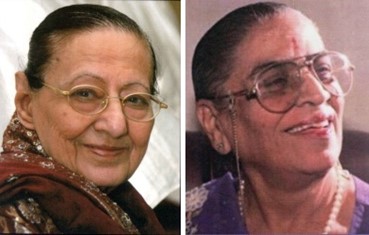
Sundri Uttamchandani and Popati Hiranandani. The pioneers among Sindhi female writers.
Perceived from the double lens of patriarchy and the displacement of the community during the Partition, female Sindhi writers faced unique challenges, says PRERNA GULRAJANI.
Sindhi literature has long been an intricately woven tapestry of lyricism, mysticism, and collective historical memory. Within that rich fabric lies a lesser-known, but powerful thread: the contributions of Sindhi women writing in Sindhi. Perceived from the double lens of patriarchy and the displacement of the community during the Partition, female Sindhi writers faced unique challenges. Apart from being overwhelmed by mainstream literary canons, they faced complex challenges, including retaining not only their own identity but also that of their community, in a shifting and evolving environment.
It is believed that Popati Hiranandani, who ranks high among the illustrious and acclaimed female Sindhi writers, once said, “To write in Sindhi is to light a lamp in the wind.”
Although there is no clear attribution for this quote, it remains true nonetheless. For Sindhi women writers, that wind frequently resembled a thunderstorm of uprooting, suppression, and cultural erosion. Through it all, these determined, courageous, resilient women continued to write. They wrote in notebooks, sitting under the street lights in overcrowded refugee settlements. They wrote while travelling on crowded trains. They wrote in lonely homes. They wove tales, created verses, and recorded memories that have kept the spirit of Sindhyat alive. They strove to be heard over the noise of the wider Indian literary conversation. The creations of these virtuous women convey unmatched feminine richness, a sense of historical awareness, and above all, a linguistic and communal pride.
To honour these women writers of Sindhi literature, I trace some of the key female voices of Sindh, their contributions, themes, and milestones in their journey within the broader cultural landscape.
How Sindhi Women became the Joint Custodians of Sindhi Literature
During the decades after the Partition, newer generations of uprooted Sindhi Hindus were born and grew up in an environment that was alien to the culture of Sindh. Those displaced from their homeland perceived this as a serious challenge to the preservation of their heritage. Sindhi writers, both men and women, rose to the challenge, striving to preserve and propagate Sindhi culture through their writing.
While male and female creators were united in their shared passion for the language and the lost heritage, the creations of female writers, poets, and others were distinguished by a unique undertone of rebellion against injustice and inequality, as well as by nostalgia and the pain of the Partition, which characterise most creations by Sindhi writers. Their writings focus on women’s experiences through the transition from Sindh to Hindustan, often challenging societal norms. Their themes revolve around linguistic and gender inequality, offering unique perspectives on love, loss, and relationships. Female Sindhi writers have thus created a distinct metier and a unique role for themselves.
Early Beginnings and Historical Context
Early Sindhi literature was predominantly authored by men. The earliest writings were shaped by folklore and cultural traditions. The exodus and trauma of the Partition triggered a shift towards pain and nostalgia. Women creators who experienced the pain of the Partition chronicled their own experiences and those of their loved ones, as well as the collective shifting and evolving identity of Sindhis as a community. They used poetry and storytelling to articulate the bereavement, heartache, despair, and desolation they witnessed. These women pioneered a new breed of writing that presented a feminine perspective to the experience of the Partition through literary criticism and pedagogy, driving an evolution of new literary forms and readership. Organisations like the Sindhu Nari Sabha, founded by Sundri Uttamchandani, a celebrated Sindhi writer, and Sindhi Sahitya Mandal, co-founded by her husband A J Uttam and Prof. Mangharam Malkani, encouraged these creators by offering a platform for expression.
Themes and Contributions
While the contributions of each writer are unique, there is a gradual yet clearly evident shift in the focus of female Sindhi writers. For instance, the work of early writers like Popati Hiranandani and Kala Prakash reflects the pain of Partition and nostalgia for the lost homeland, while younger writers like Dr Vimmi Sadarangani alleviate Popati’s pain of being a Sindhi woman by injecting a strident tone of feminism into their creations. The focus of these writers is not only on the plight of displaced women, but also on strengthening the position of these women. Contemporary Sindhi writers have expanded the canvas of Sindhi literature further, introducing criticism, educational, and children’s literature, with clearly defined goals of driving change and preserving the legacy.
The Place of Women in the Larger Context of Sindhi Literature
Sindhi literature in the pre-Partition era was characterised by the verses of nationalist poets and the chants of Sufi mystics. Women in this era bore silent witness to the creation of the Sindhi legacy. As the female voice emerged in the decades following the Partition, five key phases of evolution and change surfaced. These phases or roles include the pioneers, the foundational thinkers, the educators, the torch-bearers, and the preservers.
While these classifications are not rigid, in the following section, I share key names of female Sindhi writers in each of these roles.
The Pioneers – Disruptors who Bucked the Trend
Talking of disruption, two names emerge as drivers of change – Sundri Uttamchandani and Popati Hiranandani. While there are many others, these two women boldly forged into a predominantly male-dominated literary space during and after the exodus. They became the trailblazers who triggered a new literary consciousness.
Among the first ever Sindhi women to publish poems and short stories on the nostalgia experienced by displaced Sindhis was Sundri Uttamchandani. Her work focused primarily on emotional resilience. Characterised by a classic homespun dialect, Sundri’s work breaks gender and social barriers and presents progressive ideas and ideals. Her exposure to folk and mythological lore during the pre-Partition era, the freedom movement, the influence of mentors like M U Malkani and her sojourns into the literary world as she accompanied her husband, A J Uttam, to Sindhi Sahitya Sabha meets have all contributed to shaping her literary works. Her first known literary work is the translation of Bahadur Maao Ji Bahadur Deeah (The Brave Daughter of a Brave Mother), while she was still in college. Her contributions include 200 short stories, two novels, 12 plays, 500 essays, and 200 poems, apart from innumerable translations in various languages.
Some of Sundri Uttamchandani’s most notable creations include Bhoori (The Doll) and Vichhoro (The Separation), which won her the Soviet Land Nehru Peace Award from the Ministry of Education and the Sahitya Akademi Award, respectively. Other accolades to her name include the Government of Maharashtra Gaurav Puraskar (1990), the Lifetime Achievement Award (NCPSL, 2005), and the Sindhi Akademi Citation (Delhi, 2012).
Another trailblazer of the Partition era is Popati Hiranandani. Her work spans autobiographies, critical writing, fiction, poetry, and translations, most of which centre around feminist themes, interspersed with the trauma of displacement and a shout-out for the preservation of linguistic heritage.
Popati is recognised as pivotal in shaping modern Sindhi literature and a voice for linguistic and communal rights. Her autobiography Muhinje Hayatia ja Sona Rupa Warq (The Gold and Silver Linings of my Existence) stands as a landmark in post-Partition South Asian women’s literature. It won her the Sahitya Akademi Award (1982). Popati also won many other national and global awards. Among her most celebrated and quoted creations is the short verse entitled The Homeless Sindhi Woman, in which she likens herself to Anarkali, who was buried alive. Using this analogy, Popati refers to herself as homeless in history’s graveyard. I cannot help but reproduce the verse here.
In Akbar the Great’s durbar,
Anarkali, Queen of Beauty, reigned.
Yet, even she was buried alive.
Delhi, India’s pride, and I,
Inheritor of the marvels of Indus architecture.
Yet, even I have been buried alive.
Homeless in history’s graveyardi.
While these two women win the prize for catalysts for change, they are not alone. Sumaira Zareen, who earned the title of “first lady of Sindhi literature”, has also contributed significantly to the heritage. Her collection of stories, entitled Mehran Joon Chholiyoon (Waves in the Indus) and Geet Ujayal More Ja (Songs of Thirsty Peacocks), is among her most notable works. She was honoured posthumously for Aaoon Uhai Marvi (I Am the Same Marvi) and Roshan Chhanwro (Bright Shade). Five decades later, Nasir Mirza compiled Zareen’s unpublished stories in his book Khatton-e-Awal Kahanikara: Sumera Zareen (First Lady of Stories: Sumera Zareen).
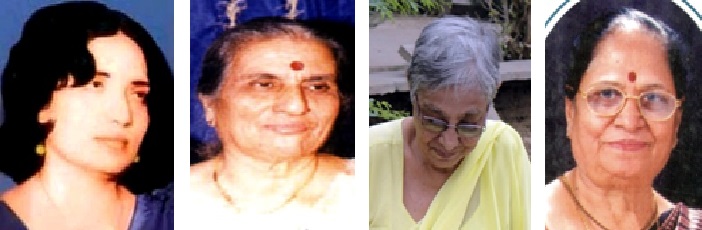
Guli Sadarangani is another significant contributor to Sindhi Literature. She became the first woman to publish a novel in Sindhi, but remained largely unrecognised. Her Ittehad (1941) was an interfaith love story that had important messages for its time. In a welcome development, Rita Kothari has recently translated this novel, providing it with much-needed visibility.
Another poet, writer, and singer from Sindh whose name stands out is Paru Chawla. The Sindhu World has portrayed her unique journey through three turning points in her life. Atheist turned devout reader of the Guru Granth Sahib, Paru’s life changed after her marriage to Thakur Chawla, whose name is also well known in Sindhi literary circles, and through him, meeting with Professor Ram Panjwani, who initiated her into the world of singing. The website, www.paruthakur.com, describes her as “the only singer who can quote ‘Shah Abdul Latif’, ‘Sachal Saaeen’, and ‘Sami Sahib’ at one go without referring to any book or diary.” Not only was Paru passionate about Sindhi literature and culture, but she also instilled passion in her two daughters, Barkha Khushalani and the late Shobha Lalchandani, who passed away in 2024.
Other notable trailblazers who broke literary and social barriers, especially post-Partition (1940s–1960s), include Kamla Gidwani, known for her essays and fiction that challenged social realism, and Kala Prakash, a strident post-Partition voice broadcast through scholarly criticism, which was instrumental in changing the lives of Sindhi women in uprooted homes. Maya Rahi is another writer who deserves attention. Born in 1937, she is a Sahitya Akademi Award-winning fiction writer and poet. Her works include Mokshu, Dhaal Mahingi Murka and Ahisaas (2003).
The Foundational Thinkers
Apart from informal, creative writings, the creations of the pioneers also form an integral part of academic syllabi, major anthologies, and more. It is studied in linguistic departments across South Asia. New-age writers have nurtured the seeds sown by these pioneers. Outstanding among these is Rita Shahani, whose narratives and essays are layered and nuanced, offering meaningful insights into social change. She has carved a unique place for herself with her mastery over English, Hindi, Urdu, and, of course, Sindhi. As a social activist, member of the Maharashtra State Board of Secondary and Higher Secondary Education, Vice-President of the Jai Hind High School, Pimpri, and many other posts, Rita has won several awards for her work, including one from the RJ Advani Trust and a Lifetime Achievement Award from the Maharashtra State Sindhi Sahitya Academy, among many others. Her most notable work is Roobaroo (Face to Face), a collection of biographical stories of the great saints of India like Guru Nanak, Sant Kabir, Meerabai, Osho, Shah Abdul Latif and Dada Jashan Vaswani, whose religious retreat in Pune continues to offer solace to the Sindhi Community. Roobaroo is not merely a collection of biographies but a deeper, more meaningful creation that goes to the heart of religion. “From Gautam Buddha to Osho, everyone has said and taught the same truth. Aham Brahma See. Vedant said the same Sutra as Ess Dhamo Santano, which Sufis said as Anal Haq…ii” This quote from Rita’s writings portrays a shift from siloed customs and beliefs to a universal truth that transcends religion.
Other notable female writers who became founders of modern Sindhi literature include Geeta Hiranandani, whose feminist themes and social critique have contributed to the emergence of critical thinking within the Sindhi community, and Sushila Jiwatram, an essayist and short story writer whose work reflects on family structure in the post-Partition era.
The Educators
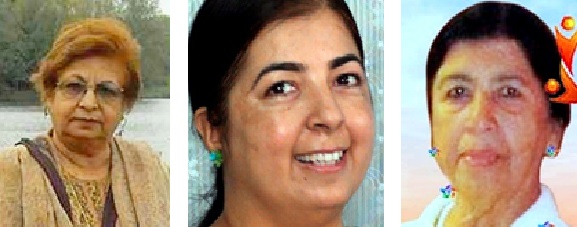
(From left) Rita Shahani, Vimmi Sadarangani, Devi Nangrani
Rita Shahani and others broke the barriers of classical Sindhi literature, which was characterised by poetic forms like the doha and ghazals, focusing on religion and philosophy. Their work became the launch pad for a new, evolved, and diverse contemporary Sindhi literature, which explores a spectrum of themes and writing forms, and scholarly work, addressing social, political, and economic issues relevant to modern times. It drove a shift not only in the subject matter but also in the script – a shift from Perso-Arabic to Devanagari – and triggered what may be called the progressive writers’ movement that became the voice for social justice and reform of the Sindhi community.
Most strident among these new voices were Dr Vimmi Sadarangani and Ms Devi Nangrani. They promoted Sindhi through academics, textbooks, and translations. Their work demonstrates how Sindhi literature and traditions can thrive by leveraging online networking to educate the diaspora.
Through books like Mukhriyoon, Sonahari Rang ji Karani, Sindhi Akharmala (The Sindhi Alphabet), Sindhi Pathmala (Sindhi Lessons), Bili-a-jo Iskool (The School of the Cat), and Mummy Iyen Chho Aahe? (Mother, Why is it Like This?) Vimmi seeks not only to educate the new generation in Sindhi culture and traditions but also in Sindhi script. Her Akharmala and Pathmala are concentrated efforts in reviving the Sindhi script. On the other hand, Devi Nangrani uses Ghazals – Gam Bhinal Khushi (2007) and Hymns – Ud Ja Panchi (2007) along with prose Sindh ki Jaayi (Born in Sindh) and stories – Maan Khinjo Na Ahiyaan (I Do Not Belong to Anyone) (2016) to educate the Sindhi community. The Sindhu World reports that Devi has over 100 titles to her name.
The creations by Devi, Vimmi, and other contemporary writers are available on various platforms, including Amazon. Many of them are also active on social media.
The Torch-Bearers
The drive for education and propagation of the heritage initiated by educators like Rita and Devi is carried forward by other contemporary writers who belong to the digital age. These contemporary writers are driving a change through digital infrastructure, not only to preserve and promote Sindhi literature but to bring together the people of the Sindhi community. These voices from the homeland are shouting out to the diaspora through memoirs, verses, and text, willing Sindhyat to survive and flourish in both Sindhi-speaking and global contexts. These contemporary authors are gaining global acclaim. They have become the torch-bearers of Sindhyat and Sindhi literature.
One name that comes instantly to mind in this context is that of Indira Vaswani a.k.a. Shabnam. One of the most recent recipients of the Sahitya Akademi award for Mitee-a Khan Mitee-a Taaen (From Dust Unto Dust) in 2012, and the new voice of Sindhi fiction, Indira writes short fiction stories that reflect the nuances in the lives of female characters. Other well-known names among the torch-bearers include Pushpa Keswani, who explores family dynamics and psychological realism through the lens of fiction, and Veena Shringi, journalist, poet, and social commentator.
The Preservers
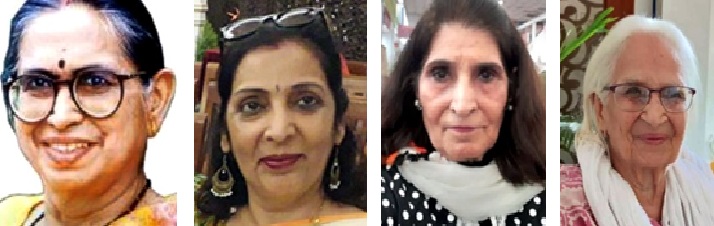
(From left) Indra Vaswani, Barkha Khushalani, Veena Shringi, Tara Mirchandani
Apart from the torch-bearers who continue to carry the legacy of Sindhi literature forward, other writers who deserve mention here are those who work at the grassroots level and who perhaps do not have as much digital visibility, but whose contributions have far-reaching cultural significance. Among the preservers are Paru Chawla’s daughters, Shobha Lalchandani and Barkha Khushalani. A retired manager from Air India, Barkha’s most notable work is Spice of Life, the translation of stories penned by her father into English, and A Passionate Sindhi, a biography of Mr Harish Dubey, originally written by Mr Holaram Hans in Sindhi. A true modernist, she has translated The Day I Stopped Drinking Milk by Sudha Murthy into Devanagari and Arabic script. Barkha has translated several original works from Sindhi to English and vice versa. Her sister Shobha, on the other hand, wrote in a more journalistic or academic vein. As the editor of Hindvasi, a Sindhi newspaper, she was socially active, organising various cultural events at Sita Sindhu Bhavan. Her sister Barkha continues this legacy.
Among other modernist female Sindhi writers are Rupa Mehra, known in community circles as a contributor to Sindhi magazines, Shobha Ramani, whose articles are often found in literary magazines and who is a well-recognised community figure in cultural preservation, and Tara Mirchandani, whose name is often associated with cultural forums and local Sindhi women’s publications.
Challenges and Future Outlook
Sindhi literature is among the oldest and richest literary heritages in South Asia. From the verses of Shah Abdul Latif Bhittai to the 21st-century writing of poems, stories, and academic compositions, Sindhi has witnessed a myriad of changes and evolutions that reflect the resilience of the Sindhi community. Still, preserving Sindhyat and keeping it relevant in today’s digital age is not without challenge.
One of the biggest challenges is a dwindling readership. Not only have second and third-generation Sindhis drifted away from their heritage, but ubiquitous digitisation has decreased the interest in reading per se. Furthermore, while there are digital platforms that offer a stage for the presentation of Sindhi writing, they face tough competition, predominantly from English but also from other languages that dominate cyberspace. This has significantly diminished the visibility, not only of Sindhi as a language, but also that of Sindhi writers. Compounding that challenge is the fact that the Sindhi script is not uniform across the globe. Sindhi writers variously use Perso-Arabic, Arabic, and Devanagari scripts depending upon their location, perception, and capabilities. There is also a noticeable lack of institutional support for authors, poets, and other creators who write in Sindhi to publish and distribute their work. This is perhaps because, although Sindhi is constitutionally recognised, both in Pakistan and India, writers and creators lack a cultural anchor and audience. One reason for this is perhaps the small size of the diaspora globally. Even in India and Pakistan, which may be dubbed the homeland of Sindhis, the community is scattered. Further, social gatherings like mushairas, religious functions, and storytelling events, which were once powerful vehicles for the transmission of literature, are fading away.
While this might portray a bleak future for Sindh and Sindhyat, there is hope. Organisations like the Sindhi Sahitya Mandal and Sindhu Nari Sabha offer digital platforms for Sindhis. If Sindhis unite and exert a concentrated effort towards propagating their culture and language, Sindhyat can still be preserved and communicated to coming generations. Through the translation of Sindhi literature into languages like Hindi and English, it can be made available to and be appreciated by the younger generation. A far more pressing and urgent need is to collate the disintegrated memories of the older generations and build encyclopaedic databases for use by future generations.
Other ways to encourage the newer generations to preserve and promote Sindhyat are to promote literary circles and multilingual education programmes, both online and offline, through which the Sindhi diaspora can overcome geographical and linguistic barriers.
Final Reflections
The future of Sindhi and Sindhyat lies in the creation of a strong digital infrastructure, translation across languages, academic recognition, scholarship and awards, and literary networks both in India and the diaspora. Only then can these voices, from homebound memoirs to diaspora, survive and flourish in both Sindhi-speaking and global contexts.
i Makhija, A., Shivdasani, M. and Mirchandani, A.S. (1998). Freedom and Fissures: An Anthology of Sindhi Partition Poetry. New Delhi: Sahitya Akademi.
ii https://sindhishaan.com/article/personalities/pers_10_04a.html

Issue 126 (Mar-Apr 2026)
-
MESSAGE FROM THE MANAGING EDITOR
- GSP Rao: Message from the Managing Editor
-
EDITORIAL
- Menka Shivdasani: Introduction
-
CONVERSATIONS
- Menka Shivdasani: In a Conversation with Mohan Gehani
- Menka Shivdasani: In Discussion with Nand Javeri
-
ARTICLES
- Barkha Khushalani: Lights, Language, Legacy - The Story of Sindhi Drama
- Maia Bhojwani: Old Times in Sind - Memoirs of Seth Naomul Hotchand, C.S.I., of Karachi, 1804-1878
- Manthan Bachani: The Resilient Ink - The Rise of Young Sindhi Voices in Indian Literature
- Menka Shivdasani: Bengal and Sindh - Lasting Connections
- Prerna Gulrajani: Sindhi Women Writers - Striving to Be Heard
- Saaz Aggarwal: Waiting on the Threshold
- Sravana J Doddapaneni: Beyond Partition Memory through Post-2000 Negotiations of Language, Diaspora and Gender in Sindhi Literature
- Susheel Gajwani: A Literature Without a Territory
- Vandana Govindani and Nirmala Menon: Partitioned Language, Audible Futures - Reconfiguring Access to Sindhi Literature through Digital Audio Archives
- Veena Shringi: The Life and Times of Dr Harumal Sadarangani Khadim
- Vidya Tewani: Bonding and Belonging - The River Sindhu in Sindhi Hindu Diaspora Poetry
- Vinod Asudani: Evolution of Sindhi Poetry in the Post-Independence Era
-
SELECTED SINDHI BOOKS
- Menka Shivdasani: From my Bookshelf – Books on Sindhi Literature in English
-
BOOK REVIEW
- Vidya Tewani: ‘My Sindh – A Journey to the Beloved Homeland’
-
POETRY
- Arun Babani
- Manthan Bachani: Poems in English Translation
- Menka Shivdasani: ‘The Flute and The Tree - A Tale of Marui-Umar’
- Nimano Faqir, Sufi Saint
- Rishika Williams
- Sandhya Chander Kundnani
- Vidya Tewani
-
SHORT STORIES
- A J Uttam: ‘Blind Faith…Self Faith’ - Translated by Abhilasha Sawlani
- Murli Melwani: ‘Those Who Have Been Behind the Rainbow’