Shatrughan Kahar
Shatrughan Kahar
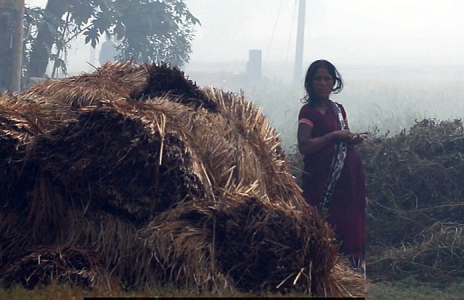
A Bhojpuri folksong about an expectant woman. Image credit – YouTube. Project Bidesia.
Abstract
The article explores the socio-cultural significance of Bhojpuri folk literature in understanding the status of women within a patriarchal society. Folk songs, often overlooked as mere entertainment, emerge as crucial sources of sociological insight, revealing the nuanced and often harsh realities faced by women. The article highlights how these folk expressions serve as a medium for women to voice their sorrow, struggles, and social issues, which are otherwise marginalised in mainstream discourse. It discusses the deep-seated preference for sons over daughters, reflecting on how this bias manifests in various folklore and songs that lament the birth of girls. The economic burden of dowries, the social pressure of early marriages, and the emotional pain of male migration on women are also highlighted. The article further explores the depiction of women’s roles in Bhojpuri society, both within the household and in agricultural work, emphasising the unrecognised and unpaid labour they contribute. Through an examination of folk songs, the article sheds light on the complex interplay between gender, culture, and socio-economic conditions in Bhojpuri society, revealing the powerful role of folklore in capturing and conveying the lived experiences of women.
Keywords: Folklore, Folksong, Folk drama, Bhojpuri, Women.
Introduction
Folk literature serves as a valuable source for understanding the position of women in the patriarchal Bhojpuri society. Over time, they have established themselves as significant tools in sociological research. Both folklorists and sociologists recognise folk music as a powerful medium for conveying both the spoken and unspoken expressions of women.1 Unlike other literary creations, folk songs hold greater socio-historical value than literary value, prominently reflecting people's attitudes toward life.2 Folk songs are a crucial source of sociological information. While they may not always directly address social issues, they often contain subtle hints about socio-cultural matters, thereby drawing attention to prevailing social concerns. As Sri Kuj Bihari Das aptly states, ‘Folk songs are the expression of the spontaneous flow of life of those who live outside the mainstream of culture and civilization, often within a more or less primitive system.’3 Highlighting their sociological value, sociologist Indra Deva (1989) emphasizes that scholars should not treat folk songs as simple documents or take them at ‘face value,’ as they are not ‘scientific monographs.’ He further argues that folk songs are not a reliable account of actual events but rather reflect people's attitudes toward those events. In other words, folk songs represent people's perceptions of incidents, situations, and relationships.4 Similarly, the popular folklores of the Bhojpuri region not only portray the position of women in society but also highlight the prevalent social issues. On one hand, these folklores depict women's roles within the social sphere, while on the other, the folk songs sung by women often express their sorrow, misery, and various social problems, along with their stories of self-lament. This article will focus on exploring these themes.
Bhojpur : The Land and Its People
The Bhojpuri language is spoken across an area of approximately 50,000 square miles in India. While its main centre extends from the eastern districts of Uttar Pradesh to the western districts of Bihar, Bhojpuri has also gained recognition abroad due to the migration of Bhojpuri-speaking people. The region where Bhojpuri is spoken is historically associated with the Bhoja kings, originally from Ujjain (Malwa), who established a city in eastern Uttar Pradesh and western Bihar, making the area known as Bhojpur. The language spoken by the people here is Bhojpuri.
Today, Bhojpuri is widely spoken in eastern Uttar Pradesh, western Bihar, Jharkhand, and the Terai region of Nepal. Due to significant migration during the colonial period, Bhojpuri influence extended far beyond its native regions, spreading to places as distant as the Caribbean, Mauritius, South Africa, and Fiji in the 19th century. Approximately 120 million people speak Bhojpuri, making it a linguistically rich language.5
Bhojpuri is indeed a rich and vibrant living language, deeply intertwined with the daily lives of its speakers. While Bhojpuri speakers often pursue education in Hindi for livelihood and knowledge, their connection with their mother tongue remains unwavering. Political, social, and religious festivals, as well as social activities, are all conducted in Bhojpuri. Conversations, advice-giving, and discussions take place in this language, and during auspicious occasions, women sing Bhojpuri songs that are filled with respect and joy. Bhojpuri plays a central role in weddings, where dramas and dances are performed in this language. The joys and sorrows of daily life, along with life practices, are expressed through Bhojpuri folk songs and folklore. In the districts of Mirzapur, Benares, and Ballia, even the monsoon song, or kajali, is sung in Bhojpuri. This deep connection highlights how Bhojpuri is inextricably linked with the way of life of its speakers.6
It may not be an exaggeration to say that Bhojpur is fundamentally a labour supply area. Historically, the general population did not place a strong emphasis on formal education. However, their folklore, folk songs, and oral traditions are exceptionally rich. Bhojpuri-speaking people have enriched their understanding of the world through these folk expressions. In the Bhojpuri context, agricultural labourers, workers, and women have faced various socio-economic and familial discriminations. These hardships are heartrendingly captured in their folklore, songs, and narratives. Over the centuries, women have borne the brunt of mass male migration from the Bhojpuri-speaking farming communities of western Bihar and eastern Uttar Pradesh. Bhojpuri folk songs, folklore, and stories serve as valuable sources of information about the villages left behind by this migration and the struggles of the women who remained. Since many of these women were not formally educated, these folk expressions offer a crucial lens through which their true history and life struggles can be understood.
Literature Review
Dr Krishnadev Upadhyay is considered a pioneer in the research of Bhojpuri folklore. He earned his PhD from Lucknow University in 1951 with his dissertation titled ‘Bhojpuri Lok Sahitya Ka Adhyayan,’ which resulted from his extensive research. Following his doctoral work, Dr Upadhyay established the Indian Folk Culture Development (Research) Institute in Varanasi and served as its founder. His classification of folklore has been widely accepted, and his work has garnered admiration from both Indian and foreign scholars. His thesis was later printed and published in 1961 by the Hindi Pracharak Pustakalaya in Varanasi.7
Satyavarta Singh is known for his work on Bhojpuri sagas. He focused on popular stories in the Bhojpuri region, such as Alha, Vijaymal, Sorathi, Gopichand, Bharathari (Bhartrihari), and Shobhanayak Banjara. Satyavarta Singh collected, edited, and compiled these sagas into a comprehensive survey, which was later published by the Hindustani Academy, Prayag.8
Prof. Shri Satyadev Ojha of Cooperative College, Jamshedpur, conducted extensive research in the Bhojpuri-speaking region, where he collected thousands of Folklores and conducted a thorough study on them. His work earned him a PhD from Ranchi University. The intimate portrayal and vivid depiction of the life and culture of the Bhojpuri people, as captured in his compilations and surveys, are unparalleled.9
Sridhar Mishra also deserves mention in this context. He was awarded a PhD from Ranchi University for his dissertation titled “Bhojpuri Lok Geeton Ka Sanskritik Adhyan.” Although his research primarily relied on secondary material, it nonetheless contributed to enriching Bhojpuri literature.10
Harishankar Upadhyay (1936-1995), the son of Krishnadev Upadhyay, was a distinguished academic who taught in the Department of History and Sociology at the University of Georgia, USA. He researched the Sociological Study of Bhojpuri Geet at Indiana University, where he earned his PhD. His research significantly enriched the understanding of Bhojpuri folklore in numerous ways.
Ravi Shankar Upadhyay (born 1958), the second son of Krishnadev Upadhyay, earned his PhD from Kashi Hindu University in 1982 for his research on Bhojpuri Lok Geeto ka Sanskritik adhyan. His work contributed to the academic understanding of Bhojpuri folk music and culture. Shri Bharat Singh has made significant contributions to the study of Bhojpuri folk drama. He collected and analysed popular folk plays like Bidesiya, Loha Singh, Ultah Jamana, along with other well-known Bhojpuri plays, and prepared a comprehensive discussion and survey on them. Nabal Kishore Roy conducted research on “Bhojpuri Vocabulary Used in Gazipur Peasant Society,” compiling approximately ten thousand Bhojpuri words. This work stands as a vital contribution to Bhojpuri folk literature. In a similar vein, the notable Amba Prasad 'Suman' undertook parallel research with the farmers of the Aligarh region, adding further depth to the study of Bhojpuri vocabulary and its cultural implications.
A similar study was conducted on the terminology used within the farming community of Ballia district. Sri Satyadev Tiwari took on this task single-handedly, collecting around ten thousand words. What makes his work particularly noteworthy is the extensive use of illustrations and diagrams to clarify the meanings of agricultural terms. This visual approach has significantly enhanced the value and importance of his research.
Sri Ramashankar Roy is a distinguished scholar of folklore, particularly known for his research on Ram, which has been highly regarded. He has collected thousands of Bhojpuri folk songs, and his writings reveal the profound influence of Ram on Bhojpuri social life. Additionally, Pandit Hargobind Tiwari has made significant contributions by exploring Bhojpuri ethical and ceremonial songs, further enriching the understanding of Bhojpuri cultural traditions. Several other scholars have made significant contributions to the study of Bhojpuri folklore. Notable works include Dr Hiralal Tiwari's Kashi Ka Janpad Ke Lok Geet, Dr Bhudev Pandey's research on Bhojpuri Ritugita, Sriparameshwar Dubey 'Shahabadi's Purbi Uttar Pradesh ke Lokgatha ke Sanskritik Adhyayan, Dr Indradev's Bhojpuri Lokgeetan ke Samajshashtriya Adhyayan, and Dr. Kiran Morali's Bhojpuri Tatha Avadhi Lokgeetan Me Ramkatha. These studies have collectively enriched the understanding and appreciation of Bhojpuri folklore and its cultural significance.11
Needless to say, the research on Bhojpuri folklore is undeniably rich and comprehensive. These works serve as mirrors of social life, often offering us valuable historical material through folktales, folk songs, and other forms of folklore. However, it is unfortunate that Bhojpuri literature has not been widely utilised in historical studies.
Main Discussion
In this proposed research paper, I aim to outline the social status and economic life of women in Bhojpuri society by drawing insights from Bhojpuri folk literature. The position of women in Bhojpuri society was very poor, largely due to the patriarchal nature of social life, where sons were more desirable than daughters. As a result, girls were often neglected in social life, and their birth was considered undesirable. This sentiment is poignantly captured in the Bhojpuri folklore saying,
‘Je pet ke aas, uhe biyail beti,’12
which reflects the disappointment associated with the birth of a daughter. This means that from the womb expected to produce a son, a daughter was born, leading to endless grief for the father. In Bhojpuri society, the birth of a daughter was often met with sorrow rather than joy. While a son’s birth was celebrated with the singing of Sohar (a traditional celebratory song), the birth of a daughter was marked by mourning. Rahul Sankritayan highlighted this theme in his Bhojpuri play Mehrarun ke Durdasha. He wrote, ‘Mehraru ke janmala par sohar na gayala, khushihali na manayal jala, baluk ulte ghar par sog udasi cha jala, malum hola janu ghar ke kehu mori gail ba,’ meaning, (When a daughter is born, there is no singing of Sohar, no celebration; instead, the household is filled with sorrow and gloom, as if someone has died.)13 The extent to which a girl child was unwanted can be understood from the following folklore
‘Bhains jo janme padwa; Bahu jo janme Dhia. Samay kulachchhan
janiye; katik barse meh.’
(If the first child of a newly married bride is a girl, it signifies bad times.) The folklore reflects the belief that the birth of a daughter, especially as the first child, was considered an ill omen, highlighting the deep-seated societal preference for sons over daughters. The following folklore further illustrates the deep-seated undesirability of a girl child:
‘Nankat Latiya; Batkat Jiya Jo pahiluthi Bitiya hoya.
Patar krishee bouraha bhaay
Ghaagh kahe dukkha kanha samaya.’
In this folklore, the poet Ghagha laments the birth of a daughter as the first child, expressing the profound grief and pain associated with it. The saying underscores the perception of the birth of a girl as an unfortunate event, reflecting its undesirability in folklore. In another folklore state that
‘Chalanaa bhalaa na kosakaa; duhita bhalee na ak. Mangan bhalaa
na bap tain; jo prabhu rakhe tek.’
It reflects the sentiment that having a daughter is viewed unfavourably, much like how excessive walking is seen as detrimental. It also suggests that depending on or asking for support from one's father is not ideal, implying that it is better to accept what is provided by divine will rather than seeking or expecting more.
In Bhojpuri society, the birth of a girl was often regarded with great negativity, and this sentiment is reflected in various folklores. For instance:
‘Bina mārē bēṭī marē, khāṛhē ukhi bikāẏa.
Bina mārē mudai marē, tā para dēba sahāẏa.’14
(If an infant-daughter dies without injury, if crops are sold while still in the field, if an enemy dies without injury, it should be understood that the gods are pleased with him. The death of the daughter is considered a blessing from the gods.) This saying indicates that the death of a daughter is perceived as a form of divine favour, reflecting the extreme undesirability of female children in Bhojpuri society. This negative perception is partly due to the economic burden of dowries, which are a significant factor in why girls are considered less desirable.
Rahul Sankritayan captures the grim reality of women's plight in a patriarchal society with the following statement: ‘…Baki parabas parike marad ke raj hawe, marad ke hukum na manlase oukar gujara kese hoi? Ehi khatir mehraru apan dayamaya chadi ke janmate betee ke mua dele. Hain, muwabe me tani chhohi dekhawe le, agi me na jalake nun bhe khaini chata dele, chahe nar nak munha par dhe dele, jouna se sans bann hoke bachiya mar jaye. Ekra sathe du-char bunn loro gira det haiye.’15 This means that the family is ruled by men; what can a woman do if she does not obey their orders? Therefore, women abandon their compassion and kill their daughters as soon as they are born. However, some semblance of mercy is shown—fire is not used, salt or khaini is given, or the nose and mouth are closed to suffocate the girl. There must be a couple of drops of tears. This statement reflects the extreme measures taken against the birth of female children in a society where men hold absolute authority. The cruelty of infanticide is tempered with a feigned compassion, highlighting the severe undervaluation of girls and the harsh realities women faced within this patriarchal framework.
The dowry system has profound socio-economic implications in many societies, particularly in Bhojpuri regions where it is deeply entrenched. The financial burden associated with dowry often renders having a girl child a perceived liability. This societal view is reflected and reinforced through Bhojpuri folklore, which often portrays the girl child in a negative light due to the dowry demands. For instance, the folklore-
Bipra Thahlua, Chik Dhan O Beti Ke Bap.
Ehu se dhan na ghate, tao kari baran se rar.’16
(If a Brahmin keeps servants, takes wealth from the butcher, and becomes the father of a daughter, but the wealth does not decrease, he becomes hostile to someone richer than himself. If a girl is born, he will become very poor due to the dowry he must pay for her marriage). The folklore underscores the financial burden associated with raising a daughter, particularly the dowry required for her marriage, which is seen as a significant financial strain. In this context, Krishnadev Upadhyay's book Bhojpuri Lok-Sanskriti details the cash dowry given to the groom based on the bride's merits, illustrating the economic pressures linked with marriage and the undesirability of daughters in this socio-economic framework.
Table 1 - Market Rate of Marriageable Bridegroom17
|
Sl. No.
|
Eligibility of Groom |
Cash value of the dowry in 1974 |
Cash value of dowry in the 1990s |
| 1. | 8th Pass | 5000/- | 10,000/- |
| 2. | 10th Pass | 10,000/- | 10,000-15,000/- |
| 3. | 12th Pass | 15,000/- | 20,000/- |
| 4. | B.A. Pass | 20,000/- | 30,000/- |
| 5. | Overseer | 25,000/- | 50,000/- |
| 6. | M.A. Pass | 30,000/- | 40,000/- |
| 7. | P.C.S. | 35,000/- | 1,00,000/- |
| 8. | Doctor | 40,000/- | 1,25,000/- |
| 9. | Engineer | 50,000/- | 1,50,000/- |
| 10. | I.P.S. | 60,000/- | 2 Lakh to 3 Lakh |
| 11. | I.A.S. | 70 thousand to 1 lakh rupees | 4,00,000/- |
The table above illustrates the market rate of marriageable bridegrooms in 1974 and the 1990s, highlighting that dowry has evolved into a significant social issue within Bhojpuri society, profoundly affecting the lives of girls. It is also noted that this rate is currently increasing by approximately thirtyfold. This sentiment is reflected in a piece of folklore:
‘Ki jage bitiya ke bap; ki jage jehike ghar sanp.’
(When a girl starts to grow up, her father begins to think about her marriage. He cannot sleep because of this anxiety and stays awake at night as if there were a snake in his house.)
In this folklore, a girl is likened to a snake, highlighting the distress and unease associated with the dowry system. Another Awadhi folk song touchingly describes the emotional turmoil faced by a mother in a household where a girl is born:
Bahike pita kea nind kaise laagi. Jehi ghar kanya kunwari.’
(How can the father sleep peacefully in a house where a virgin girl is growing up?) The song reflects the ongoing tears and sleepless nights experienced by the family due to the burden of dowry and the associated social pressures.18
This social issue is also portrayed in the play Beti Biyog (or Beti Bechua) by the renowned folk playwright Bhikhari Thakur. The drama depicts the plight of a village in a backward area, focusing on a family consisting of Chatak, a financially weak and morally questionable man, his wife Lobha, who is greedy and narrow-minded, and their daughter Upato. Despite their miserable condition, the girl takes all the responsibilities of the family on her shoulders. But soon she reaches marriageable age.
The narrative contrasts the current state of the village with its past, where societal bonds were strong, and every member was considered part of an extended family, resolving disputes through collective decision-making.
As Upato becomes eligible for marriage, societal pressure mounts on Chatak and Lobha. Unable to afford the expenses, Chatak decides to sell his daughter to a rich, elderly man named Jhhantul. This practice of selling daughters for marriage, though frowned upon, was not uncommon in backward areas.
When news of the transaction spreads, the community condemns Chatak, threatening to ostracise him. Despite this, Chatak proceeds with the marriage, disregarding his daughter's emotional turmoil. Upato, upon realising the situation awaiting her, flees from her new home back to her parents, seeking refuge.
Despite attempts by the village elders to uphold traditional moral duties, the incident highlights the prevalent issues of selling daughters, forced marriages, and the plight of helpless daughters in rural areas.19
In Bhojpuri society, girls are considered integral to the family's honour, meaning their reputation directly impacts the family's standing. This notion is reflected in local folklore, such as:
‘Beta a go kul nasela, beti duno kul rakhele,’
(A son may tarnish the honour of his own clan, while a daughter upholds the honour of both her own and her in-laws' clans.) This suggests that a daughter's honour affects multiple clans, highlighting the heightened vigilance patriarchal society places on girls. Another piece of folklore,
‘Kheti beti nitte gay, je na dekhe tekar jay,’
conveys that one who neglects their fields, daughters, and cows regularly will lose everything. Here, girls are compared to essential rural resources like land and cows, illustrating their perceived social value. When girls are viewed as property, the likelihood of their exploitation within society increases.20
Bhojpuri folklore often highlights the contrast between sons and daughters by depicting an ideal girl in a way that underscores these differences. For instance, the saying:
‘Chanchal Chapal Chihukana, Bahubhojan bohuros. Panch purush ke
lakshan hain, naree panch hain dosh.’
(Agility, quickness, loudness, excessive eating, and anger are the traits of men, while women are marked by five flaws.) This implies that qualities like agility and assertiveness are seen as masculine, while an ideal girl in a patriarchal society is expected to be calm, modest, reserved, eat little, and speak sparingly.21
In Bhojpuri society, many women are primarily engaged in domestic work, which contributes to the family’s economic well-being but is often unrecognised and unpaid. Their main occupation is housework, yet they do not receive monetary compensation for it. If they become indifferent to their role, their status could gradually diminish. This situation is reflected in Bhojpuri folklore, such as the saying:
‘Marela bhatar, ba-ki porosela kasar.’
(The husband may beat, but he also provides good and bad food.) indicating women's economic dependence on men. The question arises whether the family’s sustenance relies solely on the money men earn from farming or work. The answer is no; women often have to engage in lobourious work in agriculture or manage inhumane tasks at home if the husband is away. They frequently struggle to maintain their dignity under challenging conditions, a reality evident in their folk songs.22
During the monsoon season, villages face significant challenges related to fuel and food preparation. Gathering wood and cooking with it becomes difficult due to the constant dampness from rain and clouds. This issue is often overlooked by men, as wood gathering and cooking are typically not their responsibilities. This situation is captured in a folk song that reflects the difficulties women face:
‘Chouk-chouk chanani, Pani bhare Mahajani.
Pania mile patal main, lakdi mile neem ki, Aata mile genhu ka,
Roti pake motka.’
The song describes how wet wood is found while looking around, and how half-cooked bread is made with wheat flour by burning this wet wood. The struggle to find and use fuel for cooking becomes a major problem for women, as highlighted in this folk song.
Not only is fuel a challenge, but during crop planting, girls also take on the responsibility of sowing seeds in the fields. Their efforts are reflected in a folk song that they sing while working:
‘Hare Rama chamkal ba khetwa mein harwa Rope ropaniya a hari
Hare Ram.’
(Hare Rama, the field shines with the sowing of crops, Hare Rama.) This folk song highlights the role of women in agricultural activities and their contribution to the planting process.23
Engaging in agricultural work does not change the social status of women, even though they contribute to the family income. During these times, women often sing various folk songs, known as sower songs or bona songs, to express their family woes. In the Bhojpuri region, where paddy cultivation is prominent, women particularly engage in weaving and singing these songs. These songs, often sung by women from the 'Musahar' community, who are traditional weavers, reflect a range of personal and communal hardships. The lyrics might convey the sorrow of a grieving widow, the anguish of childlessness, the grief of a wife, or the harsh treatment by a mother-in-law toward her daughter-in-law. Essentially, these folk songs echo the tragedies of family life. Migration is common in Bhojpuri society, with many men leaving their wives behind to work abroad. The pain of separation, the abuse from a mother-in-law or sister- in-law, is frequently depicted in these songs. One affecting example reveals a woman's heartbreaking situation: her husband is abroad, and her mother-in-law harshly tells her that without her husband’s earnings, she has no means to sustain herself. The woman is then forced to forage for leaves in the forest to feed herself. When her husband returns from abroad and sees her gathering leaves, he does not recognise her and asks whose wife she is. She replies, ‘I am the unfortunate wife of a man who went abroad.’
‘A rāma hari mōrē ga'ilē bidēsa'ōẏā, sakala duḥkha'ōẏā dē'iga'ilē hō rāma.
A rāma sāsu, nanadiẏā birahī bōlēli, tu kēkara kama'iẏā kha'ibu hō rāma..
A rāma kām̐khē jām̐ti lihalī da'uriẏā, ta hāthē kē baṛhaniẏā lihalī hō rāma.
A rāma dha'i lihalī gōṛaniẏā kē bhēsiẏā, ta pata'i bahārē lagalī hō rāma.
A rāma bārahō barisa para a'ilē, ta bagiẏā mē ṭhāṛha bha'ilē hō rāma.
A rāma ka'ōẏanā abhāga'ōẏā kē tiriẏā, ta bagiẏā bahārēlu hō rāma.
A rāma hari mōrē ga'ilē bidēsa'ōẏā, ta bagiẏā bahārēlī hō rāma.’
The folk song poignantly captures the woman's despair: (Alas, my dear has gone abroad, and all my sorrows have been arranged in his absence. Alas, my mother-in-law only mocks me, asking whose earnings will fill my belly. I took a large basket on my waist and a sturdy broom in my hand. Alas, I gathered a huge pile of wood and began collecting leaves. After twelve long years, my husband returned and appeared in the garden. Alas, the unfortunate wife who gathers leaves in the garden! My husband has gone abroad, and that is why I am left sweeping the garden in sorrow.)24
Like other geets, the Purvi geet also reflects the status of women, particularly highlighting the distressing situation of a wife communicating her absence to her husband abroad. The song goes:
‘Piẏā mōra ga'ilē rāmā purabī banijiẏā. Ki dēkē ga'ilē nā, ēka suganā khilaunā.
Ki dēkē ga'ilē nā. Uṛala uṛala sugā ga'ilē kalakata'ōẏā ki jā'ikē ba'iṭhē nā, ōhi sāmī jīkē pagiẏā.
Ki jā'ikē baiṭhē nā. Pagarī utārī sāmī jām̐ṅgha ba'iṭha'ōẏalē, ki kaha suganā, mōrē gharakē kusaliẏā.
Ki kaha suganā. Mā'i tōra kuṭanī, bahini tōra pisanī,
Ki ja'iẏā ka'ilī nā, tōra da'urī dōkaniẏā. Ki ja'iẏā ka'ilīnā’
In other words, the song describes how the husband has gone to trade in eastern countries and gave her a parrot as a companion. The parrot flew to Kolkata and perched in the husband’s turban. When the husband removes his turban and the parrot sits down on his thigh, he asks the parrot about the news from home. The parrot reports that the mother has become a procurer, the sister has turned tyrannical, and the shops are in ruins. The song emotionally captures the misery of the wife left behind, emphasising her difficult situation in her husband’s absence.
The wife eagerly awaits her husband's return from abroad, frequently climbing onto the roof to catch a glimpse of him. This anticipation is reflected in the song:
‘Kōṭha'ōẏā upara chaṛhi jhām̐kēlī bāri dhaniẏā, ki nāhi a'ilē hō, alagaraji mōra balamu'ā
ki nāhi a'ilē nā.’
In other words, the song describes how the young wife climbs onto the roof of the old barn, hoping to see her husband. She laments the hardships of her life, wishing for his return, and expresses her disappointment when he does not appear. The song captures the emotional strain and longing of the wife as she waits for her husband's arrival.25
In addition to the heartbreaking themes of separation, the Purvi songs also celebrate happiness. When the husband returns from abroad with ornaments, the beautiful wife expresses her joy and excitement as she decorates herself. The song goes:
‘Sam̐iẏā mōrē ga'ilē rāmā, pūrabī bānijiẏā, sē lē'i hō a'ilē nā, rasa bēdulī ṭikuliẏā.Sē lē'i hō a'ilē nā.
Ṭikulī mai sāṭi rāmā, ba'iṭhalī aṭariẏā
sē camakē lagalē nā, mōra bēm̐dulī ṭikuliẏā sē camakē lāgalē nā.’
The song describes how the husband went to the Eastern trade and brought back a beautiful bindi (ornament). With the bindi on her forehead, the wife sits in the palace, and the ornament begins to sparkle and shine, reflecting her happiness and the joy of reunion.
The Purvi songs not only express family sorrows but also address themes of men's lust during a woman's husband's absence. In one such song, water has accumulated in the fields, and despite the rain, sowing continues with water both below and above. The women plant saplings and sing, using beautiful songs to lighten their labour and find joy. Occasionally, some men come and disturb them, taking advantage of the situation to make unwelcome advances.
In response to such advances, the woman sings:
‘Kabahī ta la'ōẏaṭīhē mōra banijara'ōẏā, Panahī sē tōhī kē piṭa'ibōm̐ rāma.’
She replies, my dear merchant will return home someday. When he comes, he will beat you with shoes.
This response highlights the woman's determination to maintain her dignity and her willingness to confront any inappropriate behaviour in her husband's absence.26
In another Geet, Lachia reacts to Jaisingh’s improper proposal with intense anger, taking drastic action to preserve her chastity. The song describes the scene:
‘Chōṛa chōṛa jaẏasinha hamarō ām̐chara'ōẏā hō nā. Jaẏasinha tōharā sē sundara mōra raja'ōẏā hō nā..
A'isana bōlī jani bōlu rāni lachiẏā hō nā. Lāchī chalī chalu hamarī sējariẏā hō nā.Atanā bachana lachī sunahī nā pa'ōẏalī hō nā.
Lachī kāṛhi kaṭariẏā ji'u'ōẏā lihalī hō nā.’
In other words, the song translates to: (Leave Jaisingh, my Anchal (veil). My beloved’s face is more beautiful than yours. Don’t speak to me like that, Lachia, or you’ll hurt me. Lakshmi, go quickly to my bed. Lachia didn’t listen to so many words and took a dagger to the king’s life, ending it swiftly.)
This song portrays Lachia’s fierce defence of her honour and her decisive action in response to Jaisingh's advances.27
The Purvi songs also reflect the sufferings, shortages, and complaints of domestic life. In one such song, the wife expresses her discontent to her husband:
‘Jahiẏā sē a'ilī piẏā tōharī mahaliẏā mē, rāti dina ka'ilī ṭahaliẏā rē piẏa'ōẏā.
Gharakē karatē kāma sūkhala dēhī kē chāma, sukha'ōẏā sapana'ōẏā hō'ī ga'ilē rē piẏa'ōẏā..
Hara'ōẏā jōtata tōra gōṛa'ōẏā pira'ilē, rūpaẏākē muha nāhi dēkhanī rē piẏa'ōẏā. Chiparī kē pāthi pāthi dina hama kāṭabi, aba nāhi ā'ibi tōra du'āriẏā rē piẏa'ōẏā.’
In other words, the song translates to: (Since I came to your house, beloved, I have been suffering day and night. The constant household chores have dried my skin, and happiness has become just a dream. I haven't seen any money, and your feet hurt from ploughing. I will live with just a lump of dung and will not come to your door again.)28
This song vividly captures the wife’s frustration with her domestic life and her decision to leave in search of peace.
Another fear among women in Bhojpuri society is the presence of the satin, or the husband's second wife. The practice of polygamy, which persists in some parts of Bhojpuri society even today, often leads to anxiety for the first wife, who may fear the loss of her rights or even be forced out of her home. This fear is poignantly captured in several folk songs that express the deep-seated resentment towards the satin. In one such song, the first wife declares:
I will sharpen that knife and break down the door with it. I will hold my husband's hair in one hand and the satin's hair in the other. I will crush a stone on Satin's chest and make a paved road, where thousands will walk over her.
‘Ōhī ṭāṅgā'ōẏā para sāna chaṛha'ibōm̐, ōhī sē jam̐jīriẏā kaṭa'ibō ē bālama.
Ēka hāthē dharabōm̐ mai sāmīkē juluphiẏā, ēka hāthē sa'ōẏatīkē jhōm̐ṭa'ōẏā ē bālama. Sa'ōẏatīkē chatiẏā para saṛaka kuṭa'ibō, lākha ā'ōẏēlā lākha jālā ē bālama.’
This song vividly reflects the emotional turmoil and intense anger felt by the first wife, highlighting the impact of polygamy on women in the community.29
The social image of widowed women is also vividly portrayed in Bhojpuri folk dramas. Bhikhari Thakur's play addresses the practice of marrying off young girls or marrying them to older men.30 As a consequence, if the husband of such a young girl dies, she is forced to live as a widow from a very young age. This harsh reality of a widow's life is powerfully depicted in Bhikhari Thakur's play Vidhwa-Bilap. The play explores the treatment of widows within their homes. It is seen as an extension of Beti-bechwa, for more often than not, young girls married to old men spend most of their lives as widows. The story reflects the hatred and seclusion a widow has to suffer in brahminical society for no fault of her own.
The Drama follows the story of Upato, who marries an old, sick man named Jhandul and becomes a childless widow when he dies shortly after their marriage.
To manage her wealth and farm, Upato invites her poor relatives, Udabas and his wife, to live with her. They serve her dutifully, but tension arises when Upato donates to a beggar without consulting them, leading to conflict. Udayabas's wife feels marginalised and suggests leaving Upato, deeming her presence inauspicious. Udabas seeks advice from his friend, Upadesh, who initially advocates for Upato's autonomy over her wealth. However, when Udayabas faces pressure to choose between his wife and his widowed aunt, he succumbs to greed. Upadesh proposes taking Upato on a pilgrimage and abandoning her, allowing Udayabas and his wife to claim her wealth.
During the pilgrimage, Udabas and Upadesh plot to murder Upato in her sleep. However, when Upato wakes up and pleads for her life, a nearby monk intervenes, scaring off Udabas and Upadesh. The monk provides shelter to Upato and advises her to worship Shri Krishna for salvation from her suffering.31
Another play by Bhikhari Thakur, Ganga Asnan, portrays the dependence of an elderly woman on her family and the unspeakable cruelty inflicted upon her by her son and daughter-in-law. In the drama, Malechu has been married for seven years but remains childless. His wife wishes to join the villagers for a ritual bath in the Ganges, known as ‘Ganga Snan.’ Malechu wants to bring his mother along, but his wife is reluctant. She eventually agrees on the condition that the elderly mother carries everyone’s gathri (bale). Due to the crowd and commotion at the fair, the bale falls, and all the goods inside are ruined. Enraged, the husband and wife beat the mother and drove her away.
At the fair, they encounter a swindler disguised as an oculist, who deceives them and steals all their jewellery. Filled with remorse, they search for the mother and, upon finding her, take her to bathe in the Ganges.
This play not only highlights the culture surrounding the Ganga and its ghats but also distressingly addresses a significant issue of our time—the neglect of the elderly. The message resonates deeply: ‘If the Ganga is worshipped, then the elderly should also be revered; do not send them to old age homes.’32
Conclusion
The Bhojpuri folk traditions heartrendingly reflect the deeply entrenched patriarchal values that have historically shaped the social and cultural fabric of the region. Through various folklore, songs, and plays, the folklore vividly portrays the lamentable status of women, particularly highlighting the harsh realities they face from birth to marriage. The overwhelming preference for sons, the economic burden associated with daughters, and the extreme measures taken to ensure the family's honour reveal a society where women's roles are strictly defined and often undervalued. The recurring themes in these folk narratives underscore the emotional and social turmoil experienced by women, whether it be through the unwanted birth of a daughter, the anxiety of securing a dowry, or the pain of separation due to migration. These stories are not just a reflection of individual experiences but are indicative of broader social structures that perpetuate gender inequality and reinforce the subjugation of women.
Moreover, the folk songs and dramas, such as those by Bhikhari Thakur, serve as a critical lens through which the collective consciousness of Bhojpuri society can be examined. They not only highlight the struggles of women but often it revealing a complex web of societal expectations and pressures that dictate the lives of women. In essence, Bhojpuri folklore serves as a mirror to the society, reflecting its values, norms, and the underlying tensions between tradition and the evolving roles of women. It provides a rich tapestry of cultural expressions that document the historical and ongoing challenges faced by women in this region, offering insight into the persistent gender disparities that continue to influence social dynamics in Bhojpuri society. In fact, the portrayal of women in Bhojpuri folk literature is often bleak, reflecting their inferior and humiliating status in society. The words of the national poet Maithili Sharan Gupta ring especially true for the women of Bhojpuri society:
‘abala jeevan haay tumhaaree yahee kahaanee.
aanchal mein hai doodh aur aankhon mein paanee ...’
Means, Oh, helpless woman, this is your tale. Milk in your bosom, and tears in your eyes!
Notes:
| 1. | Kirin Narayan, ‘Birds on a Branch: Girlfriends and Wedding Songs in Kangra’ in Ethos, Vol. 14 (1), 1986, Pp. 47–75; Kirin Narayan, ‘Banana Republics and V. I. Degrees: Rethinking Indian Folklore in a Postcolonial World’ in Asian Folklore Studies, Vol. 52 (1), 1993, Pp. 177–204; Ann Grodzins Gold, ‘Outspoken Women: Representations of Female Voices in a Rajasthani Folklore Community’, in Gloria Goodwin Raheja (eds.): Songs, Stories, Lives: Gendered Dialogues and Cultural Critiques. New Delhi: Kali for Women, 2003, pp. 103–133; Glora Goodwin Raheja, and Grodzins Gold Ann. Listen to Heron’s Words: Reimagining Gender and Kinship in North India. Delhi: Oxford University Press, 1996. |
| 2. | Sankar Sen Gupta, ‘Some Thoughts on Folksongs’, in Sankar Sen Gupta and K.D. Upadhayaya (eds.): Studies in Indian Folk Culture: Folk-songs, Folk-arts, and Folk- literature. Calcutta: Indian Publication, 1964. Pp.1–10; O. P. Joshi, ‘The Changing Social Structure of Music in India’ in Making of Music-Sociology, Context and Creators of the Art, International Social Science Journal by UNESCO, Vol. 34 (4), 1982, Pp. 625–638. |
| 3. | Dr. Shiv Narayan Mishra, Bihar ke Lokgeet, Itihas, Bibhinna Prakar, Bartaman Sthiti ebong Bisheshtain. (Hindi Article), https://drive.google.com/file/d/1Zt9pHQ4fLW9ebltEpkzZNgiiIu0GuqaO/view?usp=drive_link, Accessed on- 20/05/2024. |
| 4. | Asha Singh, Folksongs as an Epistemic Resource: Understanding Bhojpuri Women’s Articulations of Migration, Journal of Migration Affairs Vol. 1(2): 51-68, March 2019, P- 52. |
| 5. | Dr Krishnadev Upadhyaya, Bhojpuri Sahitya ke Itihas, Bharatiya Lok Sanskriti Shoudhsansthan, Allahabad, 1972, P-18. |
| 6. | Rambahal Tiwary, Bhojpuri Sahityer Itihas (In Bengali), Sahityalok, Kolkata, 2016, P-16. |
| 7. | Krishnadev Upadhyaya, Bhojpuri Loksahitya ka Adhyayan, Hindi Pracharak Pustakalay, Baranasi, 1961. |
| 8. | Satyadev Singh, Bhojpuri Lokgatha, Hindusthani Academic, Allahabad, 1959. |
| 9. | Satyadev Ojha, Bhojpuri Kahawatain Ak Sanskritik Adhyayan, Bani Prakashan, New Delhi, 2006. |
| 10. | Shridhar Mishra, Bhojpuri Loksahitya- Sanskritik Adhyayan, Hindusthani Academic, Allahabad, 1980. |
| 11. | Rambahal Tiwary, Bhojpuri Sahityer Itihas (In Bengali), Sahityalok, Kolkata, 2016, P- 92-95. |
| 12. | Dr Shashishekhar Tiwari, Bhojpuri Lokoktiyan, Bihar Rastrabhasha Parishad, Patna, 1970, P- 103. |
| 13. | Rahul Sankrityayan, Teen Natak, Kitab Mahal, Patna, 1998, P-3. |
| 14. | Dr Shashishekhar Tiwari, Op. cit, P- 103. |
| 15. | Rahul Sankrityayan, Op. cit. P- 5. |
| 16. | Dr Shashishekhar Tiwari, Op. cit. |
| 17. | Dr Krishnadev Upadhyaya, Bhojpuri Lok Sanskriti, Hindi Sahitya Sammelan, Prayag, 1989, Pp. 106, 386. |
| 18. | Dr Krishnadev Upadhyaya, Op.cit., P. 381. |
| 19. | Bhikhari Thakur, Bidesia, Editor- Prof. Ram Bujhawan Singh, Bhikhari Thakur Rachanabali, Bihar Rastrabhasha Parishad, Patna, 2005, Pp. 71-93. |
| 20. | Dr Shashishekhar Tiwari, Op. cit. |
| 21. | Dr Shashishekhar Tiwari, Op. cit, P- 108. |
| 22. | Dr Shashishekhar Tiwari, Op. cit, P- 117. |
| 23. | Bhuneshwar Bhaskar, Bhojpuri Lok-Sanskriti Our Parampara, Prakashan Bibhag, Suchana Ebang Bistar Mantralay, Bharat Sarkar, Delhi, 2016, P-11. |
| 24. | Rambahal Tiwary, Op. cit., P -125? |
| 25. | Rambahal Tiwary, Op. cit.., Pp. 131-32. |
| 26. | Rambahal Tiwary, Op. cit., P –126. |
| 27. | Rambahal Tiwary, Op. cit., P.-128. |
| 28. | Rambahal Tiwary, Op. cit.., Pp. 126-27. |
| 29. | Rambahal Tiwary, Op. cit.., Pp. 127-28. |
| 30. | Dr Beenu Yadav, Bhojpuri Lok Natak, https://jogira.com/bhojpuri-lok-natak/, accessed on 20/06/2023. |
| 31. | Bhikhari Thakur, Op. cit.., Pp. 95-104. |
| 32. | Bhikhari Thakur, Op. cit.., Pp. 131-150? |
| 33. | Krishnadev Upadhyaya, Bhojpuri Loksahitya ka Adhyayan, Op. cit., P- 23. |

Issue 125 (Jan-Feb 2026)
-
EDITORIAL
- Nandini Sahu: Introduction
-
LEAD ARTICLES
- Karunanithi Gopalakrishnan & A Chellaperumal: Therukkoothu - A Ritual Folk Theatre and its Socio-Cultural Impact on Rural People in Northern Tamil Nadu
- Nandini Sahu: Menstrual Myth, Ritual Embodiment and Regional Cosmology in Kamakhya and Raja Paraba - A Review through Folklore
-
ARTICLES
- Amrita Ghosh: Witch, Widow, Devi - Female Figures in Bengali Folktales as Alternatives to Western Feminist Modernities
- Arijit Lahiri: From Haunted Villages to Viral Tweets - How Indian Folklore Went Digital
- Debashis Mandal: From Archive to Song - Folklore as Historical Consciousness
- Devendar Sandhu: Victorian Narrative in Punjabi Folklore - A Study of Steel's Version of Puran Bhagat
- Divya Gupta: Rewriting the Script - Folktales, Structural Female Silence and Politics of Repossession
- Labiba Alam: Absent Mothers and Magical Others - Reading Girlhood in Folktales Across Cultures
- Mamta Sharma: “Sonchadi” - A Digitalised Version of a Folk-Ballad as Presented by Coke-Studio Bharat
- Marvi Sharma and Neena Gupta Vij: Lifestyle and Wellness Narratives - A Comparative Study of Contemporary Texts and Indigenous Knowledge of Thial Village
- Paromita Das: Folk songs - Living Archives
- Parthasarathi Sahu: The Aesthetics of the Folk - Symbols, Rituals and Narratives
- Pavitra Kumari: The Thieves and Fakirs of Haryanvi Folk Theatre - Negotiating Margins and Morality
- Priyanka Das: Rakkhosh Reloaded, Petni in the Feed - The SEO-Coded Digital Monster and the Platform Folklore
- Rahul Nijhara and Meenakshi: Folktale of Punjab “Chidhi te Pippal” - An Eco-critical understanding
- Sahin Shah: Sacred Shores and Flying Heads - Myth, Fantasy, and Folklore in Indian Ocean Travel Writing
- Shatrughan Kahar: Revisiting Gender Roles - The Social Status of Women in Bhojpuri Society Through Folk Literature (19th & 20th Century)
- Shibani Phukan: Tejimola and her Afterlives - A Tale of Reinvention, Resilience, Resistance
- Snehsata and Siddhartha Pratapa: Fate in Haryanvi Saangs of “Shakuntala-Dushyant” and “Nal-Damyanti” – A Comparative Study with Sanskrit and Greek Classics
- Utpal Baishya: Folklore and Oral History - Unsung Heroes of Nation Building