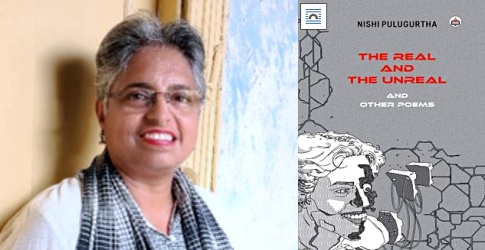
Nishi Pulugurtha in Conversation with Shouvik Narayan Hore
Nishi Pulugurtha is an academic, author, poet and occasional translator. Her publications include a collection of travel essays, Out in the Open; an edited volume of essays on travel, Across and Beyond; three volumes of poems, The Real and the Unreal and Other Poems, Raindrops on the Periwinkle (Writers Workshop, Kolkata), Looking (Red River 2023); a co-edited volume of poems Voices and Vision: The First IPPL Anthology; a collection of short stories, The Window Sill; and an edited volume of critical essays, Literary Representations of Pandemics, Epidemics and Pestilence (Routledge, 2023). Her recent book is a volume of essays written during the pandemic, Lockdown Times. She is now a Writer in Residence at Samyukta Research Foundation, Thiruvananthapuram. She is the Secretary of the Intercultural Poetry and Performance Library, Kolkata and is a member of the Advisory Board, Alzheimer’s and Related Disorders Society of India, Calcutta Chapter.
Here Shouvik Narayan Hore converses with her to get her perspectives regarding her poetry.
Shouvik Narayan Hore (SNH): Let us begin with the recently-concluded festivities around Durga Puja this year, and your narration of its arrival and departure through ‘Time for the Goddess’, ‘Goddesses Around’ and ‘We Worship the Goddess’ in the first section of Looking. The mood and tone of your verse oscillates from an optimistic hopefulness to an ambience of moral defeat; from the worshippers who “Strangle her, brand her, curse her” (22) to “Let us pray to the Goddess” (22). Explain this paradox to our readers. How has Bengali culture influenced you on how to look at the Deity when we pray?
Nishi Pulugurtha (NP): I find it a paradox that in a country where we worship the Goddess, we leave no opportunity to mistreat, illtreat, abuse, gaslight, or threaten women. Hence, I voice that in the poems that you refer to.
I have grown up in Kolkata and the culture here is what has been a major influence on me. I look forward to this time of the year, like everyone in Bengal. While the crowds put me off, yet the celebration, the festivities, and the joy, draw me in. They are a part and parcel of my being. Durga coming to her parents with all her children is what Durga Puja is for me. I do not believe in rituals, etc. Prayer to me is something very personal.
SNH: The Covid 19 Pandemic, whose impact on the Indian population has been catastrophic, has been explored in your published anthology of essays, entitled Literary Representations of Pandemics, Epidemics and Pestilence (Routledge, 2023). In Looking, especially in ‘When Sniffles Scare’. ‘The Mask is Always There’ and ‘A Different Time, a Quarantine’, you have no illusions that “It [the mask] was always there.” (70). Would you argue that the Poet can oversee psycho-spiritual anxiety preceding its medical counterpart?
NP: I suppose as a poet I react to what I see happening around me. Forced to wear a physical mask during Covid times, a mask that stifled, yet one that we had to wear, I was brought face to face with the idea of masks that we find people around us wearing, masks that hide, masks that deceive, masks that cause so much pain. The literal mask and the metaphorical one coming together is something that came to the fore even more forcefully during pandemic times.
Working on that volume of critical essays that you refer to made me also understand how the human reaction to pandemics in the past had been much the same. The fear, the mistrust, and the seclusion were all there. It all came back during Covid times. Times of great loss, times that made me wonder about human life.
SNH: The Jallianwala Bagh massacre was a dark day in Indian Colonial history. But you have, very subtly, argued how the ‘then’ and ‘now’ of history overlap, to the extent that the Colonial and the Postcolonial are not historical landmarks, but pedagogical dark alleys, often amoral, often ahistorical. While you assert in ‘Jallianwala Bagh’ that “No lessons [were] learnt.” (36), would you, alongside W.H. Auden in ‘September 1, 1939’, warn readers that All we can look out for, is a warning voice?
NP: I wrote that poem in response to an invitation to be part of an anthology of poems that commemorated one hundred years of the Jallianwala Bagh incident. I remember visiting the place some years ago, the horrors of that event brought to the fore in the bullet marks still seen there, in the stories that one reads. Yes, history does overlap, at times strongly. I always seem to feel that the overlapping is always there. We fail to see it at times. As I see violence in the world around me, I feel we have not learnt anything. Yes, I think so, the warnings need to be paid heed to.
SNH: Food is a fundamental, conceptual ingredient in Looking; from the “many stories interwoven” (29) in ‘The Photograph of Sour Mangoes’ to the “memory of nostalgia” (41) of ‘Steaming White Idli’, to “a looking forward to life” (66) in ‘Green Chillies’, your verse traverses through the culinary reconstruction of the human self. How should we, the readers, look at these verse pieces as food for thought?
NP: You put that so well, “…verse traverses through the culinary reconstruction of the human self”. During the pandemic, food and memories were something that I had been posting about on FB, sharing recipes from my mother’s kitchen along with snippets of my growing up in Calcutta. However, food has been an important aspect of my world. I did write non-fiction essays on it a few years ago. The world of the Telugu person in Calcutta, negotiating both cultures and food being an important part of it. I am now working on a manuscript that brings these two together.
I am not sure how readers would react to my poems that bring in food and memory, but I would surely like to see what they make of them.
SNH: You are renowned in the field of Alzheimer's Activism, and the predicament surrounding the disintegration of loved ones when afflicted with it. In an article, entitled “Alzheimer’s and Amma”, you confess how “the habit of repeating”, which is congenital with poets, can transform into a medical fatality in no time. Themes around forgetting, or the forgettability of forgetting, retain their place in Looking – in ‘Ma in the Mirror’, ‘At the Bus Stop’ and especially ‘Time’, where “He says I forget all/I need to go home/To my mother.” (88). Would you agree that both creative and medical amnesia prepare us to look forward towards an evolving form of medical imagination?
NP: I began to write poems on Alzheimer’s Disease much later. I wrote essays on my caregiving experiences initially. Mosarrap Hossain Khan, the co-founder and editor of Café Dissensus had asked me to write on the subject, he felt that disease, etc is not something that we talk about.
When I first shared a poem that I wrote on the subject, I saw many people engaging with it. For a condition that has no cure, awareness is of most importance. I went on to write several poems on the condition. I wanted people to engage with it, and talk about it.
When I write poems on the condition, I am writing as someone who has seen a loved one deal with it. I am, at that point in time, reliving each moment. It is a painful process, but one that has been a part of my life for several years. I hope when people read them, they do make these connections, they do realize the condition about which I am writing. It is my poetry as activism.
SNH: In ‘What Do I Do’, one finds the despondent poet-figure reinforcing the subjective “I” numerous times, as if a force greater than itself, operating immediately outside the poem, is attempting to rupture its individuality. Similarly, a piece of wax, in ‘Warmth’, evolves into more than a crafted artefact “in anxious times” (68), as if the Universe around is more a perspective, than a thing – not so much an unrealizable ideal, but nothing more than a healing crystal. Is Looking, seen that way, presented to readers as an anthology on healing?
NP: Looking is about life and its various nuances. I would wait and want to hear readers react to it, just the way I notice you do here in your question.
SNH: We end where we began. We have looked before and after Looking, but looking beyond Looking is a secret, almost philosophical casket, hidden with you! Tell us briefly about your upcoming projects, and the themes/ideas that the reader should look forward to, in the near and far future.
NP: I am now working on my fourth volume of poems. It too, will be about life. I am also working, as I noted earlier, on a volume that brings together recipes from my mother’s kitchen with memories of growing up in Kolkata (Calcutta). Food and memory, and cultural history are seen from a very personal space.
Works Cited:
Pulugurtha, Nishi. Looking. Red River, 2023.
---. “Alzheimer’s and Amma.” Café Dissensus, 2017, https://cafedissensus.com/2017/09/16/alzheimers-and-amma/. Accessed 25 October 2023.
*****
TALES HEARD
--Nishi Pulugurtha
Green, blue, faded window slats,
broken here and there —
the windows tell tales.
Hanging in places bricks show,
the masonry reveals tales to be heard.
Iron railings rusted
trying to hold on with patterns that weave
stories known and unknown that strikes the eye
remain as I move away
to look back.
The serpentine lanes where the buildings fall onto one another
holding on as they have been for years,
that I walked down
one morning, was speaking, this time loud and clear.
I heard them all
this time.

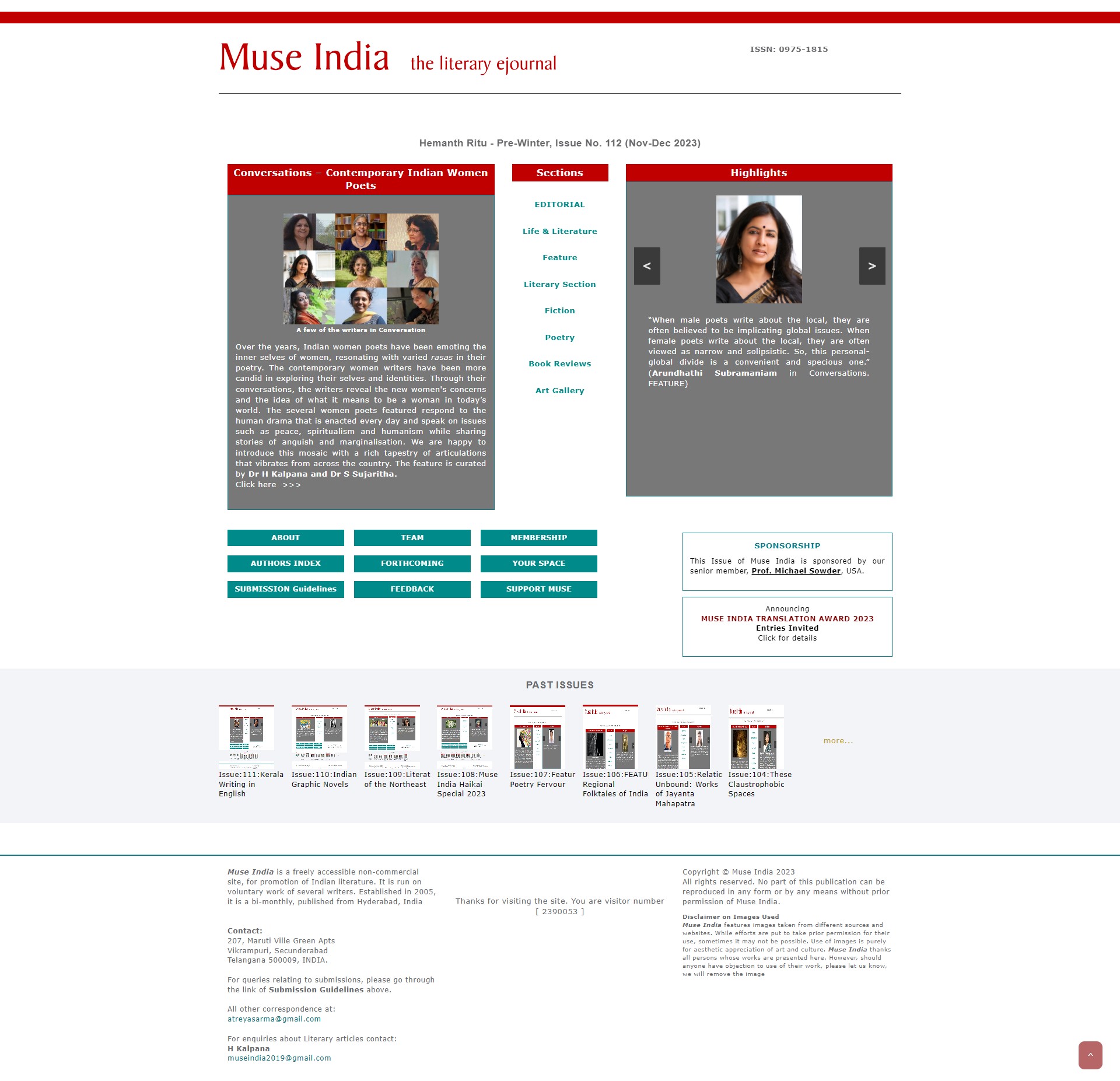
Issue 112 (Nov-Dec 2023)
-
EDITORIAL
- H Kalpana Rao and S Sujaritha: Editorial
-
CONVERSATIONS WITH POETS/WRITERS
- Aditi Rao - “Constraint is not the opposite of art making”
- Aleena – “My Politics will reflect in my Poetry”
- Amrita Bhattacharyya - “My idea of the new woman is that she has agency”
- Anagha J Kolath - “Poetry is like solving a puzzle”
- Arundhathi Subramaniam - Feminism as a “Journey of Self-discovery”
- Arya Gopi - “Emotions Know No Language”
- Hannah Lalhlanpuii - Voices of protest, narratives of resistance
- Jameela Nishat - “My subjects are the women around me”
- Jhilam Chattaraj - “Writing to me is a connection ”
- Kalyani Thakur Charal - “I Write for Life’s Sake”
- Kashiana Singh - “Discipline, Dialogue and Dedication”
- Mahima Kaur - Interrogating Margins and Marginalisation
- Malashri Lal - “Fragmented Identity and Mandalas”
- Namratha Varadarajan - “Math to Poetry”
- Nishi Pulugurtha - “Looking before and after”
- Pramila Venkateswaran - “Writing is one way to immortalize experiences”
- Pritidhara Samal - “As long as the human heart is excited, poetry will live”
- Ranu Uniyal - “Poetry is about survival”
- Rita Nath Keshari - Her Chiaroscuro World
- Sakthi Jothi - Poetry of Ecology and Environment
- Sanjukta Dasgupta - “Signature poems that represent me as a poet”
- Sharanya Manivannan - “My words are but the blossoms on the twigs of the mother-tree of hers”
- Sukrita Paul Kumar – “Poetry was a kind of a dialogue with myself”
- Swarna Jyoti - “Poetry is my friend, my companion and confidante”
- V M Girija - Vocalizing Verses