Aswin Vijayan
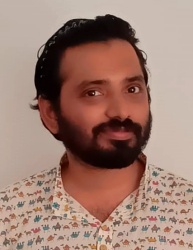
Why do I write in English?
English has been an essential part of my life growing up. Though I was brought up in a largely monolingual household, where Malayalam was the only language used in everyday conversation, I learned to read in both languages simultaneously. And for the first eighteen years of my life, English largely remained the language of books, education, and writing. Writing in English was for the classroom and occasional diary entries. Once I entered college, English became the axis of my everyday life. It occupied the centre stage in all conversations—personal, academic, and creative. This was also the point in my life when I began venturing into the world of Anglophone poetry in India with critical and creative curiosity. For my Master’s project, I read extensively about the debates on the use of English as the language for creative writing in the context of post-independence India. This was also the time when I began to consider writing English poetry as a serious pursuit. It was fascinating to consider something that had not occurred to me up to that point. Yet, as a poet, I have never had to justify my choice of writing in English. As many have pointed out before, English has become the language of our lived experience. And it felt natural to write in it. Malayalam has always been there as a possibility and it continues to remain just that.
I do not contemplate much about why I write in English. Rather, I obsess about how and why the writing itself happens and how can I improve upon what I already am doing. I wish I could simply say that I write from a place of compulsion. I do not. I have found that life goes on without much hassle even if I do not write a poem for a whole year. In the tradition of Anglophone poetry, the examples of poets who gradually ceased writing altogether are not too rare. This can be due to a lack of reward or recognition. It can be daunting to think that you may not even be read by anyone ever. In this context, it is a very deliberate choice to capture certain aspects of my experience, certain facets of my emotional existence, and commit it to writing. I continue to make that choice. And I do so in English.
Why do I make that choice? Because there is pleasure derived from it. There is community, and there is relief. I have been fortunate to not be isolated in this pursuit. There have been many workshops, clandestine meetings, poetry readings, and countless peers and mentors who have made sure that I have a supportive community around me. This community has not only been supportive but also crucial and critical in forcing me to be better.
I have developed a desire to craft my poems and do it better than I did the previous time. I approach a new poem and the blank sheet as a craftsman approaching fresh wood. I visualize what I want it to be and I keep at it. Chipping, sawing, polishing, glueing. And English has been my raw material and my trustworthy tool. I will continue to shape it in the way I feel captures how I see the world. And I will keep hoping that it resonates with someone, somewhere, at some point. And I dedicate all my effort to making the process as enjoyable to my reader as it is to me.
WRITINGS
POEMS
1. ON LISTENING
after Aracelis Girmay
I share this hour with you,
eating chicken bits
rolled in pita bread.
We listen to the echo
of a birdcall in the wailing
of an ambulance passing by.
The hours are slow
and like boomerangs
end up where they began.
Nobody rang the doorbell
at ten. A wind carries
through the open door
the low bark of a shih tzu
and the monsoon moisture
mopped up by the drying clothes
on the balcony. The noise
of a road roller levelling the gravel
grates against our softened flesh.
There is so much news
we haven’t heard yet.
We remain filled with gratitude
for all the lives
we are still left
to live with.
2. ORIGAMI 6-FOLD HEART
You attend origami classes, folding paper.
What you hate now
is the paper’s need to be filled with scribbles.
It is already too late
for you to hide
from the claustrophobic contents
of the school syllabi. Yet you can’t be contained
as you build castles from paper
and stories on thin air. You seem to hide
words under your skin. Now, now!
Where did that come from? elated,
we ask each other. You scribble
what you will. These scribbles
grow, unrestrained and uncontained
by the borders of your black slate,
notebooks, and scraps of paper.
From every scratch, a story grows.
The fox, scared, hides
from the lion. Then, trying to save its hide
finds itself a scribble
on a yellowed page. It is now
and here that he is content,
I think. You fold more paper
and find in it, pure delight.
Some days, late at night
you insist we play hide-
and-go-seek. Your voice, papery,
whispers ready or not in a babble
as I try to contain
myself in my assigned hiding cove.
Once I’m found, I will sit now
and write all this down before it’s too late.
Each word I write will contain
this moment, this joy. Hidden
away somewhere, these pieces of paper
will yellow carrying my scribbles.
When you hold this paper, encounter these scribblings
later, maybe when I’m hidden from sight,
you’ll find in its contents all that I ever want you to know.
3. EGG
“I am Egg” —John Oliver
I’m what happens
inside an egg,
the translucent shell
letting in only light
enough to know
night from day.
There’s no delay
no deadline. Just
the occasional rocking
that lulls me
to sleep.
I miss those who are gone:
distance, difference, death.
I miss more than I let on.
4. PREVENTING LOSS
After we sit down on a flat rock
on the beach just after sunset,
the breeze warm, boats bobbing,
and the crowd bustling in
and out of the cafeteria,
the park and the restrooms,
we see two pairs of slippers
being washed away by a receding
wave, followed by a man—
barefoot, a green cap on his head,
white tee, navy blue trousers
rolled up to his knees—rushing
gathering them one, two,
a stretch and three, (some effort
as the wave pushes the runaway
to a side) and four.
Triumphant, the man turns his back
to the waves, and reveals the bold
orange type on his tee— GAME OVER


Issue 111 (Sep-Oct 2023)
-
EDITORIAL
- Syam Sudhakar: Kerala Writing in English – Editorial Reflections
-
LEAD ARTICLE
- S Suthara and Syam Sudhakar: Kerala Renaissance and English Writers - An Overview
-
WRITINGS
- Aditya Shankar
- Anees Salim
- Anita Nair
- Anupama Raju
- Ardra Manasi
- Arya Gopi
- Aswin Vijayan
- Babitha Justin
- Binu Karunakaran
- C P Surendran
- Chandramohan S
- E V Ramakrishnan
- Gopi Kottoor
- Jaya Anitha Abraham
- Jayakrishnan Vallapuzha
- Jeet Thayil
- Meenakshi Sajeev
- Meera Nair
- Rahana K Ismail
- Santosh Alex
- Shashi Tharoor
- Shinie Antony
- Shivshankar Menon
- Soni Somarajan
- Sridevi Ramanunni
- Syam Sudhakar
- Vijay Nair
- Zainab Ummer Farook
-
YOUNG VOICES
- Amal Mathew
- Noureen K Ajmal
- Soumya