Naga Rajya Lakshmi Veluvolu (Trans. Atreya Sarma U)
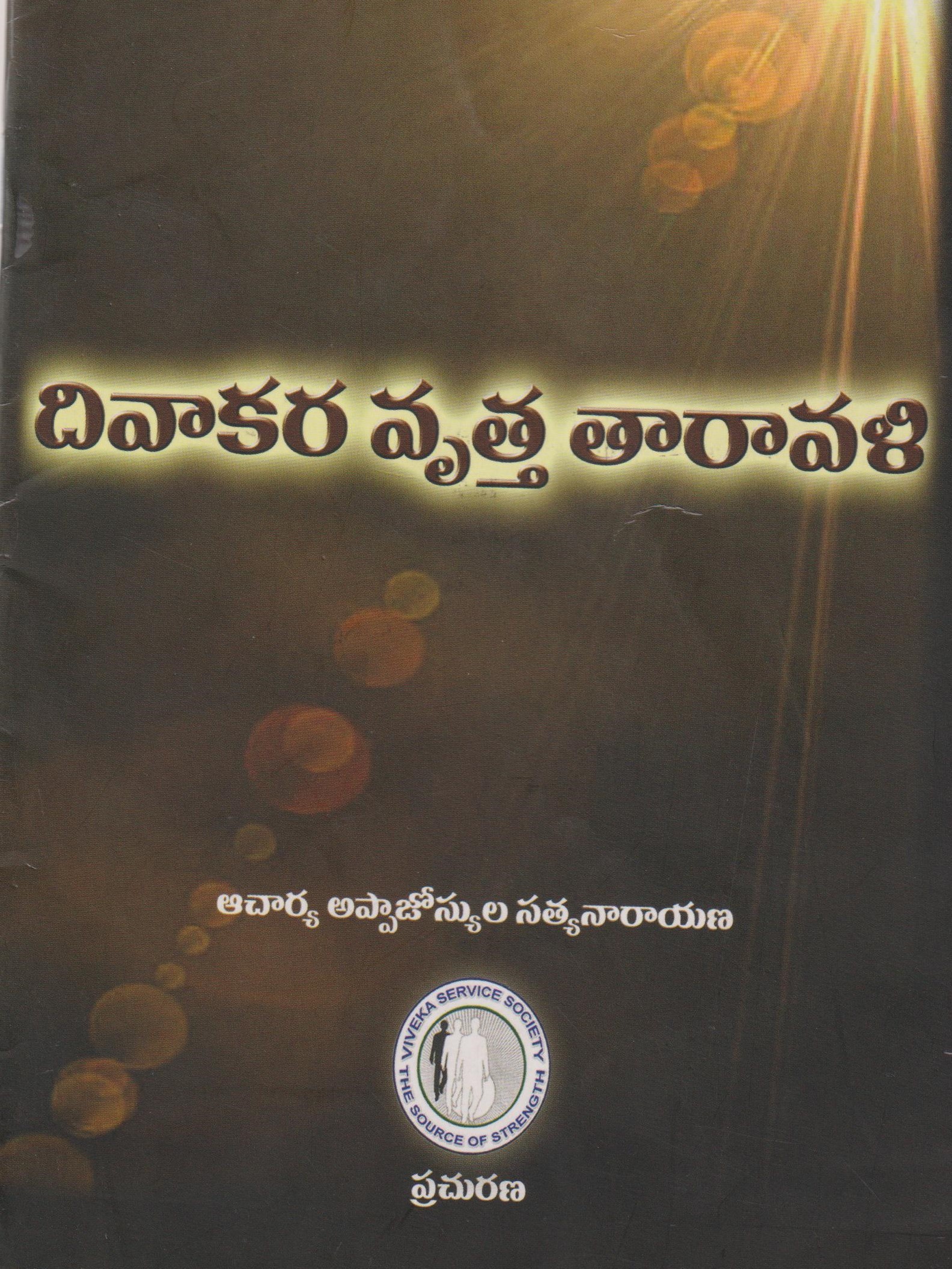
Divakara Vritta Taravali |
A Telugu Poetic Composition in praise of the Sun God |
Prof Appajosyula Satyanarayana |
Viveka Service Society, Bapatla | 2020 |
pp 40 | ₹ 250 / US$ 0.90
Review translated from Telugu by: Atreya Sarma U
About the book’s author:
Prof Appajosyula Satyanarayana was a Professor Emeritus in the Computer Science Department in Stevens Institute of Technology in Hoboken, New Jersey, USA. A computer scientist & researcher, he has published 32 research papers, and they have been quoted by over 1,100 researchers. Equally well-versed in and passionate about ancient Indian/Telugu literature & literature, he has authored several books in Telugu. He is the co-founder of the famous Ajo-Vibho-Kandalam Foundation, established in the USA in 1993. The foundation is into sterling service of Telugu literature & culture – by instituting prestigious annual awards in the field of literature, theatre, medicine & health, and social service. It also conducts theatrical contests every year. The foundation is also into publication by supplying its books at a very fair price through its unit AVKF Book Link. Voluntarily retiring after a career of 40 years in the USA, Prof Appajosyula is now totally devoted to the cause of Telugu literature & culture.
Let’s salute the repository of infinite solar refulgence
The Sun, the sustainer of life and the source o45f energy and universal knowledge, is the visible God to the entire animate world. The Vedas, the Upanishads, the Puranas, the epics and the poetic texts have sung paeans about Him. The ancient sages worshipped the orb of Sun like God and attained enlightenment. By meditating on and worshipping the Sun God, Sri Rama achieved a glorious victory; Dharma Raja was graced with an Akshaya Patra – a receptacle of inexhaustible supply of food; Hanuman became master of all subjects; Satrajit was blessed with Samantaka Mani – a wish-fulfilling gem; Draupadi was rescued from the lustful clutches of Keechaka; Mayura got rid of leprosy. In the perennial Indic culture, every meditation, invocation, and religious rite were intertwined with heliolatry.
Renowned scientist Prof Appajosyula Satyanarayana has – in his poetic text Divakara Vritta Taravali – unveiled the form, properties, qualities, spiritual essence and energising power of the Sun.
This poetic treatise, decked in metres like Utpala Mala, Champaka-Mala, Sardulam and Mattebham is a triune blend of the spiritual, the philosophical and the scientific – heartily providing both scientific wisdom and aesthetic fulfilment.
The theme of this work is sublime. The picturisation of the solar essence is suffused with poetic creativity that it flows in layers and layers of rays. In astronomy, the twenty-seven stars like Ashwini and Bharani occupy an important place in determining the weal and woe of the living beings. The tradition of having the number 27 associated with the hymn of the Divine has been coming down since yore.
Alankara Sangraha, a work of Sanskrit poetics, says that a poetic work composed with 27 poems is called Taravali, a garland of stars (which are 27 in number). Divakara Vritta Taravali is a work that presents the methods of sun-worship in a chain of 27 metres.
Prof Appajosyula Satyanarayana, is essentially a worshipper of Nature and a seeker of the purpose of human existence. In the very opening poem of the book, he specifies his two objects of worship – Mother Nature full of life; and the ever-shining universal witness of things that is the Sun.
The universe is dynamic and evolutionary and its soul is the Sun. Every living being is born and flourishes only because of the Sun. The Sun is the architect of the entire creation, and his illumination is the wisdom or enlightenment.
The poet has, in the first stanza, prayed that the object of his meditation (Upasana) should be wisdom or enlightenment. Upasana means sitting nearby; and it is a three-stage process where the devotee first prays to the Almighty from a distance; then meditates upon Him with a feeling that The Almighty (Brahman) is lying within oneself; and finally realises that the Almighty has pervaded his own form. Upasana is an exercise to reach the Brahman from His personalised form (sakara) to His impersonal or non-physical form (nirakara). The Sun is a visible God. The meditation upon the visible God gradually leads to the realisation of the wisdom about non-physical Brahman. The poet aims at such a focused meditation.
The Almighty is an embodiment of radiant energy. The Sun – who with His radiance, graces the mankind with the energising light and enlightenment, and is the direct source of sustenance of life – is the Almighty Himself. He is an all-pervading soul and is omnipresent. That’s why the Sun is worshipped as Surya Narayana, by invoking Him through the following Sloka from Brihat Parasara Smriti –
dhyaeyassadaa savitRmanDala madhyavartee
naaraayaNa ssarasijaasana sannivishTa@h
kaeyuuravaan makara kunDalavaan kireeTee
haaree hiraNmayavapu@h dhRta Sankha chakra@h
(Syllabification of the above Sloka as well as some other terms in this review is as per Lekhini.org)
This Narayana who is meditated upon is always in the centre of the solar orb; seated in the lotus posture; wears epaulets, ear-rings in the shape of a crocodile’s head, crown and necklace; has a golden complexion; and holds conch and discus.
The Sun God is worshipped as the Almighty in every Vedic ritual aimed at seeking fulfilment of wishes.
In the sacrificial fire that is the space, the Sun offers Himself as the firewood and keeps ablaze. Stimulated by that radiating heat, the oceanic waters on the earth volunteer themselves as oblation and transform into the clouds. The clouds shower down as rain. The rain turns the earth lively green. Food is thereby produced and it sustains the lives of the living beings. The human, a part of the living beings, becomes dynamic and able to lead his life. He also contributes to the societal development. And the source of all this chemistry is the Solar Almighty who has been performing His duty, relentlessly and tirelessly for billions of years.
This Sun is the source and the supremo of all this light and energy. He is the doorway for the East by driving away the dense darkness and irradiating the light all over. The Sun drinks in daily the non-potable waters of the oceans, turns them into rainbearing clouds, and the clouds deck Mother Earth with the clothes of crops, plants and trees. May such a Sun God – the prime mover of the rain – shower every blessing and prosperity on the living kingdom! So the poet, in his second stanza, invokes the Sun God who is the repository of all light and energy,.
It’s only because of the beaming affection of the Sun God that each and every particle of the earth is alive with living force. But for the solar energy, neither the plant kingdom nor the physical objects like mountans, dales and rivers can exist.
The Sun is a universal God for he is a synthesis of both Shiva and Vishnu, says the poet Appajosyula. The Sun spreads his rays all over the universe, so He is omnipresent like Vishnu. Vishnu means one who is omnipresent and it is also one of the many names of the Sun (Stanza 6). The Sun showers bounties of health, welfare, prospertiy; so He is Shiva too.
Madhava or Vishnu loves adornment. Shiva or Maheswara loves ablution. Martanda or Surya loves obeisance. That’s why, according to the Vedas and the Puranas, the salutations to the Sun (Surya namaskaras) constitute in themselves the meditation or worship of Surya. Whoever does the Surya namaskaras with devotion, earnestness and regularity, they will be blessed with physical and mental health by Him. If it’s a spiritual prayer, Aditya – the Sun God – will grant them moksha (liberation from the cycle of births & deaths). If the litany is for wisdom and enlightenment, Bhaskara – the Sun God – will bestow them with the same (Stanza 7).
Every organ in the human body senses the presence of Divakara, the maker of the day. The eye witnesses the solar orb. The ear receives sonorous signals through the rays of the sun. The nose, touched by the sunbeams, smells the fragrance of the blossoms. The tongue tastes the food readied by the Sun. The body experiences the warmth of the Sun. The inner mind is filled with wisdom and enlightenment, thanks to the divine radiance of Divkara. The Sun is a reflection of all the five basic elements – touch, hearing, sight, taste and smell. ‘Aditya vai sparsha shabda rupa rasa gandhah,’ says the Surya Upanishat.
The poet, in Stanza 8, compares the outspread of the solar rays to the pitches (swaras) of the chanting of the Vedic mantras. As the guru teaches the chanting of the Vedic mantras by articulating them himself, the disciples learn it by repeating them in the same fashion. In the dawn, the rise of the Sun from the middle of the ocean together with the spreading out of His rays upward in a series, is fascinating scene of Nature. This upward rise of the rays is compared to the acute pitch (udatta swara) of Vedic chanting. Udaatta is a lofty pitch. Around the noon time, the rays beam down, and their path is compared to the grave accent (anudatta swara). Anudatta is a low, base or mild pitch. In the evenfall when the Sun begins to set, by going down, the rays radiate both downwards as well as upwards. And this dual traversal of the solar beams is compared to the circumflex pitch (swarita swara), a combination of both the udatta and the anudatta. This is a beautiful poetic analogy. The rays of the Sun are sacred like the Vedic hymns. The matutinal solar radiatioin is conducive to the health and acivity of the living beings. That’s why, the poet calls the morning subeams lofty or noble (udaatta). Since the noontime sunrays are scorching, he calls them the oppositive way – not udaatta, i.e., anudatta.
Ravi is another word for the Sun; and Ravi comes out of the root ‘ru’. Ravi is one who has ‘ravam’ – voice. That’s why the poet’s addressing of the Sun as ‘Ravi’ in Stanza 8 is but appropriate, since he sees the chants of the Vedic hymns in the emission of the solar rays. This stanza is a standing testimony to the philosophy, beauty of Nature, cultural distinction, and devotional intensity weaving around the Sun.
Now let’s enjoy Stanza 9, which too unveils the ubiquitous reach of the Sun. Prabhakara (one who brightens up) – synonymous with the Sun – dabs the flowers that are about to bloom in the dawn with variegated hues, and renders them fragrant, thereby beautifying Mother Nature. It’s only the Supreme Solar God that instils life not only in the minutest seeds but also in the mountain-mighty giant trees.
The Sun transfers a part of his energy to the Fire, and the Fire becomes visible to us in various shades of flames. ‘viSwarupam ghRNinam jaata vaedasam (The omnipresent one with His rays in the form of the Fire),’ says the Akshi Upanishat. It’s only the Sun God that presents colours and sounds in the form of the Fire, say the Vedic hymns. It’s only the sunlight that festoons the sky with the rainbow. And the poet addresses the Sun God as veeti hotra, referring to His varied effulgence. The Sun God is called by various names like Sasvata purusha (the eternal man), sanatana (the incessant one), ananta-atma (the one with infinite soul), viswatma (the one with universal soul), viswato-mukha (the omnipresent) and chara-achara-atma (the one with his soul pervading the animate and the inanimate) – signifying the primordial divinity of Surya. And appellations like Adi Deva (the Original God) and Pitamaha (the Primordial Father) denote that Surya himself is Brahma, the Creator of the universe.
Stanza 12 states that Surya is the friend and benefactor of the entire living organisms. He is the one who controls the passage of time. The flora that He nurtures are an ecstatic banner singing the glory of Mother Earth. The delicious fruits suffused with the kindness of Ahaskara – the creator of the day – promote the welfare and progress of the living beings.
The gem of the welkin that the Sun is, He coneys a divine message through his movements. It is a message of universql equality, universal welfare, altruism and disinterested duty mindedness. Bhanu, the Sun God, is the only motivational trainer of the universe. These ideas embedded in Stanza 13, make us recall the egalitarian song of Annamacharya which says that it’s the same sunlight that plays on the back of the elephant as well as on a dog.
The Sun God is the source and architect of the lives of all the living beings, says Appajosyula, in his stanza composed in the champaka-mala metre. This stanza is also an example of the meditational splendour ensconced wtihin the poet’s heart. ‘O Divakara, the God that ushers in the Day! Thou art the source of assurance and security underlying the cosmic phases of the cyclical Creation, Operation, and Dissolution! Thou art the omnipresent God of illumination and enlightenment! Thou art the Director of the fates of the living beings in their journey in the eternal cycle of time! The six processes of birth; growth; development; maturity & discharge of one’s duties; aging; and dying & facing the divine judgment & pangs of rebirth – happen according to the rules of thy governance!’ (Stanza 18)
The Sun is none else than Sriman-Narayana staying in the centre of the solar orb; and the entire animate and inanimate world exists and evolves, only according to His dictates. The lifespans differ from category to category, from species to species, from individual to individual. Some of them are short-lived, some of them have a long life. It all depends upon the solar will and beams.
Every living being is guided by six essential basic characteristics – birth, existence, growth & development, transformation, decay, and death, according to the Surya Upanishat. These characteristics are embedded as vocal notes in the seminal stage and they continue in full measure even in the full-fledged form that comes out of it, and also in the Supreme Being, that is the Sun, who is meditated upon as the Almighty by the spiritual seekers. The vocal notes are luminous as well as sonorous.
But for the boon of solar light, Homo sapiens is bewildered by the otherwise terrestrial gloom and is made to helplessly grope for the topographical ups and downs and the directional starting points and destinations. Thanks to the presence of the solar phenomenon and the sunrise and the sunset, man has been able to designate the sunrise point as the east, and accordingly the other directions and sub-directions. And goes the Vedic chant, DiSaancha patayae nama@h (Obeisance to the Lord of the Directions).
The sunup is not only an aesthetic delight but also the infinite source of energy. And this auroral glory and significance has been so exquisitely captured by the poet Appajosyula in an elegant idiomatic Telugu, in Stanza 19, that it needs to be quoted –
| Stanza in Telugu script | 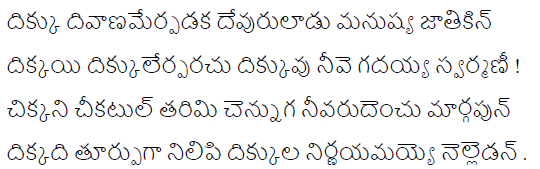 |
| English transliteration (a la Lekhini.org) |
dikku divaaNamaerpaDaka daevurulaaDu manushya jaatikin
dikkayi dikkulaerparachu dikkuvu neeve gadayya swarmaNee! chikkani cheekaTul tarimi chennuga neevarudenchu maargapun dikkadi toorpugaa nilipi dikkula nirNayamayye nelleDan. |
Every plant that grows on the earth, right from the moss to the giant trees, is sustained by the vivifying rays of the Sun. What happens to the Earth sans the existence of the solar phenomenon, asks the poet in Stanza 20. If there is no Sun, then there is nothing else in the cosmos.
Even the common people sing folk songs in praise of the Sun God, like ‘Sri Surya Narayana, maelukoe, Hari Surya Narayana’ (O Lord, Surya Narayana, Hari Surya Narayana! Wake up!). The lyrics of this song, relate the various positions of the Sun during His path in a day – not only to the colours and hues of various flowers – mastwood (ponna), bullet wood (pogada), onion (ulli), haldu (kamba), bitter gourd (kakara), royal jasmine (jaji), champaka (sampangi), jasmine (malle), scarlet mallow (mankena), drumstick (mulaga), mustard (ava), brinjal (vanga), pumpkin (gummadi) and saffron (kunkuma) – but also to the colours and hues of pearl, glass and diamond powder.
The Almighty that is described in the Vedas and other scriptures is formless, and even the mind’s eye can’t visualise such a God. But Aditya, the Sun God, is visible to the naked eye and is felt by the eyes of the skin. And He is hailed as the Supreme Being by various genres of literture and scriptures.
Aditya, the Sun God, is the blend of the Brahma-Vishnu-Shiva trinity. The kind and empathic Sun God has divided day and night, himself enlightening the universe during the day time, and in the night time transferring his radiance onto the Moon to grace the universe with the cool moonlight. The poet Appajoysyula captures this dual aspect of the Sun in a hearteningly witty manner in Stanza 5 composed in the champaka-mala meter, and it translates as –
‘O Bhaskara (the God that spreads radiance)! You seem to have felt sorry for the inert Moon. Keen on enlivening Him, you have divided the time into day and night, with Yourself being in-charge of the day. And you have superimposed your brilliance onto the Moon, invested Him with sixteen facets of light, and empowered Him as the Master of the Night.’
This poetic work of Divakara Vritta Taravali has, in a marvellous and figurative style, unveiled the infinite affluence of the solar effulgence and the splendid glory and altruism of the Sun God; echoed the distinction of the perennial fount of the ancient Indian dharma; displayed before the eye the inherent nature of Mother Nature; and lighted the Celestial Diadem on the pedestals in the hearts of the people. The poetic composition by Prof Appajosyula Satyanarayana has authoritatively proved that the entire life – of humans, plants and animals – on this earth owes its existence, health and prosperity to the Supreme Lord of Light and Energy. The light in all our eyes is only due to this wondrous God of Brilliance & Vitality. And the poet concludes on an auspicious note that only the meditation on and devotion to the Solar Power would be the elixir of our existence and lives. Taking cue from the poet, let’s all bow in grateful obeisance to the Almighty of Infinite Solar, and thereby be the beneficiaries of the accruing all-round prosperity.

Issue 101 (Jan-Feb 2022)
-
Preliminary
- Atreya Sarma U: Editorial Meditations
-
Articles: General
- N Ananta Lakshmi: Bhakti Literature in Telugu – Keynote article
- Syamala Devi Dittakavi (Trans. Elanaaga): Madhura Bhakti – An Analysis
-
Articles: On Devotees & Saint Composers
- Ambika Ananth: Saint-Poet Sri Yogi Nareyna of Kaiwara and the Beauty of his Compositions
- Dinakar Palakurthy: Ramadasu Keertanas – An Intense Supplication of a Distressed Devotee to His Dearest Deity
- Mukunda Rama Rao (Trans. Atreya Sarma U): Kanaka Dasa
- Mukunda Rama Rao (Trans. Nagaraju Ramaswamy & Atreya Sarma U): Femineity in Andal’s Divine Love
- Nagaraju Ramaswamy: Devotionalism in Kalyana Goda – The Goddess of Celestial Love
- NS Murty: Nallan Chakravartula Krishnamacharyulu – The Poet Composer
- NS Murty: Ramadasu – A Synonym for Bhadrachalam
- NS Murty: Saint Composer Annamacharya
- Ravichandran Kampalle (Trans. Atreya Sarma U): Goda Devi’s Madhura Bhakti – Mellifluent Devotion
- Srikrishna Bhamidipati (Trans. NS Murty): The Lyrics of Tyagaraja
-
Articles: On Devotional Poetry
- R R Gandikota: Potana’s Bhagavata – Pinnacle of Devotional Literature in Telugu
- Satyavathi Kavuri (Trans. NS Murty): The Savour of Bhakti in Telugu Satakams
-
Articles: On Harikatha & Its Exponents
- NS Murty: Adibhatla Narayana Dasu…the Samson and the Solomon in one
- NS Murty: Chandala Kesava Dasu – Harikatha Pioneer of Telangana
- NS Murty:Harikatha, the One-man Theatre
- Sharada Sivapurapu: Women Saints and Bhagavatarinis
-
Articles: On Contemporary Writers, Exponents & Media
- Itha Chandraiah (Trans. Atreya Sarma U & Padmavathi Setaluri): Devotional Literature in the Media
- Kameshwari Ayyagari & Atreya Sarma U: Contemporary Saints in Telugu Land
- Kameshwari Ayyagari & Atreya Sarma U: Present-day Exponents of Bhakti Literature in Telugu Land
- Varukolu Laxmaiah (Trans. Atreya Sarma U): Devotional Novels of Itha Chandraiah
- Venkateswarulu Veepuri (Trans. Nagaraju Ramaswamy & Atreya Sarma U): Dr Asavadi Prakasa Rao’s Contribution to Bhakti Literature
-
Articles: On Children & Bhakti
- Dr Siri (Trans. Atreya Sarma U): A lassie’s doubts about God, bhakti et al...
-
Poetry
- R R Gandikota: The Benevolence of the proud Bali, as in Potana’s Bhagavata
- R R Gandikota:Liberating the Elephant Lord, as in Potana’s Bhagavata
-
Classical Lyrics
- Kancharla Gopanna ‘Ramadasu’ (Trans. Atreya Sarma U):Three Lyrics addressed to Lord Rama
-
Film Lyrics
- ‘Sirivennela’ Seetharama Sastry (Trans. Atreya Sarma U): What to beg of the primeval mendicant?
-
Hai, Gouri mistress! Who’s your hubby?
Kosaraju Raghavaiah Chowdary(Trans. Atreya Sarma U) -
Why go to school? Better go to temple…
Kosaraju Raghavaiah Chowdary (Trans. Atreya Sarma U):
-
Book Reviews
- Atreya Sarma U: ‘Andhra Yogulu’ – The 7-Volume Set by B Rama Raju
- Atreya Sarma U: Novel on Adi Shankara ‘Kailasam nundi Kailasam daakaa’ by Syamala Devi Dittakavi
- Dinakar Palakurthy & Atreya Sarma U: ‘Forgotten Composers – Carnatic Music’ by Aruna Chandaraju
- Naga Rajya Lakshmi Veluvolu (Trans. Atreya Sarma U): ‘Divakara Vritta Taravali’ by Appajosyula Satyanarayana
- Suseela Adivi: ‘Adugaduguna Gudi Undi’ (Temple at every step) by Kasturi Raka Sudhakar Rao
-
FOLKSY LYRICS
- Tanikella Bharani (Trans. Atreya Sarma U) :‘Hats off to you, hey Shankara’ – Folksy lyrics
- Tanikella Bharani (Trans. Atreya Sarma U): ‘In me inheres Shiva’ – A folksy lyric