Jernail Singh Anand
Jernail Singh Anand
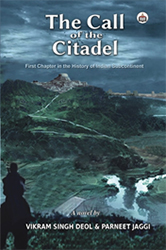
The Call of the Citadel: First Chapter in the History of Indian Subcontinent |
Fiction | Vikram Singh Deol & Parneet Jaggi |
Authors Press, 2020 | ISBN 978-93-89824-41-4 | pp 178 |  230
230
Revisiting the Glorious and Enigmatic Phase of Indian History
The Call of the Citadel is a historical novel offering an eclectic blend of history and fiction. Although the authors, in their disclaimer, clearly state that the work makes no claim to being a true account of the history of that period and place, but one author being a professor of History and the second a professor of English literature, together pioneer to revisit the enigmatic and much talked about phase of the Indian history – the Indus Valley Civilization with a meticulous detail and the eye of a historian. Historical novels written in English on this theme have been few. Writers of Urdu literature like Yawar Yaqoob who wrote Dilmun, and Mustansar Hussain Tarar who wrote Bahao have elaborated on this era, while in Indian writing in English, loose facts have been woven within the context of their stories by Amish Tripathi and Vineet Bajpai.
The novel looks more like an English movie opening in an ancient city. What impresses most is the research that has gone into the writing, the accuracy of detail, and the economy of expression. It shows how two disparate cultures, one of Mohan-toh-Daro that was advanced in farming and other skills, and the other culture of invaders, who were skilled in fighting and overpowering encounter each other.
The three murders in the very beginning set the tone for what follows thereafter. The novel begins with the reporting of these three murders, meeting at the majestic citadel of the city; and the search for the killers leads Chatur Das to disclosures that have far-reaching consequences.
As the story progresses, it displays minute and surprising facts and images of the life and culture of the Indus Valley Civilization. The rituals, food grains, city planning, water management, business transactions, seals and goods, administrative policies, security measures and a variety of other bits of information are imbibed inside the gripping tale. The new arrivers in the jungles near the city of Mohan-toh-Daro create an awe among the residents and the description is breathtaking:
They looked fair in colour, taller than us, carrying swords and a kind of armour made of animal skins. On a closer look, we saw two men and a woman looking like our residents. They were wearing just a loin cloth and were darker in colour. They were on foot, holding ropes that went round the necks of the cows. These cows were exactly the same breed we had chanced upon. The horsemen were shouting on them but they seemed to be too surprised and awe-struck to react. Moreover, they were talking in a language that had not been heard by any of us before.
The novel can be seen as a close parallel to what happened to India, once known as the golden sparrow. The people of Mohan-toh-Daro are rich in art and luxuries of life, but poor in martial arts, as a result of which they face unpredictable attacks. India has repeatedly lost its freedom and wealth to invaders, who established their rule with barbaric ruthlessness accompanied by conversions. Unprecedented events take place with the people of Mohan-toh-Daro, who are eventually taken prisoners. Weapons, says the novel, are necessary for living peacefully. This is a merciless equation, and an inescapable paradox that informs human civilization. The nomadic clan of Indro who invades the developed city, is on the move, looking for a safe settlement [the paradox is the highlight here]. Another ironic situation arises when residents like Peter Das feel that the city is now inadequate to sustain them, for trade is the soul of a society and water seemed to have been changing its course. On the other hand, Indro and his clan-mates find this place most suitable to sustain them for times to come. They plan to settle down.
Their swords were heavy with blood, blood that had seeped into the soil for their coming generations to grow crops.
The love story of Peter Das and Devika is entwined in the historic saga. Devika emerges as an empowered female of ancient India. The novel carries messages that are universal. I have yet to read a better description of love:
Love is so dramatic, I never knew. It makes you forget that you are alive. It also makes you forget that you have to die one day. It transforms you to fit into a different mould, where the self suddenly vanishes.
When people become self-centered, things start falling apart. Perhaps this is how the city falls, and this is how nations fall:
But now things were breaking down. The trader had suddenly become aware of the goods and earnings, the farmer and artisan were worried about their crops and utensils. The town’s jovial dancers were worried about their livelihood. Things were falling apart, faster than rain.
The novel presents the saga of survival in a miniscule form. This is how history marched ahead with its stony steps. This is how the fittest came to survive. The city falls because they cannot defend themselves against the aggressors. It is a pathetic scene when, instead of fighting the invaders, the entire city is trying to flee into forests. They suddenly get the realization that military was desperately needed solely for the purpose of defending the city, in the absence of which, all the progress of their ancestors had come to naught.
The novel moves with racy steps, exerts a powerful grip, and makes its place among the most powerful statements on human history as it follows history very closely. History can be made lively, has been proved by the pictorial depiction of this work.
Finally, it can be said that apart from the story, the telling of it in chaste English is also the highlight of this novel. Graphic details impart an imaginary habitation to the characters as well as the situations. The novel ends, leaving behind a plethora of mixed emotions for the vulnerable people of Mohan-toh-Daro, who have to pay a heavy price for ignoring the basic skill of living: weapons. The authors deserve appreciation for creating a work of exceptional power and eternal relevance to human thought.


Issue 93 (Sep-Oct 2020)
- Atreya Sarma U:‘Interviews with My “Dream Guests”’
- Gopal Lahiri:‘You’re the Mecca I never want to visit and other poems’
- Jernail Singh Anand:‘The Call of the Citadel – First Chapter in the History of Indian Subcontinent’
- Lakshmi Kannan:‘A Fistful of Sky – A Collection of Poems’
- Purabi Bhattacharya:‘The Museum of Broken Tea Cups – Postcards from India’s Margins’
- Sukanya Saha:‘Mandu – The Romance of Roopmati and Baz Bahadur’