Sunaina Jain
Sunaina Jain

"September is the month of maturity; the heaped basket and the garnered sheaf."
— Patience Strong
September is marked by a receding wave of monsoon downpours, major cultural celebrations like Krishna Janmashtami, Ganesh Chaturthi and Onam, and honouring the contributions of teachers through Teachers’ Day. It bridges heavy rains and pleasant autumn weather across the country. The transition to October is even more pleasing as this month is marked with pleasant festive breezes, cultural vibrance, and spiritual renewal across the subcontinent. Rabindra Nath Tagore reflected on the "transparent leisure of Aswin" (October) and the molten gold of its sunshine, which inspired his musical compositions and poetry.
A similar pulsating energy and luminous glow are reflected in the contemporary literary and cultural effervescence as we brace ourselves for the transitional months, leaving behind the scorching summers and the wet monsoons. The September-October Issue celebrates the bouquet of words as our reviewers display their critical engagement with literary works. With many contemporary voices that have carved smoke on the paper, harvested silence and turned it into an alchemy of reflections and existential thoughts, this issue carries reviews of poetry books steeped in kaleidoscopic themes. Additionally, our reviewers bring to us nuanced readings of a few fictional works, completing the mélange of creativity.
Anumula Sreedevi’s review celebrates Dr Ujjwala Kakarla’s When the Darkness Steals for its “remarkably unified vision” of hope, resilience, self-discovery, and healing, describing it as an “inclusive vision with quiet triumphs of the human spirit.” It highlights the poet’s emotional restraint, reflective simplicity, and recurring movement from “fragmentation to wholeness,” presenting the anthology as an invitation to rediscover strength, compassion, and beauty within ourselves.
U Atreya Sarma reviews a compelling bildungsroman, An Orphan on An Odyssey by Sasiprabha Manik Rao highlighting its empathetic storytelling, vivid characterization, and a sensitive portrayal of childhood adversity, while foregrounding resilience and the transformative power of education. Sarma particularly appreciates author’s poetic narration, psychological insight, and refusal to romanticise poverty, which lend the novel emotional depth and social relevance.
U Atreya Sarma’s writes another review of Manu S Kurup’s Tea and Tombs. The book is a poetic cartography of Hyderabad where history, heritage and lived memory continually intersect. With keen observation and evocative brevity, the poet juxtaposes the city’s glorious legacy against myopic urbanisation, ecological neglect and the erasure of invisible labour. Atreya Sarma particularly appreciates Kurup’s multilingual and multicultural sensibility, his perspicacious reflections on impermanence, and poet’s ability to discover philosophy in the commonplace. Ultimately, Tea and Tombs emerges as both an ode to Hyderabad and a gentle reminder that belonging is not inherited but earned and lived through years of attention and affection.
K Pankajam brings a perceptive and nuanced reading of Diffractions at Dawn by Dilip Mohapatra , tracing the collection’s exploration of fractured perceptions and metaphysical questioning, and eventually, moving towards illumination, acceptance, and stillness. It highlights Mohapatra’s distinctive ability to weave philosophical depth, contemporary concerns, introspection, and subtle humour into poetry that invites readers to look for wholesomeness in fragmented parts.
Kiran W Pathak’s review presents Rochelle Potkar’s The D’Costa Family as an “intensely interesting” saga where “humour and suspense go hand in hand.” Appreciating Rochelle Potkar’s control over a richly layered plot, memorable characters, and darkly comic twists, the review highlights the novel’s compelling interplay of family, greed, crime, revenge, and power.
Dr Madhulika Ghose’s review of Seema Jain’s poetry collection Your Silent Love captures its soul and essence by commenting on its eclectic themes. Ghose emphasises a vast array of themes, including the beauty of nature, war and violence, and mythology and folklore, and also brings to light the open-endedness of a few poems, giving readers ample food for thought.
Namrata Pathania reviews The Migrants and Other Poems by Vidya Hariharan, reading Mumbai as “a palimpsest – a city where successive histories, memories, and identities continually overwrite one another without completely erasing the past.”
Pushpa Subramanian’s reading of Morning Twilight by Jayshree Misra Tripathi presents it as a collection that “rests on the threshold between hope and despair, self-doubt and self-realisation, love and longing,” transforming personal memories into a journey “into our innermost selves.” The book’s key strengths lie in its personal recollections and its ability to dive into collective consciousness, moving from “a life in search of lost identity and a life in transition towards inner peace and redemption.”
Dr Rositta Joseph’s expansive reading of Dr Nishi Chawla’s Indigenized/Tribalized celebrates the remarkable breadth of a timely and relevant poetry collection, showing how Chawla transforms poetry into “history, politics, ecological studies, indigenous scholarship – all rolled into one.” The collection’s greatest strength lies in its “unbridled celebration of the tribal vision of life” and its powerful fusion of resistance, cultural memory and ecological consciousness.
Sindhoor Varkoor’s review presents Karuna: The Power of Compassion by the Nobel Laureate, Kailash Satyarthi, as a compelling blend of activist testimony and ethical inquiry, praising Satyarthi’s effort to transform compassion from a private virtue into a force for social change. It highlights the book’s evocative “hummingbird of compassion” and its provocative “globalisation of compassion,” while thoughtfully questioning the scientific claims behind the Compassion Quotient.
Snehaprava Das’s review of the poetry collection Days of Recovery by Nomita Kapoor is a perceptive and sensitive reading that sees the book as much more than a record of illness—as “a tale of survival” that gradually becomes “subtle, transformative, and something approximating a spiritual awakening.” The collection’s key strength lies in turning pain, uncertainty and vulnerability into “a new way to live again,” making recovery a journey of self-discovery and renewed hope, reminiscent of Maya Angelou moving towards self-knowledge and determined resilience.
Sudha Rai’s close reading of Mrs Happily Single by Shubha Sarma presents it as a poignant chronicle of the life of protagonist Malini, from her youth to her 60s. Sarma’s narrative traces Malini’s journey of self-discovery, emotional growth, and reclamation of agency in mature adulthood. Sudha Rai opines that the novel “voices the complex realities of finding an anchored identity outside marriage and patriarchy for the contemporary Indian women.”
Sunaina Jain reviews Sakoon Singh’s historical novel Fourteen Springs of Separation (2026) – as a historical reimagining of the life of Maharani Jind Kaur. Jain claims it as “an act of recovery and reclamation of a memory lost in the mists of time.” Through deep, perceptive, and critical engagement with the book, this review foregrounds the subversive voices that carry the power of challenging and upending the dominant colonial archives that reduced the last queen of Punjab, Maharani Jind Kaur, to a footnote in history.
New Release
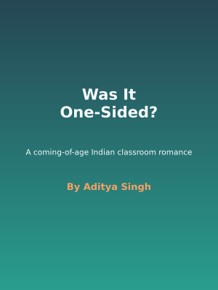
Was It One-Sided? | A coming-of-age classroom romance |
Aditya Singh |
Independently Published (Aug 2025) | ISBN-13: 9798297391154 |
Paperback | Pages 96 | ₹1,289 | US $22.67 |
Amazon: https://amzn.in/d/097wyOBN
BLURB
In a tuition classroom where ordinary days quietly shape young lives, Suraj finds himself caught between friendship, growing expectations, and feelings he has never fully expressed. When a message asks the question “Was it one-sided?”, he is forced to look back at what was said, what remained unspoken, and whether the connection he believed in was ever shared. Was It One-Sided? is a coming-of-age story about first emotions, uncertainty, friendship, and the courage to confront the truth behind an unfinished feeling.
SYNOPSIS
Suraj’s seemingly routine tuition-classroom life gradually becomes emotionally significant as friendship and unspoken affection begin to overlap. He carries hopes and assumptions that are never easy to voice, until a mysterious message — “Was it one-sided?” — forces him to reconsider the relationship and his own interpretation of it. The story follows his attempt to understand what the other person may have felt, what he failed to say, and what growing up sometimes demands: accepting uncertainty, speaking honestly, and learning that not every important relationship gives us a simple answer.


Issue 129 (Sep-Oct 2026)
-
EDITORIAL
- Sunaina Jain: Editorial
-
REVIEWS
- Anumula Sreedevi: "When the Darkness Steals" by Dr Ujjwala Kakarla
- Atreya Sarma U: "An Orphan on An Odyssey" (Novel) by Sasiprabha Manik Rao
- Atreya Sarma U: "Tea and Tombs—Poems on Hyderabad" (Poetry) by Manu S Kurup
- K Pankajam: "Diffractions at Dawn" by Dilip Mohapatra
- Kiran W Pathak:"The D’Costa Family—A Novel" by Rochelle Potkar
- Madhulika Ghose: "Your Silent Love" by Seema Jain
- Namrata Pathania: "The Migrants and Other Poems" by Vidya Hariharan
- Pushpa Subramanian: "Morning Twilight" by Jayshree Misra Tripathi
- Rositta Joseph Valiyamattam: "Indigenized/Tribalized" by Nishi Chawla
- Sindhoor Varkoor: "Karuna—The Power of Compassion" by Kailash Satyarthi
- Snehaprava Das: "Days of Recovery" by Nomita Kapur
- Sudha Rai: "Mrs Happily Single" by Shubha Sarma
- Sunaina Jain: "Fourteen Springs of Separation" by Sakoon Singh