Neera Kashyap
Neera Kashyap
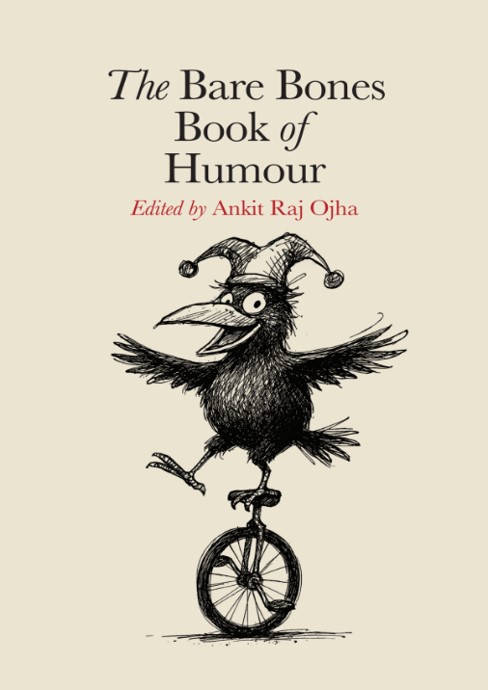
The Bare Bones Book of Humour | Edited by Ankit Raj Ojha| Bare Bones Publishing (2026)
ISBN: 978-81-986528-9-8| Pp 125| ₹399
Flaws, foibles and funny bones
This book of humorous stories is a much-needed collection in a country that has taken itself much too seriously, and forgotten to laugh at itself. By including stories not only from India but from eight other countries – USA, Canada, Africa, Australia, Scotland, Malaysia included – and from Indians residing abroad, it opens up humor as a universal phenomenon. Cultural differences, far from inhibiting, unite readers in a romp through the absurd and the everyday that becomes oddly familiar through humor. These stories cover contemporary issues such as sexuality and gender, feminist dissent, religion and tradition, urbanization and technology, state control, marriage, even death - in ways that as, one title suggests, are ‘Seriously funny’. Satire rules in some stories achieving their purpose of using humor, irony and exaggeration to expose flaws in human behavior. Then, there is spoof that is sheer entertainment.
Among the stories that relate to urban issues, we have serious themes dealing with housing, technology, urban irritants, an artificial work life and the fear of strangers. Alan Miller’s ‘The developments’ has a fascinating twist in the tail even as it describes how the protagonist attempts to foil the efforts of real estate developers hell-bent on building multi-bedroom homes in the country - people who won’t rest ‘until they’ve bulldozed every field, tree, and area of outstanding natural beauty in the entire world.’ Reflective also of a likely Indian scenario is Nigerian writer Nneoma F. Kenure’s ‘There’s a man in my bathroom’. Here, the female protagonist has a hilarious running conversation with a friend on the phone to subdue her fear, as she waits for an unknown plumber to finish his work, even as a kitchen knife acquires a persona of its own, shrieking theatrically in the climax!
Technology works at both the micro and macro levels. In Abhilipsa Sahoo’s ‘The Haunting of Chill House’ it is the voice from a fridge that speaks and petrifies non-techie parents. In Malaysian writer Shih-Li Kow’s ‘A job to love’, a ‘monstrosity called the Leisure Dome’ created for entertainment to convert night into day, has a swimming pool called ‘The Sea’, ‘The Tropical Paradise’ co-existing with the ‘Snow Palace’ – the description so technically proficient that one can only laugh at the climactic irony.
Stories on sexuality often lend themselves to humor because its ingredients thrive on strong emotions that can make one vulnerable, especially when social rules are breached and exposure reveals the gap between appearance and actual behavior. In Ankit Raj Ojha’s ‘A Man of Culture’, teenager Suraj Yadav is a raunchier, more unrefined version of Karim in Hanif Kureishi’s ‘The Buddha of Suburbia’ – both using sexual knowledge as a way to appear worldly, inventive and rebellious. When it becomes public knowledge that Suraj Yadav is a braggart who had never ‘actually done it with a woman’, his exposure is both literal and symbolic, revealing Ojha’s skill in building a colorful character in a transient world of envious students.
Mitra Samal’s ‘Sleep-induced Dilemma’ is another skilled narration of ambition and office life beneath which is the depiction of a lovable boss who alternates between dozing and brilliance. Yet, he must absorb the cost of gay love which, twice unfulfilled, spells both physical and professional decline, handled with a rueful light-heartedness.
In this anthology, feminist dissent is neither angry nor polemical but humorously subversive, exposing assumptions about gender and social norms. In ‘Robes and Roles’, Merlin Flower has Shreya look at her just-used toilet bowl ‘covered in red like a gruesome murder scene’ at two in the morning, which leads to her unflinching curse, ‘F… you, God. May you have never-ending periods!’ In ‘How to marry a prince in ten business days’, what Alice Eze achieves through Uju is not success in finding a royal partner who would treat her like a queen, but self-acceptance: ‘The crown was never missing. I just needed to stop outsourcing my worth to people who couldn’t carry it.’
One of the most effective stories of almost tender dissent is Aneeta Sundararaj’s ‘Yantra, Mantra, Tantra’. While writing to her male friend Roshan, Anjali recounts three hilarious encounters with astrologer/Guruji figures hell-bent on predicting her marriage – an intractable Indian social norm – each figure increasingly exploitative till we come to this very tender question, ‘But marriage?’
In literary traditions, humor has been long used to question religious norms and ritual beliefs, not to mock faith but to expose rigidity and superstition. In Padmanabh Trivedi’s, ‘Barambaba’, does Barambaba, the village deity actually have the power invested in it, to punish the liar? In Steve Akinkuolie’s, ‘Because of Ram and Rice’, the festival of Eid-al-Adha is authentically described through the eyes of two young brothers – young enough to question set norms with wicked innocence. A religious order breached is miraculously overturned by another breach, turning an impending punishment into a divine gift. Licking his fingers with the pride of a prophet, one brother announces, ‘You see what happens when you walk by faith?’
One of the most hilarious stories is Jahanvi Gogoi’s, ‘Seriously funny’. A young English school teacher in a small-town government school is invited to his school principal’s house for tea on the festival of Bihu. Seen from the perspective of the young teacher’s ‘million plans to live and work in a bigger city’, Gogoi produces a laugh per paragraph, as food servings are used as an ulterior ploy to expose staleness, symbolic of a breathless need to escape small town stagnation.
There are two stories that make exclusive use of dialogue: Sherry Morris’s, ‘The Sound of Something Big’ and Francois Bereaud’s, ‘Funeral Hopping’. The first has a couple quarreling at 2 am over the contentious arrival of a house guest, each pulling in different directions till a hilarious turnaround takes place under the threat of exposure! The second story is literally one of funeral hopping which brings interesting social ceremonies and fraught relationships to light, making death something of a natural event.
Satire is best seen in Aparna Kalra’s, ‘Protection’ where state control sees a reluctant police officer assigned to monitor the lives of live-in couples and their count of condom use. ‘Greetings to Jack’ by Vishaal is a delightful spoof on two hijackers subdued on a flight due to a hilarious misconception. So is Sylvia Beaupre’s, ‘Weeds’ which, leads to the question: Will Harold’s inertia, sexual distractions and the park management’s action finally lead him to pull out his weeds?
Except for the odd story with a rather risqué element where aging needs to be disproven through excessive sexual exercise, or another story more about witchcraft than humor, this is an anthology that is both culturally specific and diverse enough to be universally humorous. The book is also an outcome of its editor Ankit Raj Ojha’s knowledge and belief in the value of humor. Having read and ingested great humorists as well writers who had given gravity short shrift, Ojha writes in his introduction: ‘I wanted more of that in my world too. For humor to be taken seriously. For the grim to be given its due and then made a mockery of.’ This has evidence in this anthology in seriously funny reflections of our times and ourselves, so we end up laughing as much at the situation as at ourselves.

Issue 128 (Jul-Aug 2026)
-
EDITORIAL
- Editorial: Sunaina Jain
-
REVIEWS
- Ajanta Paul: Shining in the Air by Malashri Lal
- Atreya Sarma U: New Arrivals—Like to read & review?
- Atreya Sarma: Fractured River by Dr Gandra Laxman Rao, trans. by Julie
- Madhulika Ghose: An Ocean in the Well by D. Ravikumar, trans. by V. Ramakrishnan
- Mahendra Bahadur Thapa: Empire of AI: Dreams and Nightmares in Sam Altman’s OpenAI by Karen Hao
- Namrata Pathania: Courage to be You by Rashna Imhalsy-Gandhy
- Neera Kashyap: The Bare Bones book of Humour, ed. by Ankit Raj Ojha
- Pushpa Subramaniam: Voices in the Waiting Room by Mayank Gupta
- Ravinder Singh Sodhi: An Empire Speaks by Rupinder S. Brar
- Shivani Chaudhary: Un(bloomed) by Namrata Pathania
- Sindhoor Varkoor: Writing from the Solitary—An Anthology on Loneliness, Ed. by Semeen Ali & Priyanka Sarkar
- Sunaina Jain: Measure of My Days by Dr. Ritu Kamra Kumar
- Sutanuka Ghosh Roy: Dinosaur Granny and Other Poems by Sanjukta Dasgupta