Glenis Maria Mendonça
Glenis Maria Mendonça
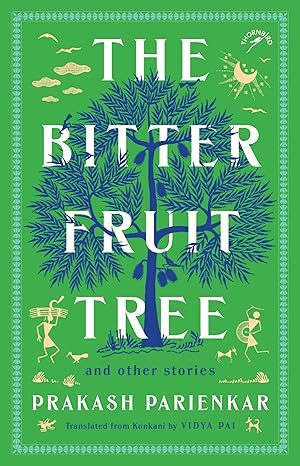
The Bitter Fruit Tree | Short Stories |
Prakash Parienkar (Konkani Original) | Trans. Vidya Pai |
Niyogi Books, India (2025) | ISBN 978-81-19626-88-5
| Pp. 190 | ₹350
Exploring the Bitter Side of Goa
“Avdu had wailed and sobbed over her husband’s dead body. But the tears that spilled out of her eyes had a different meaning…” (TBFT 170)
Avdu is the unfortunate aged widow from the last story, Abhayaranya translated as “A Forest Sanctuary” in Parienkar’s The Bitter Fruit Tree. She refuses to give up her home, hearth and farm to the forest officials who threaten her with dire consequences. Though her son abandons her, she stands her ground, battling all odds and suddenly goes missing. In all the years of her life, she seldom cried. Her ecofeminist streak is quite overt. But now, the prospect of relocation to another village due to the sanctioned forest sanctuary, gives her a heartbreak.
Such stores which are so real to the experiences of tribals living in the forests of Sattari, Goa, are penned with realism by Parienkar in this collection of short fiction. Dispelling the warped touristy image of Goa as the land of swaying palms, sun-kissed shores and exotic casinos, Prakash Parienkar’s The Bitter Fruit Tree, a collection of Konkani short stories translated into English by Vidya Pai, gives us a slice of the lesser-known Sattari taluka of Goa, which is seldom featured in the literary opus of famed Konkani writers. Thirteen tales set in the green thick forest belt of Sattari, along the banks of the Mahadei river, Parienkar gives us a taste of the bitter sweet reality of the land he grew up and lived all his life. Enmeshed into the complex conundrum of caste, threat to ecology and traditional livelihoods which knit the agrarian and culture-abiding lives of the villagers, each tale presents us a slice of the conflicts faced by villagers at the hands of corrupt bureaucrats, callous upper caste gaonkars (villagers) and self-glorified patriarchs. The victims are necessarily the tribal subalterns, women and children, mahars (dalits), vanarmare (monkey-slayers), otter-catching migrants and hapless animals. In more ways than one, Parienkar’s tales are befitting resource for an ecocritical study where nature, both physical and human, are pitied against culture and human survival.
The title story “The Bitter Fruit Tree” a translation of Kazro, is a metaphor for the embitterment in the life of the mahar Tilgo, who suffers inhuman atrocities at the hands of the upper caste gaonkars, despite offering his services to them as their irreplaceable drummer (percussionist) during their auspicious rituals. Through Tilgo’s character, the author unspools the maltreatment meted to the lower castes like mahars, by the gaonkars. This story has also been rendered as a short film Kazro and has won prestigious awards at International Film festivals.
Parienkar’s tales are riveting with a tug at eco-consciousness. There is always a conflict within the plot which churns the tension in the tale. One such tale is “the Trap” which evokes pathos at the plight of otter-catchers referred as ghanttis. These migrants are doubly marginalized, firstly for being immigrants, secondly for being extremely poor and landless. Though the Konkani story is titled “Ani Te Pot Gheun Gele”, literally meaning “they took away our livelihood”, the translator has titled it as “The Trap”, focussing on the tool they used to sustain their livelihood. The title also suggests how the trap is a way to entrap these marginalized immigrants and reinforce their sub-subalternity.
Parienkar documents lived experiences in his stories. The human-ecological combat is seen in the story “Udok” translated as “Water”. In the agrarian Kapshe village, Goklem the widow and her three daughters, resist the interventions of the villagers to bury the well with natural springs, and welcome the unreliable public taps. At once she can be seen as a deep-ecologist, comprehending the intrinsic value of the well as a perennial and reliable resource necessary for survival. On the other hand, her resistance to the public taps and the destruction of the well makes her an ecofeminist of a rare kind. As a widow, she is already discriminated and relegated, as a mother singly raising three daughters, she is derided; but she still stands her ground to insist on the preservation of the well.
Women, tribals, low-caste mahars (dalits) and even voiceless animals are given a voice in Parienkar’s narratives. “Mahaballi” translated as “The Sacrifice”, recounts the plight of Barkelo whose fruit-laden mango tree is felled for the Shigmo rituals in his absence. When he furiously questions this injustice, he is brutalized and violently killed. The tale ends with the image of the supreme sacrifice of the martyred Barkelo juxtaposed with the mango tree, both lying dead. “But the trees in the forest breathed a sigh of relief” (p.67). This story evokes a deep sense of eco-consciousness in the reader.
The author is extremely critical about cultural practices which are blindly followed without valuing human life. In “Vasshad” translated as “Desolation”, the loud-mouthed Dulyo’s mother is brutalized and killed when she sets fire to the Narkasur effigy in an unprecedented manner. Cultural practices are sacrosanct to the villagers and human lives, particularly those of widows are considered valueless and trivial. The author subtly exposes this discrimination of the marginalized widows by upper-caste patriarchs to whom sacred rituals matter most.
Tales like “Silent Affection”, unveil the discrimination of the girl-child in a world where the male-child is glorified to carry the family legacy. The author evokes the silent affection of Somargyi who nurses the hapless abandoned girl-infant and symbolically adopts her despite having six daughters of her own. There is another story titled “Chandrakor” rendered as “The Crescent Moon” where the vanarmaro (tribal monkey-slayer) is innocently victimized as a rapist and ties to the tree like an animal.
Each story of Prakash Parienkar is packed with terse emotion, conflict and a resolution which is sometimes quite unsettling. The voice of an eco-patriot is heard though most of his tales. They lament the loss of traditions, express the angst of losing water, land and livelihood, environment. “Dongravelo Baba” translated as “The Old man of the Hills” and “Kajarfal” translated as “The Fruits of Labour” reiterate the need to support farmers and agrarian traditions. They celebrate the flora and fauna of the villages in Sattari taluka and affirm the need to preserve our cultural identity by withstanding the odds of modernization and climate-change. Each story adds a fresh leaf to the understanding of nature and culture and enriches what Thomas J. Lyon calls “a taxonomy of nature writing” (Glotfelty and Fromm 276).

Issue 127 (May-Jun 2026)
-
EDITORIAL
- Editorial: Sunaina Jain
-
BOOK REVIEWS
- Ananya Sarkar: ‘They Called Us Exceptional’ by Prachi Gupta
- Dilip K Das: ‘Angkor Wat and Other Stories’ by Vandana Kumari Jena
- Glenis Maria Mendonça: ‘The Bitter Fruit Tree’ by Prakash Parienkar (Konkani Original), Trans. by Vidya Pai
- Malsawmi Jacob: ‘Moonlight Saga’ by Arupa Patangia Kalita (Assamese Original), Trans. by Ranjita Biswas
- MSR Seshu: ‘The Traitor’s Bargain’ by Rajat Roy
- P Durga Bhavani: ‘The SIS Story: How an accidental entrepreneur from Bihar built a global services conglomerate’ by Prince Mathews Thomas
- Ramesh Susarla: ‘Reinventing Indian Cinema and Culture—Emerging Supremacy of Telugu Cinema’ by CSHN Murthy
- Semeen Ali: ‘The Magnificent Ruins’ by Nayantara Roy
- Sunaina Jain: ‘The Dead Fish’ by Rajkamal Chowdhary (Hindi Original), Trans. by Mahua Sen