Sanjukta Dasgupta
Sanjukta Dasgupta
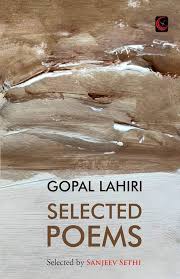
Selected Poems Gopal Lahiri, selected by Sanjeev Sethi | Poetry | Gopal Lahiri | CLASSIX (an imprint of Hawakal ) (2025) |
ISBN-10: 8198842462
ISBN-13: 978-8198842466| Paperback | Pp 128 | ₹650
Meditation A round Inner Landscapes
Poet Sanjeev Sethi has selected 103 poems to be included in Gopal Lahiri’s recently published book of poems, titled Selected Poems. Sanjeev Sethi states empathetically that the selection ‘is a salute to Gopal Lahiri’s oeuvre… The pivot of his poetry is a celebration of images.’
Gopal Lahiri is a bi-lingual poet and his poems have been translated into 18 languages and published in 16 countries. He received the Jayanta Mahapatra National Award for poetry in 2024. Expectedly, Lahiri states unambiguously that writing poetry has been a creative endeavour for him, and he clearly does not regard writing poetry to be a perfunctory pastime. He states with candour, ‘ Poetry is always a serious task for me, and I love those poems that linger for a while and fill my poetic landscape slowly but surely.’
In the Preface the poet states that the poems included in this volume have been selected from eight of Gopal Lahiri’s solo published books of poems spanning a period of fifteen years, from 2010 to 2024. The poems do not tag the title of the volume from which they have been selected, thereby suggesting a fluidity and consistency in the poetic ruminations and style. The subtle, languorous, meditative word-play of Lahiri’s poems suggest a sense of calmness and profundity as the short lines in the poem ‘Whisper’ scan the empirical and the philosophic through a process of exteroception. So, the poet wryly states, ‘I gather your whisper/into a magic box/silent but loud.’ In the poem that claims self-identification the poet writes, ‘For the poem that takes shape in this mothy room/I slide into the evening on the back of a dream’. (My Poem). The poet further states that the poems in this particular collection, “showcase a range of forms, styles, themes and emotions, offering glimpses into the depths of human emotion, the beauty of nature and concern for the ecosystem.”
Poet Lahiri defines freedom in an enigmatic mode as he states in his concluding line, ‘Let the freedom bubble burst’ in his poem titled, ‘Freedom’. Thereafter, in the poem ‘Traverse’ Lahiri redefines freedom in powerful images: ‘Freedom is still a revolving truth, a flickering secret that fixes a spike in the rib cage, eyes go low and muted.’
Among the medley of poetic content ranging from titles such as ‘Soul Music’, ‘Night Flame’, ‘Collage’ , ‘Transition’, ‘Spiral Leaf’ among others, the rapt reader is wafted into the world of soul-searching, the natural landscape, the juxtaposition of the human and nonhuman world and the silent communication between the overt and covert messages that the world generates. The tranquility that the images represent through a fine balance of colour and cadence on Lahiri’s poetic canvas underscores the maturity of a seasoned poet who congeals impulses in order to instill them with timeless impressions. So in the poem, ‘Wordless’ the poet quite uncharacteristically uses the classic mode of the dramatic rhetorical question, “What about missing the raspberries? / My sugarless mouth/insulates me from your sweet tongue.’. The choice of raspberries as the desirable fruit indicates the poet’s frequent sojourn in temperate countries, so raspberries seamlessly enter the poetic diction, suggesting the poet’s cosmopolitan affiliations, that bridge the home and the world. In fact, many of the poems exude the poet’s familiarity with the global North and its cultural diversity.
Also, Lahiri’s poems such as ‘Picasso’s Guitar’ in which the poet hears the reverberations of unheard music, silent music played in an unknown scale makes him resolve not to play the guitar again. The poem ‘Displaced’ includes an element of surprise as the poet concludes with conviction that, ‘I always imagine I am here by accident’.
Among the few gendered poems in this collection, the poems ‘Lilith in you,’ ‘Bhanumati’, and ‘The little girl’ blend history, myth, concerns for social and gender justice, in that inimitably calm way, that distinguishes Lahiri’s poetic style and tenor. So, in Bhanumati the poet unambiguously reinforces the sufferings of women and their resolve to break free. Lahiri writes in the form of a declarative statement that, ‘The thousand years of mothers and daughters/girl after girl grieve in silence/ not anymore to lie beneath the feet of men.’
Material culture and family memories are revisited in the poems ‘Grandpa’s Wheelchair’, ‘Grandma’s Piano’ and Grandma’s kitchen.’. In the description of the aroma and kitchen activities, the references and comparisons with tortilla and burrito once again underscore that poet Lahiri is familiar with culinary delicacies of Europe as well as many parts of India. Poems that address landscapes and urban spaces include City of Joy, Lodhi Gardens, Manipur Vignettes, Arthur’s Lake, Fisherman’s Cove among others, where places and people are represented in a fine balance, sometimes embedding tales and anecdotes of the past as they blend into the present unobtrusively, with remarkable aesthetic finesse.
The variegated moods and motifs that the poems use, prove Lahiri’s power as a poet, when repeatedly he refers not just to words but refers repeatedly to the alphabets, syllables and linguistic turns and twists that poetic expressions incarnate, bringing together visual images, emotive responses and the magic of affect that effectively create a web of magical spells that provokes and charms readers to decode the bard’s messages conveyed in simple words and philosophic ponderings. Hence, in the poem, ‘Night Flame’ Lahiri makes a moving urgent appeal, ‘fireflies sew moonless poems/deep within the mother’s womb/light a fire, the city needs the flame.’
In fact, the skilled use of wordplay, clusters of visual images and profound reflections are the three distinguishing facets that make Gopal Lahiri’s poetry an immersive learning experience for all serious readers of poetry.

Issue 126 (Mar-Apr 2026)
-
EDITORIAL
- Sunaina Jain: EDITORIAL
-
REVIEWS
- Akanksha Pandey: North East India: Literary and Cultural Perspectives Edited by Dr. Dipak Giri
- Ashmita Nayak: ‘Cracks in the Wall’ by Neera Kashyap
- Atreya Sarma U: ‘A Certain Penance of Light’ by Debasish Lahiri
- Atreya Sarma U: ‘Kiriti Sengupta—Selected Poems’ selected by Dustin Pickering
- D Sreejith Kadiyakkol: ‘Volume Three —A Modern History of Jammu and Kashmir—The Times of Turbulence (1975-2021)’ by Harbans Singh
- Namrata Pathania: Black Magic of Women from the Mountains: Poetry from Himachal Pradesh by Kamayani Vashisht and Shelly Bhoil
- Rupalee Burke: ‘A Poet’s Promise’ by Rositta Joseph
- Sanjukta Dasgupta: Selected Poems Gopal Lahiri, selected by Sanjeev Sethi
- Sunaina Jain: The Liar Among us by Bishhal Paul