Atreya Sarma U
Atreya Sarma U
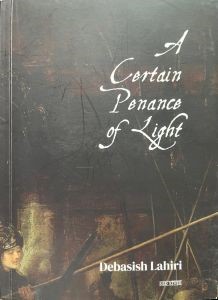
A Certain Penance of Light | Ekphrastic Poetry | Debasish Lahiri |
Red River, New Delhi (2025) | ISBN: 978-93-48111-40-1|
Pp 112 | ₹399 | Eur14.99
A unique work worth to navigate through light and shade
‘A Certain Penance of Light’, an ekphrastic poetry collection from the ever-cerebral and erudite stylus of Debasish Lahiri— academic, poet, writer, sightseer, quester— is a unique work, melding as it does art and poetry— on the fulcrum of observance from a wink or a blink or multiple eyes, virtu savviness, historical sapience, mercurial perception, lexical cornucopia, and aesthetic, cryptic, surreal, and paradoxical expression. Whatever land he steps on— intra-or-extra-territorial, he doesn’t leave it without coming up with a topographic memoir.
“…the proliferation of ekphrastic writing in the new millennium of which I am myself a part” (Introduction: A Penance, p 10)— affirming so, Debasish dedicates the book to his “Maa, the light that never was, on sea or land” (p 7).
***
Before we—most of whom being sans the de rigueur artistic episteme—have a broad coup d’oeil of the book, let’s see the endorsements from reputed artists.
“This is neither a book of poems to register an accumulation, nor a museum of visual comparisons. It’s rather a book of language in its battle for an analogical break from conventional to essential poetry” —Abdul Kader EI Janabi, Poet, Editor and Visual Artist (p 2).
“This sequence of ekphrastic responses seems to have one foot in dusty reality and the other in dream…”—David Kinloch, Poet, Winner of Cholmondeley Award 2022 (p 2).
“A homage, an interpretation, a voyage round the world’s visual art, where sumptuous and inventive language delivers stunning ideas and verbal images…” —James Sutherland Smith, Poet, Translator, Critic (p 2).
***
Now let’s look at the cognisance of Debasish himself, who observes, “…both painting and poetry are letters from a void. The void speaks a Babel of tongues, so do its letters” (Introduction: A Penance, p 10).
Where do you think Debasish’s enthusiasm for art has come from? He unshrouds the mystery.
|
|
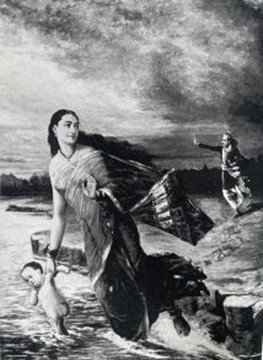
Born in a 75-year-old house, Debasish Lahiri, the child, notices— a “costume of cobweb, mold and soot” on a hidden “closet under the main staircase”, wherein he mystically finds a painting of “an Indian nobleman, or king, trying to wave someone goodbye or asking someone not to leave” (p 12), and it epiphanically happens to be an original painting by the legendary Raja Ravi Varma. It is ‘Shantanu and Ganga’ whose authenticity Debasish, years later on, checks up with the curator of the Sri Chitra Art Gallery, Thiruvananthapuram. Mysteriously, this painting was bought in an auction by Debasish’s ascendent, Idaspati Lahiri, his father’s great uncle who was “fluent in Persian, French, and…English” (p 13), and was “the black sheep in my family history” (p 14). Why, or how a black sheep? Find out for yourself by navigating the curious book. By the way, the family owned another painting by Raja Ravi Varma, “supposedly a gift from some English civil servant for a birthday in the family” (p 14). |
***
A picture is worth a thousand words, it’s said. However, the worth of the words depends upon how they are expressed by the aesthetes since each has their own individual perspective. It’s up to the readers to judge the expressions, and again, the tastes and preferences of readers are also as varied as of the poets.
The book, perhaps with its deliberately blanched pages, slightly ruffled letters, and artistically transformed syllables, features 29 ekphrases across 5 sections—Darkroom Silver; Matters Magritte; Van Guard; Indelible Link; and Penance of Light. The art, mostly paintings, is from a galaxy of artists like— the occidental Gislebertus (12th century), French; Raphael Urbino aka Raffaello Sanzio da Urbino (1483 – 1520), Italian; Pieter Bruegel the Elder (16th century), Dutch; Rembrandt Van Rijn (1660 – 1669), Dutch; Thomas Daniell (1749 – 1840), British, who spent 7 years in India on his art mission; JMW Turner (1775 – 1851), British; Claude Monet (1840 – 1926), French; Vincent van Gogh (1853 – 1980), Dutch; Maynard Dixon (1875 – 1946), American; Pablo Picasso (1881 – 1973), Spanish; Georgio de Chirico (1888 – 1978), Italian; Rene Magritte (1898 – 1967), Belgian; Mark Hall (b 1970), British; and the earlier oriental/Indian Nanha/Bishndas (c 1590); Raja Ravi Varma (1848 – 1906); and the current time’s Sudhir Patwardhan (b 1949); and Rupam Baoni, an Indian origin woman settled down in UK.
***
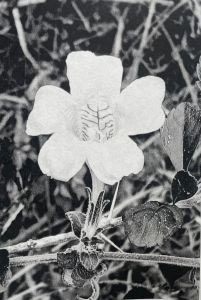
| Image: “Corolla”, Page 18 |
|
|
| The first poem “Corolla” ethereally mirrors Lord Shiva with “Three lines | drawn in ash | across the breadth of all-seeing eyes” ending with a message “Teach yourself patience, | Painter!” (19). |
The next poem “Under the Christmas Tree” is magically pulled by the Magi via “Three empty glasses under a Christmas tree | three spent Magi, | the libation of divine birth | drained | like a sea | by wild decree | of the sky” and the “inheritance” of this artwork “swills three empty glasses | like the vine’s dream | in a wine’s memory” (21).
Material avarice yielding lodes of wealth may not give salubrious happiness to the possessor as Greek philosopher Democritus (c 460 – c 370 BC) rightly observes “Happiness resides not in possessions, and not in gold, happiness dwells in the soul.” Such hoarders and philistines keep away and are insouciant against arts and aesthetics.
“Babur | had dreamt that his bag of grafts | had become too heavy to bear. | The whisper in Kabul | was that he had also banished | the poets” (Words in a Garden, p 57).
In ‘Green-Gold’, the poet goes into the nuances of the brush and colour.
“Washing colour off a brush, | priming it for the next stroke | is the most important act | in painting— … … … [Otherwise,] The quest for the present, | impossible— a house the painter lives in | but, | whose existence cannot be proved | by castaway blood…” (p 63).
The poet-artist in Debasish peregrinates like a somnambulist to visit the museums, sites, necropolises et al, hypnotised by the invisible magnets of distinct and nostalgic art creations—
“I walk slowly at night, | uncertain, | threatened by that long barrel of noise | called civilisation | … … … | I wade through the darkness of streets | and raise no ripple of light: | my silhouette darkened by the moon, | like beauty’s aspect by a voyeur” (Night-Watch, p 79).
Cognoscenti have “Delirium” gift them equanimous optics; and “darkness” illumination, strange as it may look to others.
“I sit up for fear of lying down: | night melts like candy into day. | How strange, | we remember | all our acts of forgetfulness | so exactly” (Summer Night, p 95).
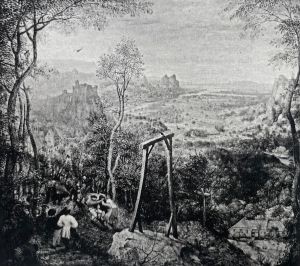
We may like to apply the “word and melody… … and every sentence” as in the poem “Burden: Perhaps of a Song” (97); and the idea and act of “pouring out work and purpose” (Sin in the Sun, p 101) to the poems by Debasish—
“I missed the return — | a song | without a burden — | word and melody | bolted like a mustang | with a thirst for green skies, | blue hills; | every sentence | now waves like dust, | a manic, indefatigable dancer, | in its wake.”
Keen artists can capture anything—
“The shadow | of a daydream | has grown slow | and found arrest in colour” (Shifting a Daydream, p 99).
***
To sum up, Debasish Lahiri’s “A Certain Penance of Light” is certainly his ardent penance under the light of his mind’s eye and heart’s touch—alloying through his sights and insights—on an ekphrastic chart—a kaleidoscope of locations, relocations, ekistics, collocations; evocations of nostalgia, wistfulness and regeneration; ciphering and deciphering loads of codes of abstractions, surrealistic glooms and blooms that are lucid, pellucid or totally otherwise—with a smart craft of start and restart—portraying a smorgasbord of faces, phases, phrases, and stages—glued with subliminal and underlying tropes—to comprehend which it’s no hardship for the expert a focused penance is an imperative.

Issue 126 (Mar-Apr 2026)
-
EDITORIAL
- Sunaina Jain: EDITORIAL
-
REVIEWS
- Akanksha Pandey: North East India: Literary and Cultural Perspectives Edited by Dr. Dipak Giri
- Ashmita Nayak: ‘Cracks in the Wall’ by Neera Kashyap
- Atreya Sarma U: ‘A Certain Penance of Light’ by Debasish Lahiri
- Atreya Sarma U: ‘Kiriti Sengupta—Selected Poems’ selected by Dustin Pickering
- D Sreejith Kadiyakkol: ‘Volume Three —A Modern History of Jammu and Kashmir—The Times of Turbulence (1975-2021)’ by Harbans Singh
- Namrata Pathania: Black Magic of Women from the Mountains: Poetry from Himachal Pradesh by Kamayani Vashisht and Shelly Bhoil
- Rupalee Burke: ‘A Poet’s Promise’ by Rositta Joseph
- Sanjukta Dasgupta: Selected Poems Gopal Lahiri, selected by Sanjeev Sethi
- Sunaina Jain: The Liar Among us by Bishhal Paul