Rupalee Burke
Rupalee Burke
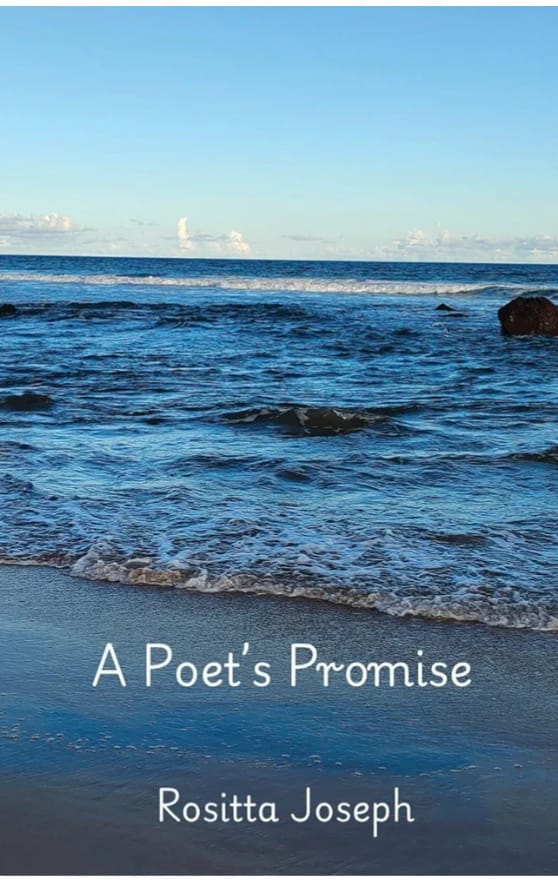
A Poet’s Promise | Poetry | Dr. Rositta Joseph Valiyamattam | Black Eagle Books, USA (2025) | ISBN: 978-1-64560-662-8 |
LCCN: 2025933749 | Paperback | Pp 168 | ₹350
Poems that Matter
‘A Poet’s Promise’ is Dr. Rositta Joseph’s maiden poetry collection. Hard to come to terms with the fact that it is her first collection, unless you get to know that these are poems written, revisited, rewritten, expanded over three decades. The end product is finely distilled poems.
The painstaking efforts underlying the production of this collection are evident. The neatly arranged foreword by senior journalist and writer Meher Pestonji, the critical introduction by eminent literature professor and poet-activist Arjuna Parakrama, the poet’s note, the blurb, and the sections in the table of contents make it a well laid out and self-sufficient text for casual readers, researchers and students alike.
As a poetry lover and researcher, going through a reader-centric poetry collection as brilliant as this has been a delightful experience. Especially inviting are the poet’s words (in the Poet’s Note) about her poems being offerings of love to the readers, of her being grateful for the privilege of sharing her journey with us, a journey which she says, “we can enjoy both individually and together, for it is finally ‘our’ journey.” This catholicity and all-encompassing gesture by the poet is the cornerstone of her work. For some strange reason, the following lines from T.S. Eliot’s ‘Burnt Norton’ come to mind:
“Down the passage which we did not take / towards the door we never opened / into the rose garden.”
The very title ‘A Poet’s Promise’ indicates the agency of the reader because of the promise made by the poet to the readers and to herself as well. These are poems written not in a vacuum or from an ivory tower, but rather from the ground. This explains why these are not nebulous poems. Just as Rositta resurrects the obsolete word ‘bridger’ from the Middle English period in the poem ‘Velankanni’, she is a bridger of the sacred and the profane in life on this planet.
The sixty-three poems in the volume offer a kaleidoscopic view of human experience, which spans across history, mythology, geography, politics, sociology, psychology, spirituality and what have you. Rositta’s poetic repertoire is panoramic. Difficult to say what is left out from her world-view. Human life in all its worthiness and its absence finds expression here: from the brute honesty in ‘Rebel’ to the incisively felt pain at the violence resulting from religious intolerance in ‘Just One Prayer’, ‘Manipur’ and ‘Phoenixes of Bombay’. The equal ease and deftness with which Rositta writes about Christ in ‘Will He Come?’ and about Draupadi in ‘The Disrobing of Draupadi’ represent her rooting within the multicultural fabric of our country. The poet’s immaculate homework is amply evident in poems such as ‘The Curse of Hussain Sagar’, ‘The Temple at Tanjore’ and ‘Adalaj’. Places and monuments extend to become markers and shifters of culture. More than sights for seeing, they become sites for reflection (pun intended). The hallmark of poems such as ‘Ahmedabad’ is the encapsulation of more than 600 years of its historical, cultural and socio-political trajectory. Since I was born and have lived all my life in Ahmedabad, the poem means a lot to me. Along with the poet, I mourn for what the city has been reduced to.
The poem ‘Post Truth’ holds up a frightful mirror to all of us, subverting the usual meaning of the term AI revolution that has gained currency in present times. Here is a poet with an umbilical connection with the world she inhabits. She is alive to anything and everything occurring across the globe, especially that which leads to strife and injustice victimising the vulnerable. Her poems embody the Ignatian ‘signs of the times’. The lens through which she views the world is egalitarian and empathetic. She sees, hears, feels, processes and expresses with a rare immediacy. That is the reason why these poems jolt the readers out of their comfort zones and compel them to brood over them. The overarching characteristic of Rositta’s poems is her ‘Commitment’ with a capital C. She is a ‘woke’ poet in the true sense of the word and not the politically fraught term that is has become today.
The contemporary themes of poems such as ‘Memories’ and ‘Lent to Lent’ are unsettling. In a rare display of courage, in this day and age, she dares to write: ‘In my ‘democratic’ country, freedom dies a little more/ Each day, with every change of rulers./ The rich teach us a new morality/ The powerful shape our destinies/Young men of great merit gladly hang/ themselves/The rest are in prison for high treason….’ (‘Lent to Lent’). Let us, in juxtaposition, recall Tagore’s more than a century old ‘Gitanjali’ 35, ‘Into that heaven of freedom my Father, let my country awake….’
‘Spy Versus Soldier’ is an uncommon yet interesting theme for a poem, reflecting upon the forever unknown sacrifices of those who serve the country as intelligence officers. There are very many tenderly written poems - ‘Dusk’, ‘The Unkindest Cut’, ‘Father’s Day’, ‘Eros’ and ‘Change’ are some of them, delving deep into the bliss and pathos of both the human-nature connection and human relationships. Hinting at the inability of language to capture experience, Kafka said, “All language is but a poor translation”. Perhaps, he would have to change his belief if he were to read Rositta’s poems; and this is no exaggeration. These are poems that matter, and they deserve to be translated into as many languages as possible. As is well-known, the space for poetry is shrinking given the contemporary onslaught of fiction. It would do well to include this meaningful collection in school and university syllabi, for these are poems that directly address our collective consciousness with an unbiased genuineness, unlike current-day social media blitzkriegs.
Having traversed the poems and having navigated all the peaks and troughs, we arrive at the concluding poem of the collection, ‘That Whereby Men Live’, which I wish to quote. It is an exquisite ode to hope, something that the world desperately needs, in these troubled times of war, natural and man-made disasters, socio-political and economic depression.
That Whereby Men Live
Night must end
And dazzling sun dawn.
Light must shine
Amid laughter and wine.
Wars end
And flowers bloom.
Peace to prevail
And foes to fail.
Victory, even in the last breath,
Believing in new life after death.
For
Hope is that Whereby Men Live.
This collection is highly recommended, not only for poetry lovers but also to those who are averse to elitist poetry and would like to embrace poems accessible to one and all. We look forward to seeing more of Rositta Joseph’s work in the times to come.

Issue 126 (Mar-Apr 2026)
-
EDITORIAL
- Sunaina Jain: EDITORIAL
-
REVIEWS
- Akanksha Pandey: North East India: Literary and Cultural Perspectives Edited by Dr. Dipak Giri
- Ashmita Nayak: ‘Cracks in the Wall’ by Neera Kashyap
- Atreya Sarma U: ‘A Certain Penance of Light’ by Debasish Lahiri
- Atreya Sarma U: ‘Kiriti Sengupta—Selected Poems’ selected by Dustin Pickering
- D Sreejith Kadiyakkol: ‘Volume Three —A Modern History of Jammu and Kashmir—The Times of Turbulence (1975-2021)’ by Harbans Singh
- Namrata Pathania: Black Magic of Women from the Mountains: Poetry from Himachal Pradesh by Kamayani Vashisht and Shelly Bhoil
- Rupalee Burke: ‘A Poet’s Promise’ by Rositta Joseph
- Sanjukta Dasgupta: Selected Poems Gopal Lahiri, selected by Sanjeev Sethi
- Sunaina Jain: The Liar Among us by Bishhal Paul