Madhulika Ghose
Madhulika Ghose
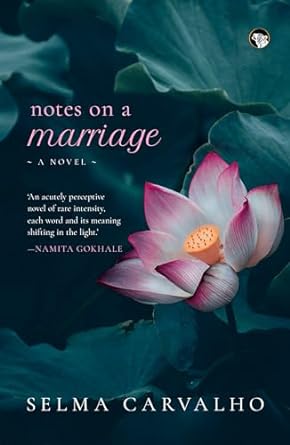
Notes on a Marriage : A Novel | Fiction | Selma Carvalho |
Speaking Tiger Books (2024) | ISBN: 978-93-5447-707-2 | Hard back |
pp 153 | Rs. 499
Family, an eternal bond
Notes on a Marriage, written by Selma Carvalho, is a short novel that illustrates the eternal nature of the familial bond through the story of a middle-class couple, Alfred Hughes (also called Freddo) and Anju Kale, living in England. After studying at William Byrd University, Anju and Freddo’s friendship blossomed into love and marriage. With the passage of time, Freddo’s fiery young revolutionary blood had transformed into the meek lifeforce of a salaried family man, while Anju had settled into the role of a middle-class wife. However, despite being haunted by memories of the past, rocked by crises and disillusionment, and threatened with the possibility of premature death, the relationship between Anju and Freddo survived the onslaught of time. This novel beautifully showcases the resilience of marriage and its ability to weather tumultuous storms.
The protagonist of this novel, Anju, is an intriguing and complex personality. In the initial parts of the novel, her happiness (in fact, almost her mere existence) seems completely dependent on the approval of her husband. Consequently, her behaviour is largely dictated by what is acceptable to him. At least in the initial part of the story, she significantly suppresses her true nature and authentic responses to situations, just to fit into a mould that is consistent with Freddo’s vision of a good wife. This behaviour can be traced back to Anju’s childhood and her complicated relationship with her father, Nivant Kale. When a child is routinely made to feel small and insignificant, it is only natural for it to grow up into an insecure individual who continuously seeks external validation. The scarring nature of the father-daughter relationship shared by Anju with her father manifests itself in various forms in Anju’s life. She is extremely traumatized by the thought of her father, to the extent that she often dreams of being shot dead by him. However, if there is any truth in the saying “circumstances maketh a man”, it is incorrect to blame Anju’s father completely for his behaviour. Nivant Kale was an Indian immigrant who had given up his Marxist dreams and settled down in his British wife’s huge house in England. His life is somewhat analogous to that of a plant that pushes aside brambles and bushes, eager to change its circumstances and grow upwards into the sunlight, only to realize that no matter how much it grows, its roots will remain firmly bound to the same soil. Despite renouncing most aspects of India, including its capitalism, religion, and language, Nivant Kale clung to his Indianism “like a hump.” It is natural for such a confused and disillusioned personality to spread only insecurity within his family.
Several aspects of this novel are interesting. Among them, a particularly intriguing aspect is Anju’s character. Her flippant attitude toward extra-marital relationships is especially jarring. A character in the book is not only described by Anju as “Uncle Tony,” “a Goan,” and “Father’s London University friend,” but also as “Mother’s old beau” and “the one she had snuck around with, behind father’s back.” These words provide a unique glimpse into Anju’s mind; along with severe insecurity, she lacks true respect for her father or her parents’ relationship. Having seen an unhappy marriage while growing up, she probably accepts infidelity as the magical balm that presents itself at opportune moments in a married person’s life to soothe the cuts and bruises of routine matrimony. However, it would be incorrect to paint her as weak or unintelligent because Anju’s response to several situations indicates quite the contrary. Throughout the story, Anju is extremely aware of her welfare and chooses it above all. Reiterating the sanctity of marriage and using it as a cloak to cover all the wrongdoings of an individual is the mark of a true coward, albeit an intelligent one. Moreover, blatant disregard for the emotions of people with whom one shares an intimate relationship, simply because they are not bound by legality, is the characteristic of a true-blue opportunist. Interestingly, whenever threatened, Anju either tries to hide, ignoring the situation completely or accedes to the most common viewpoint, trying to “belong.” Thus, despite being the protagonist, she might not be the most loved character in the book. Here, in developing Anju’s character, the author deserves accolades for painting the realistic image of a mixed-cultural middle-class woman who is unsure of what comprises her authentic self and if it intrinsically deserves any praise or love. Moreover, the author astutely highlights some of the intrinsic burdens carried by immigrants and their mixed-culture children who are born and raised outside their homeland.
This novel showcases how people live their entire lives under a façade, desperately trying to prove their worth to society while remaining cold and empty inside. After a point in time, their persona overshadows their true personality; as a result, their personal relationships gradually dissipate, finally ceasing to exist, causing irrevocable damage to all the stakeholders.
I recommend this book to all fiction lovers. Although this novel is not romantic fiction, it dwells in the world of love and responsibility. Passion, though much romanticized, is generally ephemeral and publicly derided, while marriage, though somewhat monotonous and laden with responsibility, is generally what survives and receives public ratification. With time, the comfort of living in a fixed pattern with a fixed individual typically supersedes the allure of a romantic tete-a-tete or passionate adventure. Anju too, like most middle-class women of her age, finally chooses to walk into the sunset with her husband Freddo, despite his indiscretions and her detours. Although her final decision is in tune with her character, I would have personally preferred a different ending. Nevertheless, this novel provides much food for thought and is worth a read.


Issue 116 (Jul-Aug 2024)
-
EDITORIAL
- Sukanya Saha: Editorial
-
REVIEWS
- Aparna Singh: “Nalak and Shakuntala” by Abanindranath Tagore
- Debasish Lahiri: “Even birds go home” by Purabi Bhattacharya
- GSP Rao: “The Eternal Religion – Glimpses of Hinduism” by Karan Singh
- Kashmi Mondal: “Can't - A Novel” by Shinie Antony
- Ketaki Datta: “The Bard and his Sister-in-Law” by Lopamudra Banerjee
- Madhulika Ghose: “Notes on a Marriage – A Novel” by Selma Carvalho
- N Sreekala: “Wind-Blown Leaves” by M. Mohankumar
- Sapna Dogra: “Edward Said -A Critical Introduction” by Jaydeep Chakrabarty
- Shweta Verma: “Indian Graphic Narratives: Critical Responses” edited by Sapna Dogra
- Sukanya Saha: “The Scar” by K. A. Gunasekaran
- Sutanuka Ghosh Roy: “Contemporary Urdu Short Stories from Kolkata” edited by Shams Afif Siddiqi & Fuzail Asar Siddiqi