Sachin Ketkar
Sachin Ketkar
City for Sale: A Cultural Semiotic Analysis of Gujarati Literary Avant-Garde in Baroda
After I completed my Bachelors with English from a college in Valsad, a small town in the South of Gujarat, I came to Baroda in the mid-nineteen nineties to do my Masters. The city was culturally exciting. The Shakespeare Society and other dramatic associations were energetically staging plays of a wide range of dramatists ranging from Tennessee Williams to Mahesh Elkunchwar. Renowned scholars like Prof Prafulla Kar were teaching Derrida and contemporary literary theory, and Prof Ganesh Devy was teaching Indian literature in translation. Devy's After Amnesia was making waves and the Fine Arts faculty was abuzz with activities. In Gujarati, the literary magazine called Gadyaparva was active, and I was fortunate to be part of their translation workshops and get-togethers, where I could interact with internationally renowned visual artists and writers like Gulammohammed Sheikh and Bhupen Khakkar. I remember reading modern Marathi poetry for the first time in Baroda, and hearing the renowned Marathi poet Vasant Abaji Dahake. I remember also listening to Gujarati poets like Sitanshu Mehta and Bharat Naik. The syllabus I studied consisted of authors as dissimilar as Kafka, Holderlin, Faulkner, Stevens, Brecht, Namdeo Dhasal, Ravji Patel, Eliot, Stevens, Shakespeare and Basheer along with an array of critics and theorists like Derrida, Barthes, Foucault, Lacan, Poulet, Iser, Stanley Fish, Edward Said among many others. The Hansa Mehta library offered a huge collection of books, and also the freedom to access and uses them. On the street footpaths, I came across pirated and used books by writers like Alvin Toffler and Eric Berne among others. My studies in Valsad comprised of fairly conventional Eng Lit canon which began with the bang by Shakespeare and ended with a whimper by second-hand references to Eliot's literary criticism in a book called Making of Literature by Scott-James. Drama meant books to be read. For an amateur writer, translator and literature lover from a non-metropolitan background, the two years in Baroda were liberating and transformative.
However, I was not the only one who felt so. Gulammohammed Sheikh, who lived for the first eighteen years in Surendranagar, a small town in Gujarat, and who had not even heard of the things like 'art' school, was advised by the veteran Gujarati artist Ravishankar Raval to go to Baroda and made arrangements for him there. In one of his interview to Indian Express in 2011 Sheikh says, "Once I reached and discovered Baroda, there was no question of going back to my small town. Come what may, I would stay in Baroda. And there, I discovered a vocation. A small town brings all kinds of inhibitions and terrible restrictions that prevent you from being truly free. Men and women rarely mix. Painting and drawing are not respected as professions. Besides, in many ways you are bound by religiosity. So for the first time in my life, I was away from all those restrictions and could freely explore."
Interestingly, Baroda has another side as well. Since nineteen sixty nine, Baroda has witnessed communal violence of all varieties with sinister regularity. When I joined the Department, the Babri Mosque had been demolished and I remember watching Mani Ratnam's Bombay (1995) in Baroda during which there were catcalls of a distinctive communal undertone during a love making scene featuring a Hindu hero and a Muslim heroine. In 1993, the year I had joined, there was an incident in which a local Shiv Sena chief who had great clout in Baroda was killed in an encounter. The violent and communal Baroda and cosmopolitan and progressive Baroda raises some vexed and knotty problems regarding the postcolonial modernity and cultural modernism in India and Gujarat. This socially and culturally fractured city is a prominent theme in the works of Gulammohammed Sheikh. His famous works like City for Sale (1980-84, oil on canvas), and an installation named "City: Memory, Dreams, Desire, Statues and Ghosts – Return of Hiuen Tsang" which includes the 24 feet wide City, 'raised' on a largely recreated grid of Google Earth images of Baroda, with hand-drawn or hand-painted images sourced from hundreds of photographs, suggested a city ruptured in two – the standing panels as the living city marked by the 2002 orgy of violence. Sheikh, in an interview in 2011 notes, "With all our vanity we thought the Baroda University was the biggest thing - but we looked at the Google map and found that the prison of Baroda was the biggest. So when I made CITY it was the amalgamation of desires and dreams, statues and ghosts, a few birds and the return of Hiuen Tsang".
However, in the present writeup I am going to limit myself to the question of the role of the city of Vadodara (or Baroda as it is called) in development of literary modernism in Gujarati, with this dimension of my personal relation to Baroda in the background. The relation between personal memory and cultural memory is one significant themes of the current article. It deploys the theoretical model of cultural semiotics to understand the phenomenon of modernity, literary modernism and cultural memory in Baroda.
In fact, the theoreticians of cultural semiotics Lotman and Uspensky (1978) point out that 'culture' in cultural semiotics implies "the nonhereditary memory of the community, a memory expressing itself in a system of constraints and prescriptions". In his book Universe of the Mind: A Semiotic Theory of Culture (1990), Lotman theorises how any semiotic object (be it human intelligence, a text or entire culture) not only transmits information, but also how it generates new information and retains the past information (the function of memory). As the questions of generation of new semiotic information through artistic innovation, and the retention of the past information through memory and tradition are critical to the understanding of modernism, it will be useful to look at the phenomenon from the theoretical lenses of cultural semiotics. Besides, cultural semiotics allows us to analyse all kinds of texts - verbal, visual, architectural and musical - with a common theoretical framework.
While modernity as a social and historical phenomenon in India has received significant attention from the various left-leaning postcolonial scholars like Sudipto Kaviraj, Arjun Appadurai and Partha Chatterjee, the category of 'modernism' as a characteristic literary movement/s has not received the theoretical attention it deserves. There is a tendency to take 'modernism' for granted in the discussion of modernity in India. Very often, the major theorists of modernity and modernism across the world tend to collapse the distinction by reducing modernism, an artistic and cultural category, to modernity, a social and economic category as if the relationship between these two categories is causal, linear and deterministic. This tendency to conflate these two categories resembles the classical Marxist project of reducing 'superstructure' to 'base'. Probably, the absence of critical distinction has promoted the assumption that theorisation of modernism will be subsumed under the theorisation of modernity. While the relationship between the categories might be complex, the absence of this distinction would make us unable to distinguish between Gujarati poetry of Narmad (1833-1886) and Gulammohammed Sheikh (b 1937), and end up erasing the critical difference in their poetics and politics.
Internationally, literary modernism is intimately connected to the urban and metropolitan experience, and the story of its rise in Gujarati is not a very different one. In Niranjan Bhagat's Pravaal Deep (1956), the earliest work of urban modernism in Gujarati, Bombay, a city not technically in Gujarat, is at the centre of the poet's Baudelairean vision. However, the cities like Ahmedabad and Vadodara too played a critical role in the rise of this literary movement. Bhagat (1926), in the afterword to his collected works Chandolaya (1997), notes that modern poetry is the poetry of the modern industrial city. This poetry is at the centre of poetry in languages world over. He goes on to prophesise that the other forms of poetry like those based on the themes of God or Love, and which are stylistically lyrical, musical, ghazals and so on, the forms he calls 'gopakavita' or 'pastoral poetry', are peripheral and will soon disappear over a period, and even if people will continue to compose such works, they will be anachronistic (292-294).
It is interesting that this prophecy was made in the mid-nineties, when the kind of urban modernism in Gujarati was struggling to survive against the surge of 'postmodernism' and the unceasing waves of ' gopkavita'. Though literary prophecies like this may not be very useful in predicting futures of literature, they are interesting for the assumptions which underlie such statements. The assumption which is central to such a prophecy is that of view of the culture as evolving linearly, following 'the arrow of time', where one day, to use Raymond Williams' (1977) terminology, 'the emergent' tendencies will replace the 'residual' ones and the 'residual' will become 'the archaic', and the 'archaic' will disappear. While Bhagat's observation of the role of industrialised cities and the urban experience in shaping literary modernism is significant, assumptions such as these are obviously problematic. The very fact that 'gopkavita', 'modernist' or 'postmodernist' poetries and poetics can co-exist requires a different model of analysis and theorisation of cultural change. In order to theorise modernism in India, we need to take into account the critical fact that culture is far more spatially, historically, and semiotically heterogeneous, unevenly changing, and complex meaning-making (semiotic) phenomenon, than the base-superstructure model (which is both deterministic and linear) that reduces modernism to modernity would admit.
The theoretical models of cultural change either tend to focus exclusively on discontinuity (Marx, Foucault, Kunn) or exclusively on continuity like the French Annales School of longe duree. In contrast to the linear and monolithic view of cultural change, Lotman postulates in Culture and Explosion (2004) that culture and semiotic systems change in two ways: they change gradually ie linearly and predictably or they change abruptly, non-linearly and unpredictably or in his terms 'explosively' (7). He notes, "Culture, whilst it is a complex whole, is created from elements which develop at different rates, so that any one of its synchronic sections reveals the simultaneous presence of these different stages. Explosions in some layers may be combined with gradual development in others. This, however, does not preclude the interdependence of these layers. Thus, for example, dynamic processes in the sphere of language and politics or of morals and fashion demonstrate the different rates at which these processes move. (12)"
From the cultural semiotics perspective, we can think of modernisms and postmodernisms as an umbrella terms for multiple avant-garde movements in arts which deliberately and programmatically intend to bring about 'explosive' processes of generating radically new information and meanings in various semiotics systems ie the languages of painting or visual arts and fashion or the languages of literature or architecture. We can visualise how only these processes are found in only some languages while other languages like the language of caste, religious beliefs, school pedagogy, or electoral politics change extremely slowly, in a gradual way. Hence modernity is neither a linear process nor a monolithic process which happens en bloc and en mass to a culture. It is neither exclusively a discontinuous phenomenon nor an exclusively gradual longe dureee kind, but a chaotic interaction of both the kinds of processes happening at multiple semiotic layers of cultures.
The concept of the semiosphere, the complex whole of the culture that generates meaning, needs to be elaborated here. Meaning generation, according to Lotman, is the ability both of culture as a whole and of its parts to put out in the "output", nontrivial new texts. New texts are the texts that emerge as results of irreversible processes (in Ilya Prigogine's sense), ie texts that are unpredictable to a certain degree (Cited by Peeter Torop, 2005). He argues that individual distinctive semiotic systems (languages) cannot come into being or function on their own. They need to be "immersed in a specific semiotic continuum, which is filled with multi-variant semiotic models situated at a range of hierarchical levels." Such a continuum Lotman, by analogy with the concept of "biosphere" introduced by V I Vernadsky, calls the 'semiosphere'. The semiosphere is that synchronic semiotic space which fills the borders of culture, without which separate semiotic systems cannot function or come into being. It is defined as, "the semiotic space necessary for the existence and functioning of languages, not the sum total of different languages."
Lotman provides a useful analogy for the semiosphere. "So across any synchronic section of the semiosphere different languages at different stages of development are in conflict, and some texts are immersed in languages not their own, while the codes to decipher them with may be entirely absent. As an example of a single world looked at synchronically, imagine a museum hall where exhibits from different periods are on display, along with inscriptions in known and unknown languages, and instructions for decoding them; besides there are the explanations composed by the museum staff, plans for tours and rules for the behaviour of the visitors. Imagine also in these hall tour-leaders and the visitors and imagine all this as a single mechanism (which in a certain sense it is). This is an image of the semiosphere." (Lotman, 1990:127)
With Lotman's analogy, we can compare what Sheikh, in a 1981 interview, says about living in India. Sheikh says, "Living in India means living simultaneously in several times and cultures, one often walks into medieval situations and primitive people. The past exists as a living entity alongside the present, each illuminating and sustaining the other as times and cultures converge, the citadels of purism explodes. Traditional and modern, private and public, the inside and the outside are being continually splintered and reunited. The kaleidoscopic flux engages the eye and mobilises the monad into action ….like the many eyed and armed archetype of an Indian child soiled with multiple visions; I draw my energy from the source. "Hence to understand modernisms and postmodernisms in India, we need to analyse the underlying semiosphere from where artists like Gulammohammed Sheikh draw their energy. One of the most powerful semiospheres in Sheikh's work is the city of Vadodara, which calls 'the central motif' of many of his works (1981).
Vadodara has been at the forefront of artistic and cultural innovation in Gujarat. The institutional setting of the Maharaja Sayajirao University of Baroda comprising of the Faculty of Fine Arts, the Faculty of Performing Arts, and the Faculty of Arts allowed Baroda to have a cultural and intellectual environment where academia, critical theory, literary and artistic practices could come together for a dialogic interaction in the nineteen sixties, and produce important artistic and literary movements, figures and texts. Internationally renowned visual artists of the 'Baroda School' like Gulammohammed Sheikh and Bhupen Khakkar are also major names in Gujarati literature. The senior modernist Gujarati writers like Suresh Joshi, and Sitanshu Mehta, and the later generation writers like Jaydev Shukla, Babu Suthar, and Rajesh Pandya along with younger writers like Manisha Joshi, Ajay Sarvaiyya and Piyush Thakkar have a strong cultural association with Baroda.
While theorising about the role of cities like Mumbai, Ahmedabad and Mumbai in thinking about modernism from the cultural semiotics perspective, Lotman's observations about the role of city as a space for generation of new information are extremely pertinent. He remarks, "The city is a complex semiotic mechanism, a culture-generator, but it carries out this function only because it is a melting-pot of texts and codes, belonging to all kinds of languages and levels. The essential semiotic polyglottism of every city is what makes it so productive of semiotic encounters. The city, being the place where different national, social and stylistic codes and texts confront each other, is the place of hybridisation, recordings, semiotic translations, all of which makes it into a powerful generator of new information. These confrontations work diachronically as well as synchronically: architectural ensembles, city rituals and ceremonies, the very plan of the city, the street names, thousands of other leftover from past ages act as code programmes, constantly renewing the texts of the past. The city is a mechanism, forever recreating its past, which then can be synchronically juxtaposed with the present. In this sense the city, like culture, is a mechanism which withstands time. (1990: 194-195)." Baroda or Vadodara in that period was nothing if not a semiotic polyglot meaning-generating mechanism functioning on translational and dialogic situations between multiple semiotic systems like visual arts, performative arts, literary arts and critical theories. This peculiar semiotic polyglottism of Baroda has made it probably the most semiotically cosmopolitan of all Gujarati cities.
Giving biographical information about one of the most key individual figures in the rise and establishment of modernism, Suresh Joshi, who made Baroda his base in 1951, Gujarati critic Shirish Panchal writes, "Unlike megacities like Bombay, Delhi and Kolkata, Baroda was not a centre of great many literary and cultural activities. But the M S University of Baroda had a well-established faculty of Fine Arts. The Faculty enjoyed an international reputation. Notable artists of world renown and of high distinction like K G Subramanyam, Shanko Chaudhari, Gulammohammed Sheikh, Jyoti Bhatt, Krishna Chhatpar, Jeram Patel, Bhupen Khakkar, Raghav Kaneria, Himmat Shah and so on. Many of these were students and then teachers of this faculty. These artists came into contact with world literature through Suresh Joshi who in turn came into contact with the artists of the outside world through them. This give and take yielded rich results. Besides, the Darshan film society of Baroda made available classic films and experimental films of Europe-America-Japan to the elite of the town. (Panchal 2004: 8-9)
In 1975, Suresh Joshi, who was, in J Birjepatil's words, 'A one-man University (2001:7)' published an anthology of modern world poetry in translation titled Parkiya or 'the other man's woman'. Parkiya was a culmination of two decades of work of translating and publishing modernist poetry into Gujarati. It includes poets like Baudelaire, St John Perse, Giuseppe Ungaretti, Pavo Havicco, Neruda, Pasternak, Jibananda Das, Bishnu Dey, Buddhadev Basu, Borges and many European, Chinese, and Indian poets. He also wrote critical articles on many of these poets which are collected in his book Kavyacharcha (1971). Suresh Joshi brought out two extremely influential periodicals named Manisha (1954-58) and Kshitij (1961-66) after coming to Baroda and in the words of Gujarati literary historian Dhirubhai Thakkar, 'literally undertakes a modernist Jihad' through these periodicals, especially Kshitij. He also carried informative critical pieces on visual arts and films in Kshitij (2006: 67). The journal also used to publish article on New Cinema of the sixties. Kshitij published the screenplay of An Andalusian Dog a 1929 silent surrealist Buñuel and artist Salvador Dalí in one of the issues.
Sheikh who dedicated his collection of selected Gujarati poetry Athva Ane (2013) to his mentor Suresh Joshi acknowledges how he experienced discovering his precursors and fellow travelers while reading the international modernist poets like Rilke, St John Perse, Lorca, Neruda, Paz and other Latin American poets with Suresh Joshi and discovered, 'the interpenetration of the roots of the Eastern and Western sensibilities' (169). Sheikh (2015) notes, "Suresh Joshi was a polyglot and knew Bengali, Marathi, English and Early Gujarati. He translated directly from Bengali. He asked Prof Sheikh to translate from English. Joshi was friends with renowned writers like Vinda Karandikar from Marathi and Buddhadev Basu from Bengali and these writers formed a 'literary universe' for people associated with Joshi. Joshi was aware of the significance of translation and the need to master the craft of translation. It can bring people together. Joshi made people read and translate various non-British writers like Rilke, Neruda, St John Perse. Suresh Joshi, through his journals and activities, always questioned the existing literature and literary culture. They also opened doors to the world literature which broadened the horizons of Gujarati literature."
Baroda also provided a space for informal interaction for various visual artists, critics, writers and editors of periodicals. Suresh Joshi, and other writers like Prabodh Chowksi, a noted Gandhian Bhogibhai Gandhi and Gulammohammed Sheikh started an informal club at Bhogibhai place where they used to meet regularly once a week. Chowksi was so impressed by Joshi's erudition and passion that he offered his own periodical to him to edit.
Sheikh went to London in 1963, and he said, he spent a quarter of his scholarship to buy and collect little magazines and periodicals published in England. On his return he was actively involved in founding the Group -1890 in l963, a group of twelve young artists who sought to make a critical intervention in what they perceived as the mainstream of a stale national-modem art practice. Jagdish Swaminathan a renowned painter and part of this group brought out a small magazine in English called 'Contra' as a protest against established conventions and practices of national establishments like the Lalit Kala Akademi in order to democratise them.
Later, some artists met at Sheikh's home and decided to bring out a journal. Sheikh recalled that as four people in the meeting had Scorpio as their sun sign and as it was going to 'sting anyway' they named the periodical as Vrishchik which ran from 1969-1973. Vrishchik continued an agenda similar to Contra. Prof Sheikh pointed out that though magazines may be small, the ambitions are not and there is no caution too. Due to efforts of magazines like Vrishchik and Contra, the Government of India was forced to appoint the Khosla Commission to reform the National art institute. Vrishchik and Contra included the art work of renowned visual artists like Bhupen Khakkar among others and also contents including the poems and translations by Arun Kolatkar, AK Mehrotra, Gieve Patel and Dilip Chitre. Kolatkar's translation of Janabai, Mehrotra's translation of Kabir, and Chitre's translation of Tukaram were particularly significant. He also talked about a Greek writer based in Baroda who wrote about that then Greek crisis. Sheikh recalls how these periodicals also used to provide internal critiques of the group because of which they earned 'hundreds' of enemies. One example of such internal critique was when Bhupen Khakkar as an unnamed artist fictitiously interviewed a well-known unnamed art critic and made fun of many members of the group.
Suresh Joshi also introduced twentieth century western critical theories to Gujarati in a big way. His writings constantly allude and refer to various continental philosophers, structuralist and poststructuralist thinkers. The influence of this massive 'glocalisation' of the language of Gujarati literary criticism continues on numerous other critics.
However, it was not merely the language of Gujarati literary criticism but also the language of the avant-garde Gujarati fiction and poetry that depicted this phenomenon. The experimental novel Kachando ane Darpan (The Chameleon and the Mirror) written by the Gujarati writer and linguist Babu Suthar (b 1955) which appeared in the May-July 1991 issue of the Gujarati periodical Gadyaparva can be considered to be an illustration of this. Suthar also holds a significant connection with Baroda. The novel juxtaposes extensive quotations from the western poststructuralist theorists of text like Derrida, Lacan, Wittgenstein, Gadamer, Godel, and Heidegger in English translation printed sometimes in margins along with non-linear metafictional narrative in Gujarati which explicitly invites reader responses to make sense of the narrative by naming the characters according to the reader's wish or by using the names of conventional Gujarati fiction. The narrator also provides options to the reader about how to end the novel. The text also uses quotations from the dictionary of biology, Perfumed Garden, a letter to the editor Bharat Naik from a reader, a poem by Rilke, quotations from Philippe Sollers, Cixous, Kristeva, along with paintings and illustrations from various sources. At times, quotations appear parallel in columns to the Gujarati narrative and at times, Gujarati narrative goes into the margins. The narrative involves an explicit presentation of an extramarital affair between the unnamed male and female character from multiple points of view. The Gujarati narrative opens with the unknown protagonist waking up to find lying naked between a chameleon on the left and a mirror on the right. The narrative itself reads like an allegory of poststructuralist ideas of the mirror-phase and identity (Lacan), pleasures of text and writerly texts (Barthes) and so on. It seems to be a conscious attempt to model the language of Gujarati fiction on rather incompatible language of theory. In many ways, it is a postmodern attempt to translate the language of Theory into the language of Gujarati fiction to generate indeterminate and unstable meanings. It seems to be an attempt to destroy the conventional language of Gujarati fiction and invent a new one. However, such a semiotic multilingualism implies that such texts are located on the boundaries and margins of the culture in which they are produced and would remain in their space, unless they are theorised and critiqued.
The metaphors such as the ones found in Kachando ane Darpan produced by juxtaposing multiple incompatible semiotic systems (languages) were very often, what Lotman in Culture and Explosion (2004) called 'scandalising metaphors' which are 'principally innovative' and which are "treated by the carriers of traditional meaning as arbitrary and offensive to their feelings". Such metaphors "compensate the continuous process of "aging" of the various means of meaning-generation by the introduction and use of new, previously forbidden, meaning-generating structures" (19). The avant-garde movements mostly sought to about what Lotman terms as 'explosive' processes of cultural change in the languages of art by deliberately juxtaposing two or more unjuxtaposable and mutually untranslatable languages (ie semiotic systems) in order to evoke 'illegitimate' associations and to generate newer unpredictable interpretations.
Sheikh's installations "City: Memory, Dreams, Desire, Statues and Ghosts – Return of Hiuen Tsang" and "Kaavad: Travelling Shrines: Home" can be understood as this avant-garde juxtaposing of multiple semiotic systems to create new unpredictable semiotic possibilities Sheikh is famous for using Rajastani and Pahari miniatures styles and folk visual languages to comment on the turbulent contemporary times torn apart by riots, evoke personal memories and allude to multiple indigenous artistic and spiritual traditions like Kabir and the Sufis. The Rajasthani folk storytelling device 'Kaavads' are small, portable 'travelling' shrines which have three-dimensional wooden paintings that tell a religious story. The Kavadiyas or the performers open layer after layer of painted narrative to them till they reach their climax. In the earlier work, Sheikh's Hiuen Tsang (or Xuanzang) the famous Chinese Buddhist monk of the sixth century who travelled to India to bring home the scriptures comes to the 'City', probably Kota in Gujarat, becomes a key figure and a trope. Sheikh imagines that he came to Vadodara too, as relics of Buddha excavated from a site called Devni Mori were probably housed in this city. Sheikh also works with digital formats like videos and Google maps. Sheikh has also famously used Mappamundi or the map of medieval Europe (a 13th century circular map of the world that was destroyed in the Second World War) to communicate the loss of the beautiful Kashmir Valley.
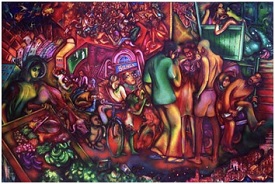
In the centre of his work 'City for Sale', one sees a banner of the film 'Silsila'. Surrounding the cinema are street scenes of Baroda life. Figures drop from a riot scene over buildings and vegetables spill from a vendor's cart. Narrow alleys beyond the scene are simultaneously escape routes as well as mazes spelling anxiety. One finds a leper, visible on the top right hand side. Nearby rioters strip other men to see whether they are Muslims; tiny figures appear trapped into the veil of a vegetable vendor.
Individual texts, like "City for Sale", Kachindo ane Darpan or "City: Memory, Dreams, Desire, Statues and Ghosts – Return of Hiuen Tsang" according to Lotman are in semiotic terms, 'isomorphic' or structurally similar to the culture in which they are produced. As he notes, "The laws of construction of the artistic text are very largely the laws of the construction of culture as a whole. (1990: 33). As mentioned earlier cultural semiotics allows us to analyse all kinds of texts - verbal, visual, architectural and musical - with a common theoretical framework. Analysis of such texts helps understand the structure of the semiosphere, the space that generated those texts. It would be useful to analyse two more texts, using cultural semiotics and see how they throw light on the semiosphere of Baroda. Both the texts are poems by Gulammohammed Sheikh and are from his collection Athva Ane. Translations are mine.
SANSKAR NAGARI
The full-moon rips apart
The palm leaves and waits
On the filigreed rails
Of the museum balcony
No one has time
Even to cast a glance
At his face
Pale like the visage
Of a deposed king
Just as no one bothers
To cast as much a glance
At the carcass of the whale
Dangling in the museum hall
No one cares to look at him
The city
Like a sheep sniffing the light
Is herded towards the darkness
The exasperated moon
Climbs atop the museum
No one bothers even to grin
At his face which bobs like a dish
On the museum top
Behind the closed doors
The grave-faced ladies and gentlemen
Untie the straps of the mummy
And begin to devour
The moon roams around
Snorting like a pig
Rubbing his tongue
On the road
(Athva Aney 115)
The semantic trope, as defined by Lotman, is 'a pair of mutually non-juxtaposable signifying elements, between which, thanks to the context they share, a relationship of adequacy, is established', on which the poem is built is the juxtaposition, a dialogic relationship, between the two untranslatable languages. the symbolic language of the elemental and primitive world of nature 'prakriti' on the one hand and the language of the artificial world of culture or 'sanskruti' (literally 'refinement') on the other. At least one aspect of the semantic trope, according to Lotman, is the visual language.
Vadodara is popularly known as 'Sanskar Nagari', literally 'the City of the Cultured' and also as 'Sayaji Nagari' literally, the City of Sayaji, after the erstwhile ruler of Baroda, Maharaja Sayajirao Gaekwad III (1863-1939). It is also called the cultural capital or the educational capital of Gujarat. However, according to the speaker of the poem the 'culture' today has turned into museum where 'the grave-faced ladies and gentlemen' turn a blind eye towards the living and the elemental aspects of human life symbolised by the moon and devour the dead bodies mummified in the museum. The irony in the poem rests on pointing out that necrophilia which is associated with the lack of culture and civilisation is actually what characterises the contemporary culture in the cultural capital of Gujarat. The poem hints at the sinister underbelly of the city which has unsurprisingly seen such communal tension.
The semiotic encounters and confrontations in the city, as Lotman has noted, work diachronically as well as synchronically: the images of Baroda museum, the skeleton of the whale and the mummies in the museum, and even the deposed king of princely state and other 'leftovers from the past', and the images of contemporary decadence in the form of grave-faced ladies and gentleman eating the dead bodies produce what Lotman has termed 'illegitimate' associations and new information reveals that the city itself is a mechanism which not only produces new information but also recreates its past and withstand time. History, according to Lotman, is culture's memory and it not only a relic of the past, but also an active mechanism of the present. (1990: 272). The poem generates a new image of the past by multiple modes of translating.
The poem, so striking in its visual and surreal imagery, attempts to translate the visual language into verbal. The poem also translates the Western avant-garde languages of surrealism and imagism into Gujarati. It need not be overstated that translation in Lotman's semiotically bilingual model of communication is not conceived as imitation or copying but as being fundamental to generation of new information. In fact he argues, 'translation is a primary mechanism of consciousness. To express something in another language is the way of understanding it. (127)" and that "the elementary act of thinking is translation. (143)." In fact, entire semiosphere functions because of translation.
An another poem 'People' (Manaso : Paintings of Robert Hansen) we see these translating mechanisms underlying modernism and the avant-garde more clearly. It is built typically on comparable juxtapositions, and dialogic interactions: those of the language of visual art and the language of the verbal art, on the language of the elemental imagery and the language, and on the language of the Western avant-garde and Gujarati language.
PEOPLE
(Paintings of Robert Hansen)
These people don't have mouths.
Those who have mouths
Have them inside them
They do have legs, hands, chests, or fingers.
What they don't have is a faintest idea
If they are their own.
Hence at times it seems
They are standing on their companion's legs,
With a child's chest and aged heads.
If there is any blood left at all
In their pipe-like bodies
It will be all white.
Their bones are insufferable
Like the claws of the steamed crabs.
Their feet stuck in the marble-white mud.
Their heads are like crosses
Unable to turn around and look.
One of them
Tall as a mountain
Looks down in contempt
Upon his wasted and handicapped brother.
Another one has only clothes for his body.
One of them has a head
But no body
Another one listens frigidly
To a message from an angel
Yet another one drips like a lump of flesh
Dangling at the butcher's
In one place a few of them huddle together
And look intently at one of them
In another other place they stand static
Like a tree of milk
Putting on the garment
Puffed up with the rags of the lifeless sky
And in another place
They are frozen like the graveyard cacti
Over the trash heap of dismembered limbs
(Athava Ane 45)
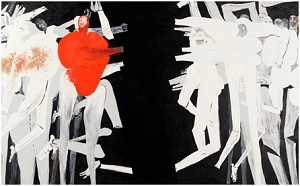
The poem obviously translates the language of the paintings of the American visual artist Robert Hansen (1924-2013). Dennis Reed (2005) notes, "Hansen is fundamentally a figurative painter, and the figures that populate his paintings display an endless variety of postures. The figures are highly mannered (not classical in proportion). Sometimes they stand alone, squarely facing the viewer. They stare, often blankly. The figures can be passive or aggressive, humble or god-like. In some paintings, single figures seem to float or balance precariously. In other paintings, figures huddle in mass. Alone or grouped together, they are universal— the skin of individuality has been stripped from them." Reed also goes on to note, "There is another possible source for the imagery in his work. Hansen grew up in a tiny farm community, the son of the town butcher. Working for his father, Hansen learned various aspects of the trade. He observed the joints that divide body parts as he dissected carcasses and carved steaks and roasts for sale at his father's meat market. Hansen believes that his stylized, fragmented – even dismembered – figures may have had their origin in these activities, as did his interest in the fundamentals of the human anatomy."
Another interesting fact for us that Reed tells us is that in 1961-62, Hansen received a Guggenheim Fellowship and a Fulbright Senior Research Grant. These awards allowed him to travel in India and to Southeast Asia and Baroda in particular. He was attracted to Asia and India in particular, because the multi-limbed figures of Asian art were similar to the figures that he had produced prior to his travels. Hansen translated human figures from Asian art and the Asian poet translated his paintings into an Asian language. It is not known whether Hansen was aware of the poem written in Gujarati on his works, but what is interesting that whether it is the Gujarati avant-garde poetry or the avant-garde in the American visual art, it is always a translational and semiotically dialogic phenomenon where the texts or the codes from across the borders of the semiosphere are adapted to introduce an element of unpredictability and bring about 'explosive' changes in the respective language. Thus from the perspective of cultural semiotics we no longer follow the pervasive normative tendency to view modernism and avant-garde in India as 'derivative' or 'inauthentic' phenomenon as the mechanisms for generation of new information in any culture are similar.
Besides, as this framework allows us to address the questions of generation of new semiotic information through artistic innovation, and the questions of the retention of the past information through memory and tradition – the questions critical to our understanding of modernism - it helps us to comprehend the phenomenon of modernism and avant-garde in the Indian context in a nuanced and enriching ways. It reveals that modernity is neither a linear process nor a monolithic process which happens en bloc and en mass to a culture. It is neither exclusively a discontinuous phenomenon nor an exclusively gradual longe dureee kind, but a chaotic interaction of both the kinds of processes happening at multiple semiotic layers of cultures. We can visualise why some languages (like fashion) develop abruptly while others processes like natural languages, the language of caste, religious beliefs, school pedagogy, or electoral politics change extremely slowly, in a gradual way.
Modernisms and postmodernisms, on the other hand, can be conceptualised as umbrella terms for multiple avant-garde movements in arts which deliberately and programmatically intend to bring about 'explosive' processes of generating radically new information and meanings in various semiotics systems i.e. the languages of painting or visual arts and fashion or the languages of literature or architecture. It can also account for the ways the multiple dissimilar poetics and poetries like 'gopkavita', 'modernist' or 'postmodernist' co-exist and often dialogically.
Moreover, cultural semiotics allows us to analyse all kinds of texts - verbal, visual, architectural and musical - with a common theoretical framework. It provides us with handy tools to analyse them and also discover the underlying semiotic mechanisms (the notion of semiosphere, semantic tropes and so on) which generated them. In short, cultural semiotics can provide a framework not only for cultural history, comparative literary historiography, but also tools for textual and contextual analysis.
As far as Gujarat is concerned, Baroda, as a 'semiosphere', can be seen as a unique semiotic mechanism, a distinctive culture-generator. Its semiotic polyglottism and dialogic apparatus comprises of often incompatible languages like the languages of western avant-garde visual arts like surrealism or expressionism, folk and regional idioms (Sheikh's use of kaavad), languages of experimental cinema, Bollywood (the Sheikh painting shows a banner of the film 'Silsila' ), languages of modern poetries from all over the world, languages of western literary criticism and theory, languages of diverse architectural styles, a "melting pot of texts and codes" which are peculiar to it in . As a place, in Lotman's terms, it is "a place of hybridisation, recordings, and semiotic translations" which makes it into "a powerful generator of new information". It is a mechanism which 'forever recreates its past' as Sheikh's poem shows and 'withstands time', and a space that is distinctive and unique in Gujarat. Cultural semiotics allows us to analyse all types of texts: verbal, visual, architectural, musical and so on with a single theoretical framework. Analysis of individual texts like Kachindo ane Darpan or poems and paintings by Sheikh helps us to discover the underlying semiotic mechanism of this space which generated these dark, surreal and dazzling polysemantic texts.
WORKS CITED
- Lotman, Juri. "On the semiosphere." Translated by Wilma Clark. Sign Systems Studies 33.1, 2005, Web
- ---Culture and Explosion. Edited by Marina Grishakova. Translated by Wilma Clark. Mouton de Gruyter. Berlin
- New York, 2004. Print.
- ---Universe of the Mind. A Semiotic Theory of Culture. Bloomington/ Indianapolis: Indiana University Press. 1990. Print.
- Lotman, J and Boris Uspensky. "On the Semiotic Mechanism of Culture." New Literary History, Vol 9. No.2: Soviet Semiotics and Criticism: An Anthology. 1978, 211-232, Internet http://www.jstor.org/stable/468571
- Panchal, Shirish. Suresh Joshi: Makers of Indian Literature series. New Delhi, 2004
- Reed, Dennis. 'On Selected Works of Robert Hansen (1957-1987)'. The Thomas Hayes Gallery, Hollywood. Nov. 2005, Web. http://www.thomashayesgallery.com/2010/01/robert-hansen/
- Sheikh, Gulammohammed. "The Keynote Address', National Seminar on Theorizing Little Magazine Movements in India, organized by Dept of English, MS University of Baroda, March 2015. Based on my personal notes.
- ----Athva Ane. A collection of Gujarati poems. Vadodara and Ahmedabad. Sawad Prakashan and Kshistij Prakashan. 2013
- ---"Weaving Worlds within Worlds: Conversation with Gulammohammed Sheikh', an Interview by Uma Nair, Academia.edu. 2011. Web
- URL : https://www.academia.edu/11313353/Conversation_with_Ghulam_Mohammed_Sheikh
- ---" Poetry and Painting Allow me to be Free", Interview by Nadine Kreisberger, Indian Express Daily, New Delhi, 5 June 2011, Web.
- URL: http://indianexpress.com/article/news-archive/web/poetry-and-painting-allow-me-to-be-free/
- Thakkar, Dhirubhai. Arvacheen Gujarati Sahityani Vikas Rekha: Aadhunik ane Anuaadhunik Pravaho. An Outline of the Development of Modern Gujarati Literature. Ahmedabad, 2006. Print
- Torop, Peeter. "Semiosphere and / as the research object of semiotics of culture'. University of Tartu, Sign Systems Studies 33.1.2005. Web.
- Williams, Raymond. Marxism and Literature. Oxford: Oxford University Press, 1977, pp 121-6, Print
- Williams, Raymond 'Modernism and the Metropolis' and 'When Was Modernism' in Dennis Walder ed. 1990, pp 164-170, Print.
- Zaman, Rana Siddiqui, "Medium and Message', Frontline, Vol:28 Iss:23, Nov. 05-18, 2011, Web. URL http://www.frontline.in/static/html/fl2823/stories/20111118282313000.htm
**********

Issue 67 (May-Jun 2016)
-
Conversation
- Ambika Ananth: In Conversation with Shailender Singh
- Pratibha Umashankar: In Discussion with Kamla Bhasin
-
Critical Articles
- Jabeen Fatima: Mahasweta Devi’s “Souvali”
- Mithun Bhattacharjya: Laxman Gaekwad’s The Branded
- Namrata Pathak: Visions of Utopia
- Sachin Ketkar: City for Sale
- Samrat Laskar: Bhopal Gas Tragedy in Indian Fiction
- Srinivas Reddy: ‘Look to this Poem’