Rositta Joseph Valiyamattam
Rositta Joseph Valiyamattam
Narrating the Nation in Post-colonial times
[This paper focuses on Adiga’s second book Between the Assassinations (2008) - a collection of inter-linked stories set in Kittur on the South–western coast of India, between 1984 and 1991. Undoubtedly, the human existential drama is obvious, but the book also becomes an authentic, objective chronicle of the political, economic and socio-cultural history of India between 1984 and 1991. Kittur, a small, undistinguished everytown becomes an India in miniature. It would be highly interesting to assess how far Adiga has succeeded in narrating the true story of a nation and presenting the intricate intertwining of national and personal destinies in post-independence India. – Author]
The Nation in Indian English literature
Indian English literature, especially the Indian English novel has always reflected the story of the Indian nation. Post 1980, after Rushdie’s Midnight’s Children, writers began to express and deconstruct national realities in new ways. (1) Caught betwixt the forces of western corporate globalization and anti-western extremist movements, the writer becomes merely an instrument to express the paradoxes of a nation that is too complex and unreal to be portrayed accurately. (2)
The Indian Nation and Adiga’s work
Aravind Adiga’s work forces us to take a new look at ourselves as a nation. Balram Halwai in The White Tiger says that prior to freedom India was like a well-kept zoo, but when the British left, the cages were opened and the strongest animals ate all the others-“..in the old days there were one thousand castes and destinies in India. These days there are just two castes: Men with Big Bellies, and Men with Small Bellies. And only two destinies: eat-or get eaten up.”(3) Again he speaks of “the Rooster Coop” syndrome whereby millions are kept in perpetual servitude by a few powerful and rich citizens. (4) Adiga’s sense of India’s pluralistic tradition, his frank portrayal of the realities in India and his deep desire to see the regeneration of India is reflected in the views of eminent writers. Writes Arundhati Roy, “Fifty years after Independence, India is still struggling with the legacy of colonialism, still flinching from the ‘cultural insult’. As citizens we’re still caught up in the business of ‘disproving’ the white world’s definition of us. Intellectually and emotionally, we have just begun to grapple with communal and caste politics that threaten to tear our society apart.” Meanwhile we have to deal with the indiscriminate privatization of our natural and human resources. (5)
Today, the fundamentals of the national movement need to be reinforced strongly. As Gandhi stated in 1922: “Swaraj can never be a free gift by one nation to another. It is a treasure to be purchased with a nation’s best blood.” (6) India, if it is wise, shall preserve its way of life, its civilization of diversity, tolerance and spirituality against the onslaught of global culture.
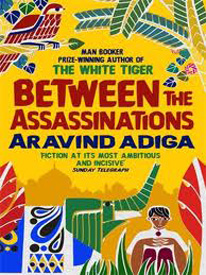
Between the Assassinations
Aravind Adiga was born in Madras in 1974. He studied at Columbia and Oxford Universities. His first novel, The White Tiger, won the Man Booker Prize for 2008. A former Indian correspondent for Time magazine, his writing has also appeared in the New Yorker, the Financial Times, and the Sunday Times among other publications. He lives in Mumbai
Between the Assassinations (2008) is an entertaining, finely detailed “novel in stories”, presented as a travelogue and written in a warm, lively, colloquial style, with a cartographer’s precision and a novelist’s humanity. The stories revolve around different classes, castes and religions in India. Even though it was published after The White Tiger, Between the Assassinations was started - and most likely finished - before The White Tiger but was shelved for lack of publishers. Several incidents in The White Tiger are seen here in raw, unpolished form. But, it is more mature, subtle and offers a richer portrait of India than his novel
Reminiscent of R.K.Narayan’s Malgudi, Kittur is a fictitious town closely modeled on Adiga’s native Mangalore. However, there is also a real ‘Kittur’, a village of Belgaum District of Karnataka, a place of historical significance. Queen Chennamma of Kittur (1778-1829) is known for her resistance to British Raj. Adiga’s powers of accurate observation and his realistic presentation of geography, history, economy and culture transforms a small town into a symbol of the authentic realities of millions of small towns, villages and cities between 1984 and 1991, a period of extraordinary transformation in India. In Between the Assassinations, one can see, hear and smell India even as the pathos, ironies and injustices of life are reiterated.
The Oxford dictionary defines “assassination” as the murder of a political or religious leader. The assassination of an important leader almost always changes the course of a nation’s destiny. Adiga has neatly segmented his stories into seven days of narration, representative of the seven years of life that elapses in Kittur between the assassinations. This comes in contrast to The White Tiger, written in the epistolary form. (7) What finally emerges in Adiga’s book is the political, economic, moral and social chronicle of a nation in transition in the seven-year period between the assassinations of Prime Minister Indira Gandhi and her son Rajiv.
In their monumental work India Since Independence, Bipan Chandra, Mridula Mukherjee and Aditya Mukherjee give an objective assessment of the Rajiv Gandhi era, the time period of Adiga’s book. Each of Adiga’s stories has a tragic tone. Indeed this was the time when the euphoria of Independence had finally given way to “ frustration, cynicism and a sense of despair”. (8) The murder of Indira Gandhi, secessionist movements, regionalism, Naxalism, militancy, communal, linguistic and caste violence and the tragic end of Rajiv Gandhi – all culminated to put the nation in a sombre mood.and many predicted the disintegration of India. All the same, the new policies initiated by Rajiv had raised a lot of hope. To put it like Dickens, “It was the best of times; it was the worst of times.” Many of Adiga’s characters miss Mrs. Gandhi’s firm leadership and are disappointed with her son. Adiga highlights the years of Rajiv’s rule and the period immediately thereafter :new policies and modernization, corruption, caste-based politics and the rise of religious fundamentalism as a great political force. Nevertheless, sweeping reforms take place post ’91 under a non-Gandhi. Adiga’s stories examine those years of squandered idealism and hope.
This book occupies a major place in the post-colonial narration of the nation since it deals with the 80s and 90s, when according to eminent sociologist Satish Deshpande, “…for the first time in the history of independent India, the nation faced a number of ‘big’ problems that …were more social than economic. Secessionist movements in Punjab and Kashmir based on ethnic-religious identity; the Mandal controversy and the intrusion of caste into a supposedly casteless urban middle-class milieu; the advent of Hindutva and its elevation of the communal divide on to the centre stage in national polity; and the widespread concern about the cultural impact of globalization…” (9) Also, the very term ‘post-colonial studies’ reflects the confident and sophisticated attitude of Indian scholarship which had overcome its awe of Western scholastic dominance by the 1990s. (10)
Adiga’s book is a true re-appraisal of India in a specific time period. In his book Being Indian, Pavan K Varma argues that India must understand herself before dreaming of becoming a global power. This is also vital for the world community since India will have a tremendous impact on global affairs in the 21st century. Europeans either gaped or gulped at the idea of India or the Orient, which they had created to suit themselves. Enthusiastic nationalists created an image of India as ever democratic, peaceful, non-violent, religious, otherworldly and spiritual. All this was self-deceptive since post-independence India has seen a fascination for power, wealth, violence and technology. But what redeems Indians is the “amazing ability to retain hope” and “the resilience that comes from being continuously exposed to adversity.” (11) This is exactly what Adiga’s stories reveal for his characters show infinite patience and perseverance.
Adiga sets Kittur on India’s southwestern coast, in between Goa and Calicut, bounded by the Arabian sea on the west and the Kaliamma river on the east. A town with a rich history, amazing scenic beauty and diverse religions, races, cultures and languages, Kittur is a ‘must-see’ place for tourists, especially during the “dry, cool” months of October, November and December.
Adiga’s book reads like a tourist brochure. The first page gives information on ‘How to Get to Kittur’ which according to Khushwant Singh “will stay in the reader’s mind till the end”(12) Then follow twelve (in certain editions, fourteen) short stories which are put put down in the form of the jottings of a traveller’s diary from Day One to Day Seven. Sandwiched between the stories are informative sections like ‘How our Town is Laid Out’, ‘The History of Kittur’, ‘The Languages of Kittur’, ‘Kittur Total Population- caste and religious breakdown’. The book concludes with a chronological account of the major events in Kittur between October 1984 and May 1991. Adiga pretends to be a tourist guide, someone who has spent years in Kittur and knows the place in and out and is intimately explaining things to the reader.
The first story of Ziauddin, a coolie, is the story of a little boy who rises above his poverty and the insults of the majority community, to turn down the attractive offer of becoming a terrorist. Here, we see our secularism under threat and the indoctrination of impressionable minds. These years witnessed the anti-Sikh and Babri-Ayodhya riots that shook the very soul of a nation. Though riots had been occurring ever since Partition, 1984-1991 was the time during which religious fundamentalists, especially Hindu communalists, whipped up religious passions and sentiments to a new frenzy and the secular fabric of the nation seemed to be in real danger. We see a slackening of the nation’s long vigil against communal forces. Infact during the 1990s the BJP had launched a campaign to hoist the national flag at Idgah Maidan in Kittur, near Hubli.As Shashi Tharoor remarks, the political ethos of India changed in the 1990s and as nationalism was defined in terms of religion, there was a second partition of the Indian soul. (13)
Adiga now describes the layout of the town. At the heart of Kittur is the porn-theatre Angel Talkies lying in the commercial district of Umbrella Street. To its north is the Catholic area of Valencia and Bajpe forest. To the south lies the sea-port and Tipu Sultan’s fort.
The second story of Abbasi, a factory-ownerwho fights corruption,risking his livelihood,shows how the corrupt system and red-tapism suffocates a country. Infact, corruption charges led to the fall of Rajiv’s government. Every patriotic Indian will ask himself the question Abbasi puts to his own self: “Is there nothing we can do to fight back?” To quote Bipanchandra, et al in India Since Independence, “Corruption at the lower levels of the bureaucracy was an issue of everyday concern for all citizens, rich or poor, and it was widely felt that high-level corruption created conditions of legitimacy for the lower-level variety.” (14)
While the first two stories depict two Muslims fighting the forces of communalism and corruption, the next two stories document the deep caste-based divisions in India. Arundhati Roy writes, “Deep at the heart of the horror of what’s going on lies the caste system: this layered, horizontally divided society with no …human – humane- interaction that holds the layers together. So when the bottom half of society simply shears off and falls away, it happens silently…” (15) Perhaps, that is why Nehru regarded the “psychological and emotional integration of the people of India” as the greatest challenge. (16)
There is the story of a Dalit bookseller, Xerox Ramakrishna, who takes pride in selling illegally xeroxed books at low rates, for his father’s profession was cleaning the toilets of rich landlords with his loincloth. But, when he is caught selling Rushdie’s ‘Satanic Verses’, the upper caste Inspector takes pleasure in breaking his legs, though Xerox pleads ignorance of the ban on the book. Once out of the hospital, Xerox openly defies the police and plans to sell only one book “banned throughout the Republic of India”- ‘Satanic Verses’. For the policeman and the lawyer who torture him, Xerox is not just a petty thief but a symbol of the oppressed who have begun to assert themselves and challenge the powerful. While the obsolete system of reservations and the discontent of the Inspector may well be a prelude to the Mandal agitation of the 1990s, Xerox’s open rebellion shows that the Dalit too will no longer take insults lying down. His act of defiance challenges the Indian State which has failed to establish true equality. Adiga underlines the fact that unless social attitudes change, no amount of quotas will lend dignity to the downtrodden .The conditions in jail and the corruption of the police force reflect the sorry state of the criminal justice system in India.
Also, we meet a college student, Shankara Kinni who bursts a bomb in class to avenge those who humiliate him for being a half-caste.As he tells himself, “ I have burst a bomb to end the 5,000 year old caste system that still operates in our country…to show that a man should not be judged, as I have been, merely by the accident of his birth.”Adiga projects the intense longing -of an older generation to find security in caste and of an educated young generation to be “free” of this “repulsive” creation of their ancestors. It is made clear that, on the eve of the 21st century, no religion in India is free from this system. The frustration and discontent that ripened in that era, have resulted today in Naxalism and terrorism. Shankara’s act of exploding a bomb sounds so familiar in this age of terror.
The fifth and sixth stories are about two men, D’Mello and Kamath, confronted with Change, with the Truth of the moral and political degeneration of a country.
Mr. D’Mello, the strict, orthodox, highly idealistic teacher at St.Alfonso’s School, is bitterly disillusioned by the corruption in post-independence India and the immorality of the young generation. When, his favourite pupil and sole comfort, Girish too shows a desire to see pornographic pictures, he dies of a heart attack. The old-fashioned D’Mello versus the rest of the school symbolizes the fall of orthodoxy and the changing morality of a nation during the era when western ideas were being increasingly imitated. The shadow of the Emergency lies heavily over the story as does the question whether coercion is to be allowed in a democracy and to what extent the State can control the private lives of citizens, questions that echo even today. D’Mello strongly feels that India has a “beast” inside her and only Mrs. Gandhi knew how to control it.
Adiga now quotes a Jesuit scholar and narrates the history of Kittur, which turns out to be a history of India in miniature, ruled by invaders and colonizers. An ancient town famous for the Kittamma Devi Temple, it became home to Arab merchants, Muslim dervishes, The Vijaynagar empire, Jesuits, Portuguese, British and finally the freedom struggle in 1921.
Gururaj Kamath, committed and famous journalist, one day realizes that freedom of the press is a myth. He realizes that it is the “fate of every journalist ... in this whole world” to walk on a “false earth” where the innocent are punished and the guilty are free, for his paper is owned by the corrupt politicians and rich men he tries to fight. His effort to write a true history of Kittur is deemed as madness and he loses his job. It was during this era that newspapers and media were increasingly becoming the fiefdom of politicians and business-houses. The Emergency curbed freedom of the press and the late 80s and early 90s saw the media reduced to a handmaiden of the elite, a process that has reached its culmination today. As the Editor tells Kamath, “You and I and people in our press pretend that there is freedom of press in India but we know the truth.” Ignorance seems to be bliss for knowledge leads to a frustrating death. As Arundhati Roy states in her essay “Peace is War”, neoliberal capitalists control democracies by reducing the press, parliament and judiciary to commodities that are available to the highest bidder. (17) The incredible extent of corruption in public life, even in the judiciary came to the fore in the 1990s. Aravind Adiga poignantly delineates the psychological crisis of a changing nation as the common man finds himself helpless in the face of the corrupt and mighty State and System.
Even as Adiga gives us a brief description of the languages of Kittur, we realize that it is a portrait of India, a nation that has retained its multicultural, multilingual identity inspite of the onslaughts of globalization. Several dialects of Kannada, Tulu, Konkani, Malayalam, Tamil, Urdu and English are spoken by people ranging from Brahmins to Bunts and Hoykas, Roman Catholics to Muslims, Migrant workers to affluent middle classes.
The next three stories present a moving picture of poverty and the ever-increasing gap between haves and have-nots as India enters the era of liberalization and privatization. Adiga’s stories reveal the total failure to implement the Directive Principles. The story of rural migration to cities and the life in slums is seen through the eyes of the little children of a construction labourer, Soumya and Raju, who beg to buy drugs for their father. The two stories of two servants, Jayamma a Brahmin cook and George D’Souza a catholic driver, show the subtle yet formidable barriers that separate master and servant, rich and poor. Adiga explores the psychology of the master-servant relationship revealing how poverty becomes a great leveler, uniting people of all castes and creeds
Meanwhile, Adiga provides a caste and religious breakdown of the 1981 census of Kittur, where 89 people out of more than a lakh declare themselves free of religion and caste.
The tale of Ratnakara Shetty, a struggling lower middle-class salesman who helps a young man to fight AIDS, reflects the power of one man’s compassion against the backdrop of the enormous social stigma and ignorance attached to the disease, at a time when India came to terms with the AIDS epidemic. This episode takes place against the larger backdrop of moral, social and political degradation in the country. A man represents the fatalism of Indians when he says, “Everything’s been falling apart in this country since Mrs. Gandhi got shot…We’re not meant to be masters of our own fate..” Ratnakara Shetty believes in destiny but will not give up without a fight. The fate of an individual and a nation become inextricably intertwined.
Next, we are shown how the beautiful forest of Bajpe,the ‘lungs ‘ of Kittur is mercilessly destroyed, symbolic of the massive deforestation unleashed in the 80s and 90s by greedy multi-national corporations and land developers, creating the monster of pollution and a spiritual wasteland.
Finally, the story of a disillusioned old Communist, Comrade Murali, is the story of how Marxism, idealism and all other political ideologies have failed to uplift the less privileged in India, as these systems are either hopelessly outdated and impractical or completely corrupt.
The continuing colonial legacy is frequently reflected in the stories, whether it is in the references to British rule or the disillusionment with post-independence India, the divide and rule policy continued by politicians to spark riots that serve vested interests or the memorials of freedom fighters that are shown only to those who speak English or dress well. The conflict between tradition and modernity which pervades several stories is also the result of a unique interaction with the West. Neo-colonialism continues as the elite join hands with western powers to set up empires in India and even gag or buy the media. The propaganda machine in the West asserts that the West is aiding the poor East, while in fact looting it(18) There is even an English lady who earns a living teaching Yoga to Indians. Each story has discontented poor like Xerox Ramakrishna or George D’Souza or Soumya and Raju who thirst for the power of education and money.
The stories of Xerox, Shankara and Jayamma show individuals hopelessly trapped in an absurd caste system that curbs the full flowering of the human being. Infact, caste itself is a colonial construct. It was the British who solidified the caste system by introducing caste based census . Imperialists asserted that caste-rivalry was an essential part of the Indian identity and thus justified colonial rule. (19)
Nothing reflects neo-colonialism better than the socio-economic situation in Kittur. The village economy is destroyed and migrant labourers flock to the town. The industries all depend on western nations and workers go blind embroidering shirts for American ball-room dancing. The fall of the Soviet Union had made the Indian economy more dependent on the U.S. By 1991 the Gulf war had worsened the economic crisis. India’s foreign exchange reserves fell rapidly and the country was at the edge of default. According to Eric Hobsbawm, the extreme economic inequality and instability created by the global free market in the 1990s is at the root of the major social and political tensions of the 21st century. (20)
The amazing hope and resilience of most of the characters in Adiga’s stories is the redeeming feature of Indian society. As Verrier-Elwin the British scholar-missionary who took up Indian citizenship wrote in 1963: “All the same I am incurably optimistic about India. Her angry old men and disillusioned young men are full of criticism and resentment. It is true that there is some corruption and a good deal of inefficiency; there is hypocrisy, too much of it. But how much there is on the credit side! It is a thrilling experience to be part of a nation that is trying, against enormous odds, to reshape itself.” (21)
The chronology of events in Kittur at the end of the book proves that Kittur is a mirror image of India between 1984 and 1991. On 31st October 1984 Kittur gets news of Indira’s assassination and shuts down but there is greater interest in knowing the political destiny of the nation even as thousands of TV sets are bought to watch the PM’s funeral. In the November 1984 elections, just like Rajiv Gandhi, the Congress candidate rides a sympathy wave, defeating his political rival by a huge margin.1985 sees a surge in stock trading and private business. 1986 sees politicians leading Backward Class agitations. 1987 brings in a craze for cricket, communal riots, RSS rallies, urbanization, deforestation and slums. 1988-89 ushers in the Maruti car and the rise of the BJP. 1990 is a happening year- bomb blasts, computers, economic crisis due to Gulf war. All these are indicative of changes in India which is equally affected by international events and Rajiv’s IT plans. But on 21st May 1991, Kittur again shuts down after the PM’s assassination and once again a nation’s destiny changes course.
In his interviews Adiga himself says that his two works envisage 1991 as the year dividing old India from the new. The India of Between the Assassinations was ready to wait and suffer but post ‘91 the India of The White Tiger is exploding with the violence of the long suffering people. He says, “In that sense, Between the Assassinations is not a prelude to The White Tiger but presents an alternative vision of India – and poses a challenge to The White Tiger.” (22)
With regard to the themes, the social injustice presented in Between the Assassinations flares up into the cold heartlessness of the White Tiger, Balram Halwai. It is a powerful social criticism and warning that crime and terror will only escalate until social inequalities are removed. Adiga explores power-relations, the quiet anger of the subaltern, of those who are oppressed whether it is the minorities, backward castes or poor. His tragic vision of life where human beings have no way out and yet refuse to give up, makes him convincing. Vikas Swarup calls it a daring foray into the underbelly of India. (23) James Urquhart writes,” These punitive lives steadily accumulate into a simmering outrage at the injustice of poverty and caste discrimination, both in principle and in muscle-knotted, exhausted, hungry, desperate reality. (...) Moral complexities give texture and depth to most of Adiga's conflicted or oppressed characters, but the landscape of endemic corruption and relentless contempt for the have-nots makes Between the Assassinations a forceful, sobering interlude." (24)
Regarding characterization, Adiga’s meticulous description of men, women and children from all walks of life makes him, according to the Telegraph, “ a sensitive chronicler of modern India” (25) Soumya Bhattacharya in The Independent admires the empathy and insight in his characterization.(26)
And about his style, if he is inspired by Dickens, he has also tried to imitate R.K.Narayan in describing the beauty , the simultaneous simplicity and complexity of mundane life in India. Admiring the readability of Between The Assassinations, Khushwant Singh describes Adiga as “a born storyteller with a special gift of saying a lot in the briefest of space” (27)
Indeed, Kittur is a microcosm of India. Adiga stated, “The most patriotic thing a creative artist can do is challenge people to see their country as it is,". Indians may not always like what Adiga has to say, but their future depends on his freedom to keep saying it. (28) And that is why narrating the nation becomes so important in these postcolonial times.
NOTES
1 Naik, M.K. and Shyamala A.Narayan. “The Lie of the Land: Introduction.” Indian English Literature 1980-2000 – A Critical Survey. By Naik and Narayan. New Delhi: Pencraft International,2001.16-17.Print.
2 Baral, K.C. “Imaging India:Nation and Narration.” Rethinking Indian English Literature. Ed. U.M.Nanavati and Prafulla C.Kar. New Delhi: Pencraft International,2000.71-72.Print.
3 Adiga, Aravind.The White Tiger.(2008).Delhi:Harper Collins Publishers India and The India Today Group,7th Impression, 2009.63-64.Print.
4 Adiga, Aravind.The White Tiger.(2008).Delhi:HarperCollins Publishers India and The India Today Group,7th Impression, 2009.175-194.Print.
5 Roy, Arundhati. “the ladies have feelings,so…”.the algebra of infinite justice.(2001)By Roy. New Delhi:Penguin Books India Pvt. Ltd.,2002.198.Print.
6 Gandhi. ‘Independence’, Young India,5 Jan,1922. Qtd. in Chandra,Bipan,et al. “TheEvoution of the Constitution”. India Since Independence. By Bipan Chandra, et al. New Delhi:Penguin Books India, Rev.Ed.2008.41.Print.
7 Sebastian, A.J. Is Adiga’s Between the Assassinations a Coop for The White Tiger?. Web. 3 June,2010.
8 Chandra, Bipan,et al. Introduction. India Since Independence. By Bipan Chandra
Et al. New Delhi:Penguin Books India, Rev.Ed.2008.9.Print
9 Deshpande, Satish. “Squinting at Society”. Contemporary India-A Sociological View. (2003).By Deshpande. New Delhi: Penguin Books India,2004.23. Print
10 Deshpande, Satish. “Mapping A Distinctive Modernity”. Contemporary India-A Sociological View. (2003).By Deshpande. New Delhi: Penguin Books India,2004.43. Print.
11 Varma, Pavan K. “ Introduction-Image versus Reality”.Being Indian-The truth about why the twenty-first century will be India’s. (2004).By Varma. New Delhi: Penguin Books India Pvt. Ltd.,2005. 15-16. Print.
12 Singh, Khushwant. “Review of Between the Assassinations”.The Outlook Magazine,24 November,2008. Web. 3 June,2010.
13 Tharooor, Shashi. “Unity,Diversity and other Contradictions: From the Milk Miracle to the Malayali Miracle”. India: From Midnight To The Millenium And Beyond. (1997).By Tharoor. New Delhi:Penguin Books India Pvt. Ltd.,2007.52,79.Print.
14 Chandra, Bipan,et al. “ Run-up to the New Millenium and After”. India Since Independence. By Bipan Chandra,et al. New Delhi:Penguin Books India, Rev.Ed.2008.361.Print..
15 “Scimitars in the Sun-In conversation with N.Ram”.The Shape of the Beast: conversations with Arundhati Roy.New Delhi:Penguin-Viking,2008.6. Print.
16 Nehru, qtd.in Jawaharlal Nehru-a Biography, Vol.3, p.22 Rpt. in Chandra, Bipan,et al. “Consolidation of India as a Nation(I)”. India Since Independence. By Bipan Chandra,et al. New Delhi:Penguin Books India, Rev.Ed.2008.107. Print.
17 Roy, Arundhati. “peace is war.” An Ordinary person’s Guide To Empire.By Roy.New Delhi: Penguin Books India Pvt.Ltd,2006.87-112.Print
18 Roy, Arundhati. An Ordinary person’s Guide To Empire.By Roy.New Delhi: Penguin Books India Pvt.Ltd,2006..Print
19 Deshpande, Satish. “Caste Inequalities in India Today”. Contemporary India-A Sociological View. (2003).By Deshpande. New Delhi: Penguin Books India,2004.122-123. Print
20 Hobsbawm, Eric. Preface. Globalisation,Democracy And Terrorism. By Hobsbawm. London:Little,Brown,2007. 3. Print.
21 Verrier Elwin,The Tribal World of Verrier Elwin,Bombay,1964,p.327. qtd. in Chandra, Bipan,et al. Introduction. India Since Independence. By Bipan Chandra, et al. New Delhi:Penguin Books India, Rev.Ed.2008.11.Print.
22 Adiga, Aravind. Interview by Vit Wagner.Web. 3 June, 2010.
Adiga,Aravind. “ Q & A: Aravind Adiga on India, the Man Booker Prize and His
New book Between the Assassinations”. Interview by Brad Frenette.The
Afterword. 10 June 2009. Web. 3 June,2010.< www.google.com>
23 Swarup, Vikas. ‘Caste Away.” The Guardian Review. 10 June 2009. Web. 3
June,2010. < www.google.com>
24 Urquhart, James, The Independent on Sunday- Review.19 July 2009. Web. 3
June, 2010.
25 Abell, Stephen. The Telegraph U.K.-Review.10 July 2009. Web. 3 June,2010.
< www.google.com>
26 Bhattacharya,Soumya. The Independent- Review.24 July 2009. Web. 3 June,
. 2010. < www.google.com>
27Singh, Khushwant. “Review of Between the Assassinations”.The Outlook
Magazine,24 November,2008. Web. 3 June,2010.
28 Greenberg, Susan H. “Tiger by the Tales”. Newsweek. 6 June, 2009.
Web. 3 June,2010.


Issue 35 (Jan-Feb 2011)
- Atreya Sarma : Hyderabad Literary Festival 2010
- Aparajita Ray : Immigrant Identity in Bharati Mukherjee’s novels
- Rositta Joseph Valiyamattam : Adiga’s 'Between the Assassinations'
- Samrat Laskar : Amitav Ghosh’s 'The Hungry Tide'
- Sukla Basu Sen : The ‘English’ Madhusudan Dutt