Yater Nyokir
Yater Nyokir
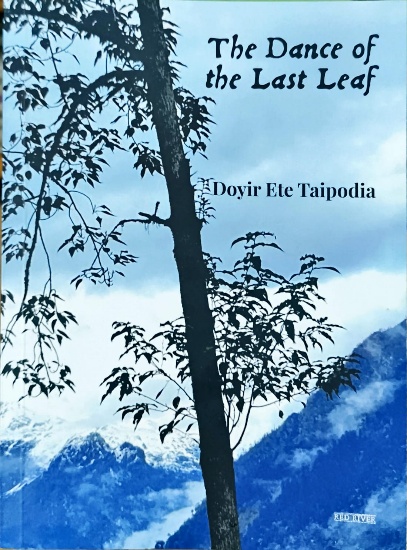
Emerging literary voices from the Arunachal Pradesh region have begun to articulate complex narratives of identity, memory, ecology, and cultural transition and continuity rooted in Indigenous worldviews. Among these voices is Doyir Ete Taipodia, a poet and academic whose work draws deeply from the cultural and ecological consciousness of Arunachal Pradesh. Taipodia is an Associate Professor in the Department of English at Rajiv Gandhi University, Arunachal Pradesh, whose work centres on oral traditions, Indigenous epistemologies, and the literary cultures of Northeast India. Her debut poetry collection, The Dance of the Last Leaf, published by Red River, emerges from the rich cultural and ecological landscape of Arunachal Pradesh, drawing particularly from the cosmology, folklore, and lived experiences of the Galo community. The anthology brings together personal memory, collective history, and Indigenous myth, weaving them into poetic reflections on land, identity, and cultural transition. In this interview, Dr. Taipodia reflects on her journey into writing and the influence of the oral traditions of Arunachal Pradesh in shaping her anthology The Dance of the Last Leaf. She also reflects on the role of poetry in negotiating identity, memory, and change. She discusses the aesthetic and cultural motivations behind her use of Indigenous imagery, the challenges of representing tribal experience in English, and the evolving literary landscape of Arunachal Pradesh. The conversation offers valuable insights into how contemporary poets from Arunachal Pradesh engage with questions of cultural preservation, literary representation, and the shifting realities of modern life.
*****
Yater Nyokir (YN): Could you briefly describe your journey into writing? What inspired you to become a writer?
Doyir Ete Taipodia (DET): I have always liked writing, but the urge to write creatively has grown stronger in the last few years. There are many stories around us waiting to be told. Our oral traditions, our everyday lived experiences, and the changing social fabric are all waiting to be narrated. These stories are important to me, and that is what pushed me to start writing more seriously. I found that poetry works best for me because it allows me to express these stories in a very nuanced space. Some experiences cannot be easily told in a straightforward narrative, but poetry provides a space to express them, even the most sensitive and emotional ones. Additionally, Arunachal is undergoing a very exciting phase in its literary journey. We now have well-known writers like Mamang Dai, Y. D. Thongchi, Yumlam Tana, Gumlat Maio, and also fresh voices like Bompi Riba, Subi Taba, Moge Basar, Gankhu Sumnyam, and many more. It feels encouraging to see writings from our state being read and appreciated in other parts of the country. In a way, it makes us all a part of this joyous moment.
YN: How would you define your literary identity—as a woman writer, an Arunachali writer, an Indian writer, or through another lens?
DET: I really feel a sense of pride and belonging as an Arunachali writer. My state, its culture, and its people are a big source of inspiration for me. I also enjoy reading literature from around the world, and I have many favourite authors from different places who have inspired me in different ways. But when it comes to my own writing, I naturally feel more comfortable writing about my state, its culture, and its people. I don’t see this identity as something that limits me. Rather, it grounds me and gives me a sense of where I come from. It helps me stay connected to my roots. At the same time, while I take pride in being an Arunachali, I also take equal pride in being Indian and a woman. For me, all these identities are connected, and I try to embrace them, including in my literary journey.
YN: Your book The Dance of the Last Leaf emerges from what appears to be a deeply personal yet collective memoryscape. What compelled you to transform personal memory into poetic testimony?
DET: Yes, I agree. Most of the poems are deeply personal. Almost every poem began with some kind of trigger—maybe a personal experience, a touching scene, an insight from certain events, memorable people I have met, a sense of loss, or moments that stayed with me. These have all been important sources of inspiration. Many of these experiences also felt meaningful to me because they reflect things and situations that we hold very close in our culture and community. “Lost Words,” for instance, grew out of many conversations and debates about our oral tradition. We have this story of how the script was lost to us, which I find very interesting. What is also fascinating is that versions of this story exist across different tribes. I have also always been drawn to the stories of our ancestors, especially the legendary Abo Tani, our many cultural motifs, our faith and traditions, and even our everyday struggles as we grapple with the strong presence of modernity.
Through my poems, I wanted to reflect both our cultural past and our living present—not just for readers in our state but also for readers outside. I hope that, in some small way, these poems can cross borders and carry our stories to a wider world.
YN: The title itself suggests fragility and continuity. What does the “last leaf” symbolize in the context of Arunachal Pradesh today?
DET: “Last Leaf” represents many things to me, but most importantly, it stands for a critical moment for our people and for our lives. I feel that right now is a moment of decision. If we are able to balance our society, protect our culture, environment, and values, and at the same time embrace the positive aspects of modernity, then we can move towards a future where we stand with sure footing, with our roots and dignity intact. But if we lose this critical moment, then in many ways we risk losing ourselves.
For me, the “Last Leaf” is still there, still attached. As long as it keeps fluttering in the wind and remains green, it can give hope to new sprouts and new leaves. Losing the last leaf should not be an option for us.
YN: Many poems such as “Igi,” “Gomku,” and “Mopin” draw from Galo cosmology and folklore. You retain Indigenous Galo terms without translation. Is this a political, aesthetic, or cultural choice—or all three?
DET: Definitely an aesthetic and cultural choice, and perhaps a political one too. I feel it is high time that our cultural signifiers, our metaphors, and our images become part of literary aesthetics and are accepted in literary discourse. And we should be unapologetic and proud of using them.
We have always learnt to use figures like Adam as the first man and as a symbol of mankind, the sun as a mighty god, or the rose as a symbol of love. But we have our own such representations. Tani, or Abo Tani, for us is the first man, and he also represents mankind. He is also the figure most familiar to me, so it felt natural that he becomes my first preferred reference. The sun is a mother to us; we call her Ane Donyi (Mother Sun), and this is how I want to refer to her in my writings. In this sense, it is also my way of bringing these Indigenous images, metaphors, and terms to a wider readership, and of showing the richness of our cultural signifiers.
YN: Do you see your poetry as an act of cultural preservation, resistance, or renewal?
DET: It is all three. Poetry is such a versatile medium that you can do many things within just a few lines. You can open up your heart, share your innermost thoughts, and express the most sensitive human emotions in lines that seem to come from the deepest recesses. Writing poetry is not only cathartic but also empowering. I feel a real sense of liberation when I am able to write even a few lines that truly capture what I want to express. I feel something similar when I read poets like Rumi, Maya Angelou, Alice Walker, W. B. Yeats, T. S. Eliot, Rainer Maria Rilke, Mamang Dai, and many others.
YN: Your portrayal of Itanagar in the poem “City of Bricks” captures a city negotiating between bamboo and concrete, hills and neon. How do you personally negotiate this tension between rootedness and urban transformation?
DET: Itanagar is like any other modern town, but it also has its own unique sensibilities that perhaps only a denizen of the town can fully understand. It has a rhythm of its own—chaotic and messy at times, with lanes and bylanes criss-crossing, and Fortuners and Scorpios almost racing with autos and trekkers. It has most of the modern amenities, but at the same time you see defaced mountainsides, vanishing hills, sludge and washed-out roads during the monsoon, and dust along the new highways.
Yet despite all this, the town carries on in its daily grind. People are resilient, often unbothered by these everyday inconveniences, moving ahead with a certain grit day in and day out. Everyone is negotiating these conditions in their own way and through their own struggles. It is a vibrant town, full of life, though it is also a place that needs more discipline and planning when it comes to urban life. I am sure we will get there someday. In my poems, I try to capture the ebb and flow within all this chaos. In many ways, I owe a lot to this place.
YN: Do you perceive modernization in Arunachal Pradesh as enrichment, erosion, or a complex combination of both?
DET: I feel that we Arunachalis have become quite adept at celebrating our traditions even in very urban settings. In fact, a kind of revival seems to be happening in society, with modern adaptations of different aspects of our culture. You can see people wearing their ethnic attire with pride, and there are also modern adaptations of folk and oral songs, stories, and even efforts toward preserving ethnic cuisines.
What does concern me, however, is the pace at which concretization is happening. Hills have vanished, and rampant deforestation and earth-cutting have transformed the landscape within just a few years. It is quite jarring and disconcerting. If development continues at this pace, there could be a heavy loss of the natural landscape. I think what we really need is a well-planned blueprint so that development can happen in a more balanced way.
YN: “Old Villages” powerfully captures the abandonment of ancestral spaces. How does migration, both physical and emotional, shape contemporary Arunachali identity in your view? DET: It is a reality that in many villages today most of the youngsters have moved away to more urban places, mainly for education and livelihood. In many cases, only the elders remain behind. In “Old Villages,” I imagine such elders wondering how they will manage things back in the village—who will follow the ancestral rituals and who will cultivate the jhum. Many such questions remain unanswered. On top of that, they are also worried about the well-being of their young ones who are away from home. It is a poignant situation and a sad reality. I do hope that in the near future we might see some kind of reverse migration in Arunachal, especially as the state opens up more to tourism and as young people begin to start new ventures in their own villages.
YN: As a woman poet from Arunachal Pradesh, do you feel your engagement with land, memory, and community differs from that of male writers?
DET: I don’t think my engagement with land and memory is very different from that of male writers. But yes, as a woman, I naturally articulate a more women-centric perspective because I am thinking and writing from my own experience as a woman. I tend to focus more on female subjects, and I feel more comfortable doing that.
YN: How does your experience as a woman inform your sensitivity to themes of loss, continuity, and cultural transition?
DET: When changes happen—whether personal, social, or collective—one of the first people to feel their impact on a very visceral level is often a woman, whether as a grandmother, a mother, or a daughter. For instance, in “Lady of the Meat Stall,” the woman is hard-pressed to chop and sell meat while a baby clings to her side. In “The Crow’s Dance,” it is an elderly woman who sits alone at home during the day while the rest of the family is away. She longs for the familiar fields, but she can no longer go there. The poem “Yearning” is about the bond between a mother and a daughter.
So even though these poems focus on women, they also reflect a woman’s position in society—how changes in society affect her and, through her, the family as well. For me, a woman’s experience often becomes a way of understanding my own society and culture more deeply.
YN: How would you situate your work within the broader landscape of Indian women’s poetry and Northeast Indian literature?
DET: Oh, I am happy to fit in wherever I find a place! I am happy to be seen as an Arunachali poet, a North Eastern poet, or an Indian poet. All I hope is that my poems become a gateway to Arunachal—its people and its culture.
YN: What challenges do you face when representing Indigenous experience in English?
DET: For me, one of the questions has always been how much of the Indigenous terms to use in my writing. The more Indigenous terms I use, the more a glossary may be needed, and too much glossary can sometimes take attention away from the reading process. So, it requires a nuanced balance when introducing native words into creative writing. There is also the challenge of translating tribal sensibilities that are deeply rooted in our cultural context. At times, the absence of equivalent terms means I have to use the closest possible meaning, which is not always completely satisfying. These are challenges, but they also give us opportunities to experiment with our writing, which I find exciting and refreshing.

Issue 127 (May-Jun 2026)
-
EDITORIAL
- H. Kalpana: Editorial Comment
-
ARTICLES
- Kavita: A Tryst with Economy: Liberalisation in Literary Discourse
- Lovely Soni: Narrating the Silence – A Human Rights Reading of Joothan: A Dalit's Life
- Monika Mishra: The Object Gazes Back: Women as Active Agents in the Development of the Narrative in Siddhartha Deb's Surface
-
INTERVIEW
- Anugrah Smitha Reghu: “You’ve Got to Be Connected”: A Conversation with Kalpana Naghnoor
- Raman Kaur & Narinder K Sharma: Stories of Living Earth – In Conversation with Claire Buss
- Yater Nyokir: Legislating Identity, Culture, and Memory – An Interview with Doyir Ete Taipodia
-
TRIBUTE
- Shirish Khare: Gyanranjan – A Guardian of Hindi Literature and the Ethical Imagination1