Bhavika Sachan, Abhinav Rai
Abstract
Drawing on Mikhail Bakhtin’s concept of carnivalesque and grotesque realism, this paper argues that the graphic novel, A Gardener in the Wasteland (2011), destabilizes traditional hierarchies. The paper presents the novel as a creative and literary work that repositions perspectives, visually and textually, by placing different timelines, spaces, sensibilities, aesthetics, and idioms together to underscore the pervasiveness and multidimensionality of caste oppression. The sequential art form employs various nuances such as grotesque, cartoonish images, interesting fonts, and speech bubbles to represent and symbolize subversion. This ‘visual’ carnivalesque manifests itself satirically within the liminal space of an inverted world which invites laughter by assigning the informal slang and cultural motifs of contemporary times to the 19th-century Hindu social order. The art also simultaneously elevates Dalits from the mire and filth with which the upper castes equate them. A Gardener in the Wasteland is explored as an alternative educative voice within the tradition of Indian comics. Education as a remedy to casteism is not just the novel’s subject but an objective; it tries to achieve through its form. The paper utilizes the carnivalesque literary mode to celebrate the rebellion engraved in the novel’s impactful narrative and witty visual imagery.
Introduction
Graphic novels have emerged as a significant tool for illustrating oppression and rebellion in India due to their ability to combine visuals with words, present diverse narratives and provide arguments with a unique dimension. Aparajita Ninan and Srividya Natarajan’s A Gardener in the Wasteland (2011) is a graphic adaptation and re-working of Jotiba Phule’s Gulamgiri (1873) which links perspectives and timelines with the visual mode to create awareness for Dalit marginalization in contemporary India. Unlike most graphic texts produced by survivors, or second-generation inheritors of what Marianne Hirsch designates as ‘post-memory’ (2002), texts like A Gardener in the Wasteland intend not to explore trauma’s psychoanalytic and social dimensions (as done in the works of Cathy Caruth [1996], Hirsch [2002], LaCapra [1997, 1999], among others), but to analyze the narrative strategies used in graphic writing.
The story of Phule’s life seeks to narrativize a continuous and ongoing process of traumatisation. The work addresses the very nature of continuities of oppression from history into the contemporary and its all-pervasive nature that cannot simply deem it as a past horrific event, and therefore must regard the pain as a “trauma-continuum” (Mehta and Mukherji 2015). Pramod Nayar’s “Graphic Memory, Connective Histories, and Dalit Trauma: ‘A Gardener in the Wasteland’” substantially establishes the link between the historical past and the contemporary present, by compelling the authors and readers to negotiate their perspectives within the narrative and outside in the socio-political realm by radically altering modes of storytelling and history writing (143-50). Meanwhile, Sarsar and Poonia argue for the narration in a graphic novel form that reconstructs the myths revolving around the caste system, providing an alternate space to reinforce Phule’s indictment of Hinduism (265-72). While recent studies on graphic narratives discuss the significance of the form for its political, cultural, visual, and social importance, the utilization of the carnivalesque element in the novels is hardly explored. This paper argues that the carnivalistic nature of A Gardener in the Wasteland represents historical oppression and the subversion of Brahmanic ideology through its grotesque and witty illustrations.
Visual Carnival and Carnivalesque
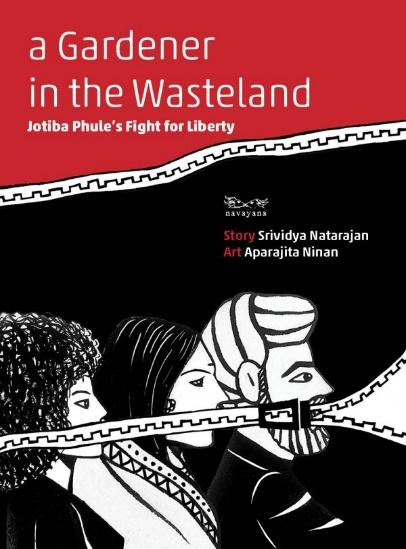
Associated with the negation and inversion of the normative societal trends, Mikhail Bakhtin developed the concept of the carnivalesque primarily through his analysis of Rabelais’ work, Gargantua and Pantagruel, in his acclaimed study of medieval folk culture, Rabelais and His World (1965). Herein, he defines ‘carnival’ as an established period in time when certain cultures engage in a celebration in a world of travesty. When a similar spirit permeates a work of literature, Bakhtin suggests that it partakes in or promotes the “Carnivalesque.” The carnival is textualized, and the carnivalesque provides a mirror of the carnival; it is carnival reflected and refracted through the multi-perspectival prism of verbal and herein, visual art. It designates “the transposition of carnival into the [textual and visual] language of literature,” to which Bakhtin refers appropriately but cumbersomely as “the carnivalization of literature” (Bakhtin 122). The carnivalesque thus transgresses strict rules of time, place, persons, and form; the logical confinement of reality into structures is mocked. Writers of the Nietzschean tradition have attributed the Spirit of the carnivalesque to a Dionysian frenzy. From the subversion of hierarchy in the plays of Plautus to the masquerade of Aphra Behn's The Rover, which challenges individual and social identities of gender and class, the carnivalesque gives the masses a chance to challenge the structures and hierarchies that oppress them. In effect, the carnivalesque mode eventuates a temporary subordination of certain embedded features of the official culture that may include the particular use of language and dress (including the profoundly important mask, cross-dressing or reversal of class). The unzipping of the protagonists’ mouths in the book cover illustration and the continuation of this idea throughout the work symbolically presents A Gardener in the Wasteland as the ‘unzipped’ carnivalesque space for disempowering an established system of discrimination.
Bakhtin characterized the “carnival sense of the world” (Bakhtin 107) as a space of "joyful relativity" (Francis 2019). However, the original concept is insufficient in accommodating the brutality of our modern world. The present context requires a neutral attitude of the carnivalesque such as that of Carl Jung (1933), who refers to it as a reversal of the hierarchical order. A significant instance in the novel is the visual representation of Savitribai Phule draping an unwashed, dirty, and ragged saree on her way to the school, tackling the hysterical mob against the education of the low-caste in 1840s Poona, and then changing into a clean saree for the classes.1 The counterculture that carnivalesque propagates finds basis in the concept of an alternate space. Liminality and liminal spaces of carnivals are the boundaries that serve the festering inversion and revolt. Turner posits liminality as time and space where normal modes of social action are withdrawn (Turner 359). This carnivalesque liminality is explicit in Savitribai’s attempt to educate sudra children. She wears an unwashed saree before entering the school and after leaving it. The dirty saree becomes representative of the larger system of prejudice while the school is recognized as the celebratory liminal space.
By placing different points of time, spaces, sensibilities, aesthetics, and idioms next to each other, A Gardener in the Wasteland creates a visual mimesis that underscores the pervasiveness and multidimensionality of caste oppression. The movement of the text through different temporal and spatial locations establishes the scope of its subject matter. It does not restrict itself to the trauma of a singular point and place in time but explores a “trauma continuum” (Mehta and Mukherji 2015). The man using a casteist slur in 2010, the Brahmins insulting Savitribai in 1848, the racist white Americans in 1957 and the berserk mob demolishing the Babri Masjid share the same angry, angular, and snake-fanged speech bubbles (Natarajan 9, 12, 13, and 110). The intervening distances of years and kilometres cease to be relevant as the text knits these incidents into a single narrative of continuing oppression – the twelfth-century massacre of Buddhists and the twenty-first-century anti-Mandal protests can be compared through political and ideological underscores (83,102). This collation of the past and the present is also achieved by assigning the informal slang and cultural motifs of the present to the 19th century: a Brahmin in a black eye mask of a thief says, “Squeeze the peasants dry – that’s my motto. Easy money” (11).
There is an absence of well-formed panels and gutter spaces with historical figures such as Thomas Paine popping out of the book, Rights of Man, to enlighten and guide Phule in his fight against caste oppression. This is a move away from the accepted form and structure of a graphic novel in a carnivalesque sense. Savitri’s break from the ‘prohibited’ icon (as shown) is visualized so powerfully that it even smashes the comic panel, unable to contain the fervour and spirit of rebellion and subversion within the graphic space.
Mythic Representation and Grotesque Realism
The oral and written mythologies within a community play a significant role in not just
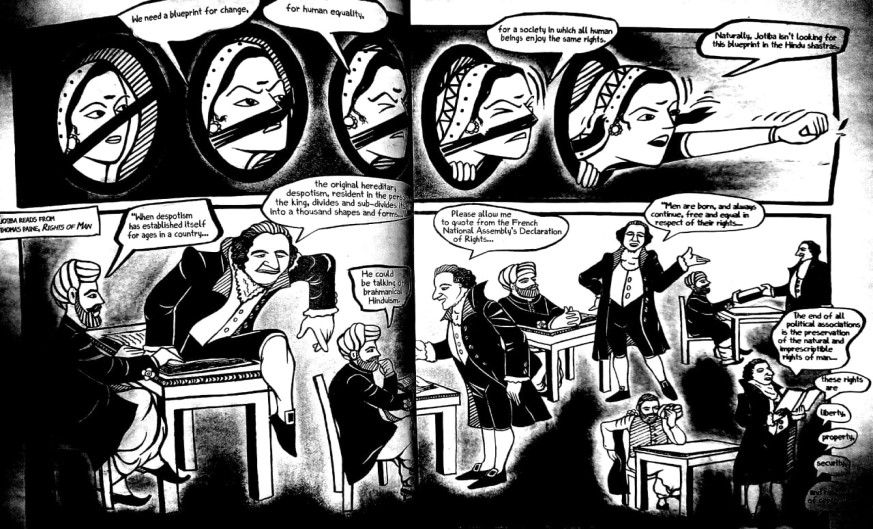
Figure SEQ Figure \* ARABIC 1 Ninan, A Gardener in the Wasteland, 18-19
teaching valuable lessons of morality and survivability but also establishing the cultural practices and behaviours of a community. Mythology often becomes an instrument that can be used to maintain the status quo through the reiteration of stories for generations, advancing the acceptability and the normativity of ancient practices. By adding the element of religiosity to mythology (that can be tweaked to serve a narrative), it is further legitimized as a doctrine(s). Nicholas O’Shaughnessy, who refers to myths as a “conceptual lynchpin of propaganda”, notes in “Persuasion, Myth and Propaganda”:
Myths work because of their essential property of storytelling, and they exploit our primordial craving for narrative momentum. The rationalist-analytic approach to politics tends to disregard myths, not willfully, but because we tend to view reality through the cognitive lens of the concepts we hold. Such models neglect the power of myths in political motivation. But societies cannot function without myth, and realists/rationalists who seek to expose their vacuity are doing a service to the cause of truth but not that of civic harmony. (O’Shaughnessy 102)
The graphic novel is significantly carnivalesque in its visual grotesque realism that posits an alternate mythology and representation of body figures. Bakhtin interprets the grotesque as something that is both frightening and humorous. Grotesque realism aims to pervade the abstract, spiritual, and noble, revealing them as diseased cultural coding. In the graphic novel, the Brahmin is a cartoonish and beastly figure, personifying the brutality of the caste system.
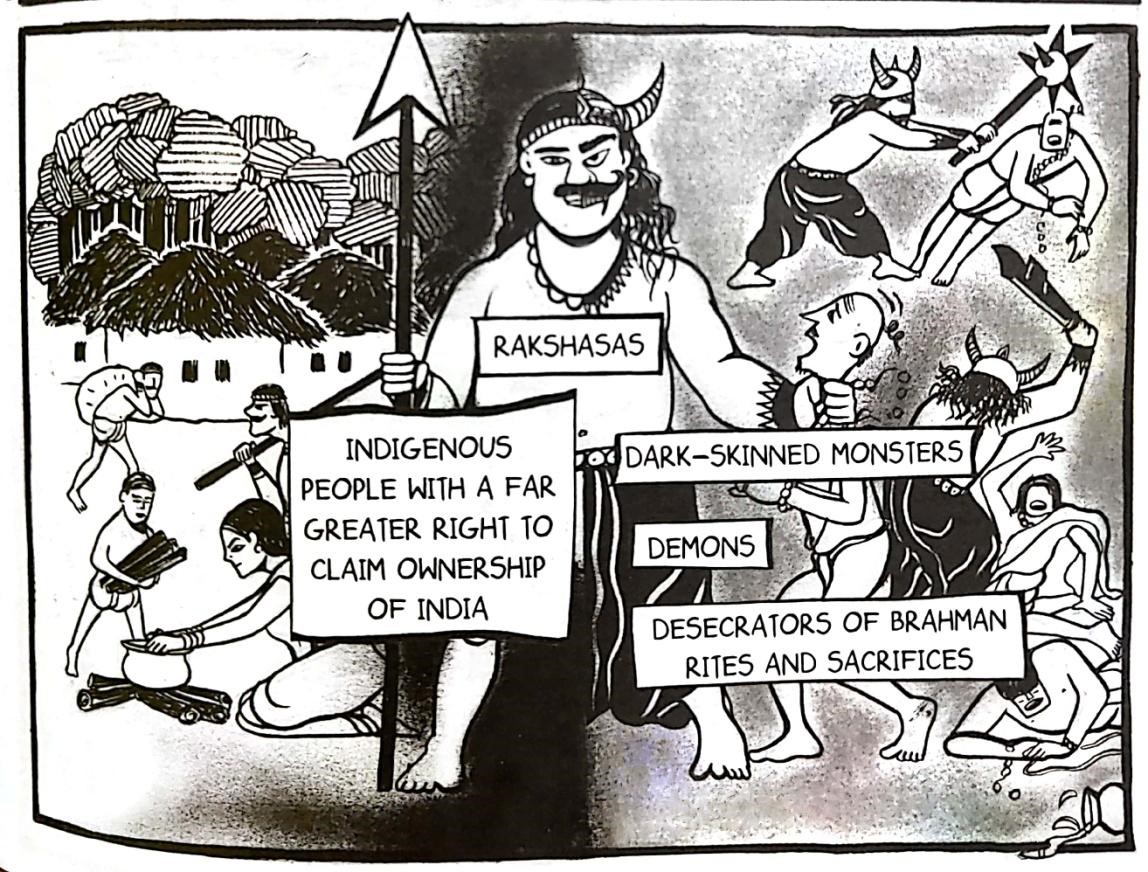
Figure SEQ Figure \* ARABIC 2 Ninan, A Gardener in the Wasteland, 67
His words are constantly captured within serpentine dialogue bubbles, highlighting his dishonest, crooked thinking and misuse of language as compared to Natarajan’s portrayal of her thoughts and imagination in cloud-like speech bubbles: harbouring the fragile yet divergent space for subversion fighting the ‘winds’ of religious orthodoxy.
In depicting caste oppression, juxtaposition is a significant visual tool used by the text. In one instance, the repugnant hypocrisy of the Brahmins who consider themselves pure by drinking cow urine and declare “clean spring water in the hands of sudras dirty and undrinkable” (Natarajan 90) is seen. Another instance is the images concerning the dual perspectives on mythological characters; the body of the character changes with the perspective adopted (67-69). The Rakshasas have horns, pointed eyes and unruly hair from the Brahmanical point of view. These features do not appear in Phule’s perspective. Instead, the Brahmin is monstrous with a hairy body, protruded belly, and convoluted speech bubbles, always twisting the scriptures and the mythic past to favour his caste (76-77). Phule’s portrayal is carnivalesque as it deliberately strips the 'sacred' and the favoured narrative of its power to evoke the "image of an anti-Vedic, anti-Aryan, and anti-Caste egalitarian message with its use of poetry, dialogue and drama [that] could reach beyond the literate elite”; further assisted by the graphics to “dig up the weeds of myth” in the wasteland of caste (Yadav 52). The graphic novel recognizes the biases with which Dravidians were looked at in mainstream calendar art and popular comics such as Amar Chitra Katha where the heroes were always fair while the antagonism was restricted to “rakshasas” that were “dung green” (Chandra 2008).
Hindu mythology legitimizes the caste hierarchy through symbols and representations that have been reiterated for thousands of years. Northrop Frye, in his essay, The Archetypes of Literature, distinguishes mediocre literature from classics by the presence of recurring patterns, or archetypes. Psychological theorist Carl Jung also identifies archetypes as primordial images embedded in our collective unconscious, found in our mythologies: that any civilized man “unconsciously preserves the ideas, concepts, and values of life cherished by his distant forefathers, and such ideas are expressed in a society’s or race’s myths and rituals” (Jung 1928). These myths, according to Frye, are the centripetal force of our literature. James Frazer in his work, The Golden Bough (1921) defines myths as “mistaken explanations of phenomena whether of human life or of external nature.” While critics like Michael Grant (1971) and Terence Hawkes (1977) identify myths as ‘para-history’2, Phule contests myths to be anti-history and that by exploring them, we may be able to re-structure the social order against systematic suppression. As such, Phule tries to rationalize the origin myth that describes the creation of the four ‘varnas’ from Brahma's mouth, arms, groin, and legs. Phule humorously maintains the stance that Brahma would require four vaginas and sixteen days of menstruation to successfully birth them (Natarajan 32-3). The war of the Deities and Daityas scattered throughout sacred Hindu texts is reasoned to be the actual struggle for power and supremacy between the Indo-European descendants of Aryans that crossed the Hindu Kush to enter the subcontinent and its former natives. The myth deliberately uplifts the Aryan race as protagonists while Phule emphasizes how the brutal annexation of India is romanticized and rewritten by Brahmins who claimed to be the original occupants of the then subcontinent.
Vishnu avatars are presented as scheming Aryan horde leaders that the Brahmins have portrayed as God-like heroes. In Gulamgiri, Phule refers to Vamana as a monster and not a hero who stopped the brutalities of the Asura king Bali. The graphic novel highlights how interpretations vary among communities. In Kerala, folk songs praise the king Maveli or Mahabali for establishing a casteless kingdom. Bali is celebrated during Onam every year; however, Brahmin narratives present Onam as a celebration of the birth of the Brahmin Vamana (Natarajan 36-42). Phule wished to reestablish the mythical Mahabali that predates “Aryans’ treacherous coup d’etat”. The Hindu mythology is anchored by Brahmanical supremacy that is spread through such myths to not only tyrannize other castes but also mould the oppressed castes to be participants in their oppression. Phule asserts how “Brahmanical Hinduism was the festering wound which bred the infections of caste, prejudice, cruelty and enslavement of women” (94). The graphic novel revisits the mythic past, probes, and analyzes it, and attempts to create a counter-hegemonic chronicle against the official history of Brahmanical India, albeit temporarily.
Bakhtin refers to the impermanence of a carnival and how, at the end of the day, the ongoing celebratory performances end, and the existing social orders are re-established. However, there is a possibility of negotiation, if not absolute transgression within the carnivalesque, which is the spirit of the graphic novel that stirs in the human psyche even after the 'zipping' back of the book. A reader may eventually close the book and store it somewhere, however, the potentialities it portrayed for a particular milieu may linger on in the mind for a long time to come.
Grotesque Monopoly over Education
Jotiba and Savitribai Phule played a historic role in the promotion and development of education among Dalit people. They were both strong advocates for women’s education and started the first school for Dalit girls in 1848 in Pune. Jotiba was ostracized for teaching his wife and sister to read and write. Therefore, the themes of education and knowledge are central to the narrative’s discourse on caste. The graphic form is important in this regard as A Gardener in the Wasteland positions itself as an alternative educative voice within the tradition of Indian comics, as opposed to the mainstream Brahmanical pedagogy of the popular Amar Chitra Katha Comics. It is within this larger tradition of Indian comics that the text then articulates Jotiba and Savitribai Phule’s efforts in challenging Brahmanism through education.
Arundhati Roy in an introduction to B.R. Ambedkar’s Annihilation of Caste highlights the stranglehold of caste in Indian society, “caste was implied in people’s names, in the way people referred to each other, in the work they did, in the clothes they wore, in the marriages that were arranged, in the language they spoke” (17) including rights to education, thoughts and free will. For Ambedkar, caste was slavery and a “veritable chamber of horrors” for the untouchables (259). In 1873, Jotiba Phule dedicates his book, Gulamgiri, to the ‘good people of the United States’ as a token of inspiration for their emancipating education in the cause of Negro Slavery. Regarding the events as exemplary, Phule hoped that his countrymen would work towards Sudra emancipation and freedom from the trammels of Brahmin thralldom. Ninan et al take the initiative one step further, giving it modern undertones of visuals and graphics, connecting the past with the present through the comic panels which slip into different time zones and transition smoothly to present a nuanced understanding of the ‘missing links’ in India’s narrative of cultural history.
The text further draws attention to the fact that its narrative, like all historical narratives, is a mediated one. The reader accesses the history of caste oppression through the thoughts of the authors who themselves appear on panels, often surrounded by books in a bookstore. Due to this use of self-reflexivity, Nayar argues, the reader develops the critical literacy required to read the text. Thus, education as a remedy to caste is not just the subject of the novel, but an objective it tries to achieve through its form (Nayar 2019).
The Brahmin monopoly over education and knowledge keeps the juggernaut of caste moving. That the lower castes had begun mirroring and reflecting the interests of the upper castes and the Brahmins to the point that their understanding of themselves comes from what has been told to them repeatedly over centuries adds to the ideology of “infection of imitation” of Brahmanism as propounded by Ambedkar. He says "…Hindus observe caste not because they are inhuman or wrong-headed. They observe caste because they are deeply religious…the enemy, you must grapple with, is not the people who observe caste, but the Shastras which teach them this religion of caste” (1989). The philosophy and religion of Hinduism in our society are so intricately woven around its core faith that the ideas of religious teachings and philosophy get blurred in the memory of the people. While, anciently, Hinduism was a way of life, it is nowadays more closely associated with religion. This extreme expression of religious traditions into the social and cultural lives of the people, who have given an un-questioned legal sanction to its existence, is responsible for hierarchies of inequalities and complexities of fixed exploitations, of rage, struggle, and unwarranted injustices in the lives of lower castes in India. The lower castes, in a carnivalesque sense, are thus masquerading as the upper castes although unconsciously. These complications and continuous manipulations need to be addressed for a more informed Dalit identity to be created.
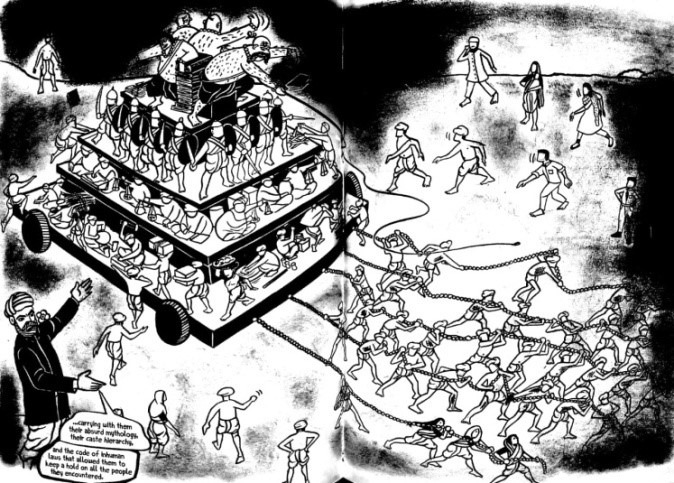
This also finds visual representation in the novel (Natarajan 72-3). Here, it is significant that all but the Brahmins are faceless – signifying how the caste system denies subjectivity. The ugliness of the Brahmanical compilation of writings and scriptures is visualized through the abnormally large mouths of the Brahmins, drooling and printing books which decree the lower castes as their slaves (76-7). Education, thus, becomes the only way to reclaim their subjectivity. The text in the illustration shown is thematically like the former one, only this time after receiving books from Phule, the Dalits are given faces (94).
Phule declares the Brahmins to be “pen-wielding butchers, slitting the throats of the poor” and devouring books like selfish, greedy gluttons (Natarajan 114, 117). Savitri sees school as a place where it is possible to obtain “a blueprint for change, for human equality,” against the notions of purity and pollution which have been deeply internalized in the psyche of women, sudras and atisudras: “[education] could make people critical” (18, 121). Phule is represented with a flower on his shoulders, as the Hindi word “phool” (which means a flower) is phonetically similar to Phule who himself belonged to the Mali community of Maharashtra and is seen as a fierce gardener in the wasteland of caste, digging out weeds of tyranny and planting education as ‘seeds’ for change.
Conclusion
A Gardener in the Wasteland exhibits a carnivalesque sense of re-dressing and re-addressing various characters and systems in Indian society through juxtapositions, metaphors, and satirical and grotesque representations. Bakhtin argues that carnival forms are rooted in the human psyche; hence the subversion of norms that it festers constitutes the extension of the individual and the communal identity. The revolutionary potential and ability to emancipate from political and religious authoritarianism is portrayed as inevitable, a constant, within the subconscious of the oppressed. The lines between the acceptable and the unacceptable are blurred for long enough that people must question the status quo and transgress. Thus, A Gardener in the Wasteland visualizes caste in a way that challenges mainstream Brahmanical representation in both form and content. It is a multi-layered text that emphasizes the all-pervasiveness of caste across time and space. Further, the text is not just a historical catalogue of brutality and trauma of caste but also a carnivalesque narrative and a vehicle of resistance against oppression.
Endnotes:
1Some critics may dismiss this as a romanticization of the dirge and poverty faced by the Phules in their lives for a just cause of emancipation and freedom, overlooking the economic hardships of the time. However, P. Sarsar and A.K. Poonia highlight the value of this representation that centres the female perspective, as according to them, Gulamgiri fails to acknowledge the contributions of Savitribai Phule, and Ninan and Natarajan through “the pictorial representation of her going to school in a dirty saree facing the 'hysterical mobs' and afterwards changing 'into a good saree for classes,’ brought life to Savitribai as an individual whose recognition was previously confined to just a supporter of her husband” (270).
2History is that which has happened while para-history is that which is believed to have happened. As such, man constructs the myths and social systems, and in doing so, constructs himself. See Grant, ‘Roman Myths,’ 1971; Hawkes, ‘Structuralism and Semiotics,’ 1977.
Works Cited
Ambedkar, Bhimrao Ramji. Annihilation of Caste: The Annotated Critical Edition. Edited by S. Anand, Navayana Publ., 2015.
Bakhtin, M. M., and Iswolsky He´le`ne. Rabelais and His World. Indiana University Press, 1965.
Behn, Aphra. The Rover: The Banished Cavaliers. CreateSpace Independent Publishing Platform, 2017.
Caruth, Cathy. Unclaimed Experience: Trauma, Narrative and History. Edited by Cathy Caruth, Johns Hopkins University Press, 1996.
Chandra, N. The Classic Popular, Amar Chitra Katha, 1967–2007. Delhi: Yoda Press, 2008.
Francis, Errol. “Michel Foucault's Concept of Heterotopia and Postcolonial Artistic Responses to Museum Spaces.” UCL Discovery - UCL Discovery, UCL (University College London), 28 Apr. 2019, https://discovery.ucl.ac.uk/id/eprint/10049632/.
Frazer, James George. The Golden Bough: A Study in Magic and Religion. Edited by Robert Fraser, 2009 ed., OUP Oxford, 1921.
Frye, Northrop. “The Archetypes of Literature.” The Kenyon Review, vol. 13, no. 1, 1951, pp. 92–110. JSTOR, http://www.jstor.org/stable/4333216. Accessed 2 Mar. 2024.
Grant, Michael. Roman Myths. Weidenfeld & Nicolson, 1971.
Hawkes, Terence. Structuralism & Semiotics. Methuen, 1977.
Hirsch, Marianne. The Generation of Postmemory: Writing and Visual Culture After the Holocaust. Columbia University Press, 2012.
Jung, Carl Gustav. Contribution to Analytical Psychology. 2008 ed., Read Books, 1928.
Jung, Carl Gustav. Modern Man in Search of a Soul. Harcourt, Brace & World, 1933.
LaCapra, Dominick. “Trauma, Absence, Loss.” Critical Inquiry, vol. 25, no. 4, 1999, pp. 696–727. JSTOR, http://www.jstor.org/stable/1344100. Accessed 30 Dec. 2023
Mathew, Raisun, and Digvijay Pandya. “Carnivalesque, Liminality and Social Drama: Characterising the Anti Structural Potential of Theyyam.” Rupkatha Journal on Interdisciplinary Studies in Humanities, vol. 13, no. 3, 2021, https://doi.org/10.21659/rupkatha.v13n3.28
Mehta, Binita, and Pia Mukherji, editors. Postcolonial Comics: Texts, Events, Identities. Routledge, Taylor & Francis Group, 2015.
Moon, Vasant, et al. “Babasaheb Dr. B.R. Ambedkar.” Babasaheb Dr. B.R. Ambedkar, 1989, https://www.mea.gov.in/Images/attach/amb/Volume_01.pdf. Accessed 2 March 2024.
Natarajan, Srividya, et al. A Gardener in the Wasteland: Jotiba Phule's Fight for Liberty. Navayana Publishing, 2016.
Nayar, Pramod K. “Graphic Memory, Connective Histories, and Dalit Trauma: A Gardener in the Wasteland.” English Language Notes, vol. 57 no. 2, 2019, p. 143-150. Project MUSE muse.jhu.edu/article/736497.
Nayar, Pramod K. “The Indian Graphic Novel and Dalit Trauma.” Dalit Literature in India, 2018, pp. 330 – 348., https://doi.org/10.4324/9780429489563-23. O'Shaughnessy, Nicholas. “Persuasion, Myth and Propaganda.” Journal of Political Marketing, 2014, pp. 87-103, DOI: 10.1300/J199v03n03_05.
Paine, Thomas. Rights of Man: Being an Answer to Mr. Burke's Attack on the French Revolution. Cambridge University Press, 2012.
Phule, Jyotirao. Gulamgiri. 2017 ed., CreateSpace Independent Publishing Platform, 1973.
Sarsar, P., and A.K. Poonia. “Man, Mythology or God: Historicizing Indian Sectarianism In A Gardener in The Wasteland and Phule’s Gulamgiri.” Vidyabharati International Interdisciplinary Research Journal, vol.12, July 2021, pp. 265–272. Turner, Victor Witter, and Jon P. Mitchell. Liminality and Communitas: Form and Attributes of Rites of Passage. 1969.
Yadav, Deepali. “Visualising Caste: A Gardener in the Wasteland and the Politics of Graphic Adaptation.” Graphic Novels and Visual Cultures in South Asia, 2020, pp. 47–58., https://doi.org/10.4324/9781003007807-5.


Issue 115 (May-Jun 2024)
-
EDITORIAL
- H Kalpana Rao & S Sujaritha: Editorial
-
LITERARY ARTICLES
- Bhavika Sachan, Abhinav Rai: Visualizing Carnivalesque - Caste and Grotesque Realism in Aparajita Ninan and Srividya Natarajan’s A Gardener in the Wasteland
-
INTERVIEWS
- Aaditya Pandey: In conversation with Manjiri Indurkar
- Anwesha Sahoo: In Conversation with Sarojini Sahoo